What Is SQL Injection and How to Prevent It
SkillVeris Team
Cloud & Security Team
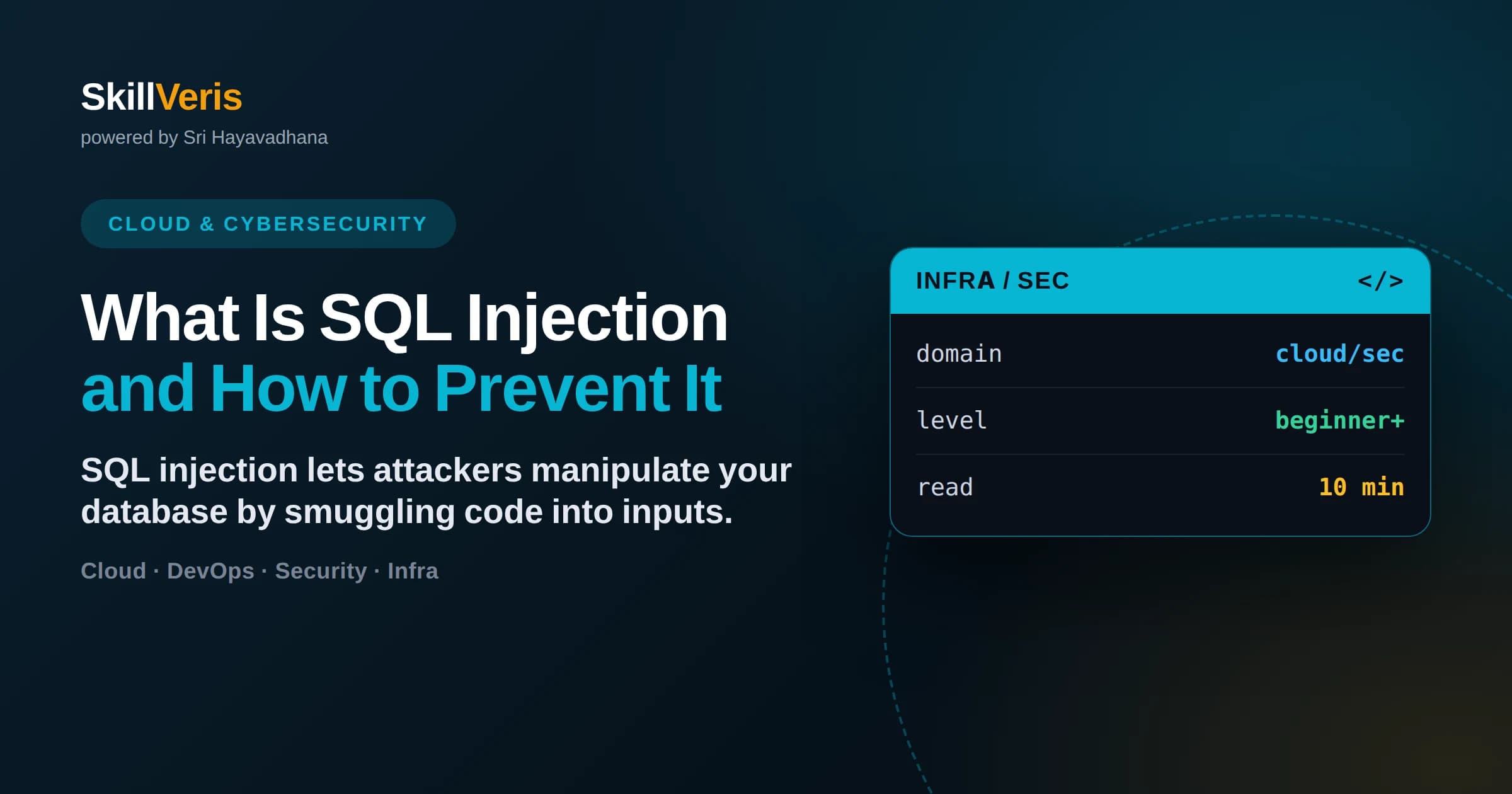
SQL injection is an attack where malicious input is smuggled into a database query, letting an attacker read, modify, or destroy data they should never reach.
In this guide, you'll learn:
- It happens when user input is concatenated directly into SQL, so the input can change the query's structure and meaning.
- The primary defense is parameterized queries (prepared statements), which send data separately from the SQL so input is never executed as code.
- Injection can leak entire databases, bypass logins, or delete tables, and it remains one of the OWASP Top 10 risks.
- Layer defenses: parameterized queries first, then least-privilege database accounts, input validation, and safe error handling.
1What Is SQL Injection?
SQL injection is a vulnerability where an attacker inserts malicious SQL into an application's input, tricking the database into running commands the developer never intended. It lets attackers read, alter, or delete data — and sometimes take over the whole database server.
It arises whenever untrusted input is mixed directly into a SQL query. Because the input becomes part of the query's code rather than staying mere data, a carefully crafted value can rewrite what the query does. It is one of the oldest web vulnerabilities and still appears on the OWASP Top 10.
2How the Attack Works
The vulnerability comes from building queries by gluing strings together. Consider a login lookup built like this, where username comes straight from a form.
- Vulnerable: "SELECT * FROM users WHERE name = '" + username + "'"
- Normal input alice produces: SELECT * FROM users WHERE name = 'alice'
- Malicious input ' OR '1'='1 produces: SELECT * FROM users WHERE name = '' OR '1'='1'
- That WHERE clause is always true, so the query returns every user and can bypass login.
🔑The Root Cause
The database cannot tell the difference between the code you wrote and the input an attacker supplied — because you merged them into one string. Fix that separation and the attack disappears.
3What Attackers Can Do
SQL injection is dangerous because of how much a database controls. Depending on the app and permissions, a single injectable input can lead to serious outcomes.
- Read sensitive data: dump user tables, password hashes, or payment records.
- Bypass authentication: log in as any user without a password.
- Modify or delete data: change balances, escalate privileges, or drop tables.
- Blind extraction: infer data through timing or true/false responses even without visible output.
Beyond One Query
With enough privileges, injection can move beyond the current query — reading other tables, running stacked statements, or in some configurations executing commands on the host. That is why the impact is often catastrophic rather than cosmetic.
4The Primary Fix: Parameterized Queries
The definitive defense against SQL injection is the parameterized query, also called a prepared statement. You write the SQL with placeholders and pass the input values separately, so the database treats them strictly as data — never as code.
- Python: cursor.execute("SELECT * FROM users WHERE name = %s", (username,))
- Java (JDBC): use PreparedStatement with setString(1, username)
- Node.js: db.query('SELECT * FROM users WHERE name = ?', [username])
- The ' OR '1'='1 trick now searches for a user literally named that string and finds nothing.
💡Never Concatenate
If you are building a query with + or string interpolation around user input, you have a bug. Placeholders and bound parameters are the rule, with no exceptions for 'trusted' inputs.
5Defense in Depth
Parameterized queries stop the core attack, but layered defenses limit damage if something slips through, such as dynamic table names that cannot be parameterized.
- Least privilege: the app's database account should only have the permissions it needs — not DROP or admin rights.
- Input validation: reject obviously invalid input (an email field should look like an email).
- Allowlists for identifiers: when a column or table name must be dynamic, match it against a fixed allowed list.
- Safe errors: never show raw database errors to users — they hand attackers a map.
- ORMs: query builders and ORMs parameterize by default, reducing hand-written SQL risk.
Why Layers
No single control is perfect. If an ORM is bypassed with raw SQL somewhere, least-privilege accounts and generic error messages ensure the blast radius stays small rather than exposing the entire database.
6Common Mistakes to Avoid
SQL injection persists mainly because of a few recurring habits.
- Concatenating user input into queries because it seemed simpler than parameters.
- Assuming input from dropdowns or hidden fields is safe — attackers control every request.
- Relying on escaping or blocklists of bad characters instead of parameterization.
- Running the app with a database account that has full admin privileges.
⚠️Escaping Is Not Enough
Manually escaping quotes feels like a fix but is fragile and easy to get wrong across encodings and database dialects. Parameterized queries are the reliable defense; escaping is not.
7Best Practices
A few consistent practices keep applications free of SQL injection.
- Use parameterized queries or an ORM for every database call, everywhere.
- Give each application a least-privilege database account.
- Validate and constrain input, and use allowlists for any dynamic identifiers.
- Return generic error messages and log the details server-side only.
- Add automated scanning and code review to catch raw string-built SQL before it ships.
8Key Takeaways
The essentials of preventing SQL injection come down to a few durable principles.
- SQL injection smuggles code into a query by mixing untrusted input into SQL.
- The root cause is string concatenation that lets input change the query's meaning.
- Parameterized queries send data separately from code and are the primary fix.
- Add least privilege, input validation, allowlists, and safe errors as defense in depth.
- Never build SQL by concatenation; use prepared statements or an ORM consistently.
9Frequently Asked Questions
Q: What is the best way to prevent SQL injection? A: Use parameterized queries, also called prepared statements, for every database call. They send the SQL and the input values separately so user input is always treated as data and never executed as code, which eliminates the core vulnerability.
Q: Do ORMs protect against SQL injection? A: Largely yes, because ORMs and query builders parameterize inputs by default. The risk returns whenever you drop down to raw SQL strings inside them and concatenate user input, so keep any raw queries parameterized too.
Q: Is input validation enough to stop SQL injection? A: No. Validation and escaping help as extra layers but are fragile on their own and easy to bypass across encodings and database dialects. Parameterized queries are the reliable defense; treat validation as defense in depth, not the primary control.
Q: Can SQL injection do more than read data? A: Yes. Depending on privileges it can bypass logins, modify or delete records, drop tables, and in some setups run commands on the database host. This is why running the application with a least-privilege database account is so important.
Related Reading
Get The Print Version
Download a PDF of this article for offline reading.
About the Publisher
SkillVeris Team
Cloud & Security Team
Our cloud and security experts break down complex infrastructure topics into practical, beginner-friendly guides.
View all postsRelated Posts

Never miss an update
Get the latest tutorials and guides delivered to your inbox.
No spam. Unsubscribe anytime.