100% Free Forever
AI-Powered Learning
Industry Expert Content
Certificates & Badges
Learn At Your Own Pace
HomeBlogWhat Is Infrastructure as Code (IaC)?
Cloud & Cybersecurity

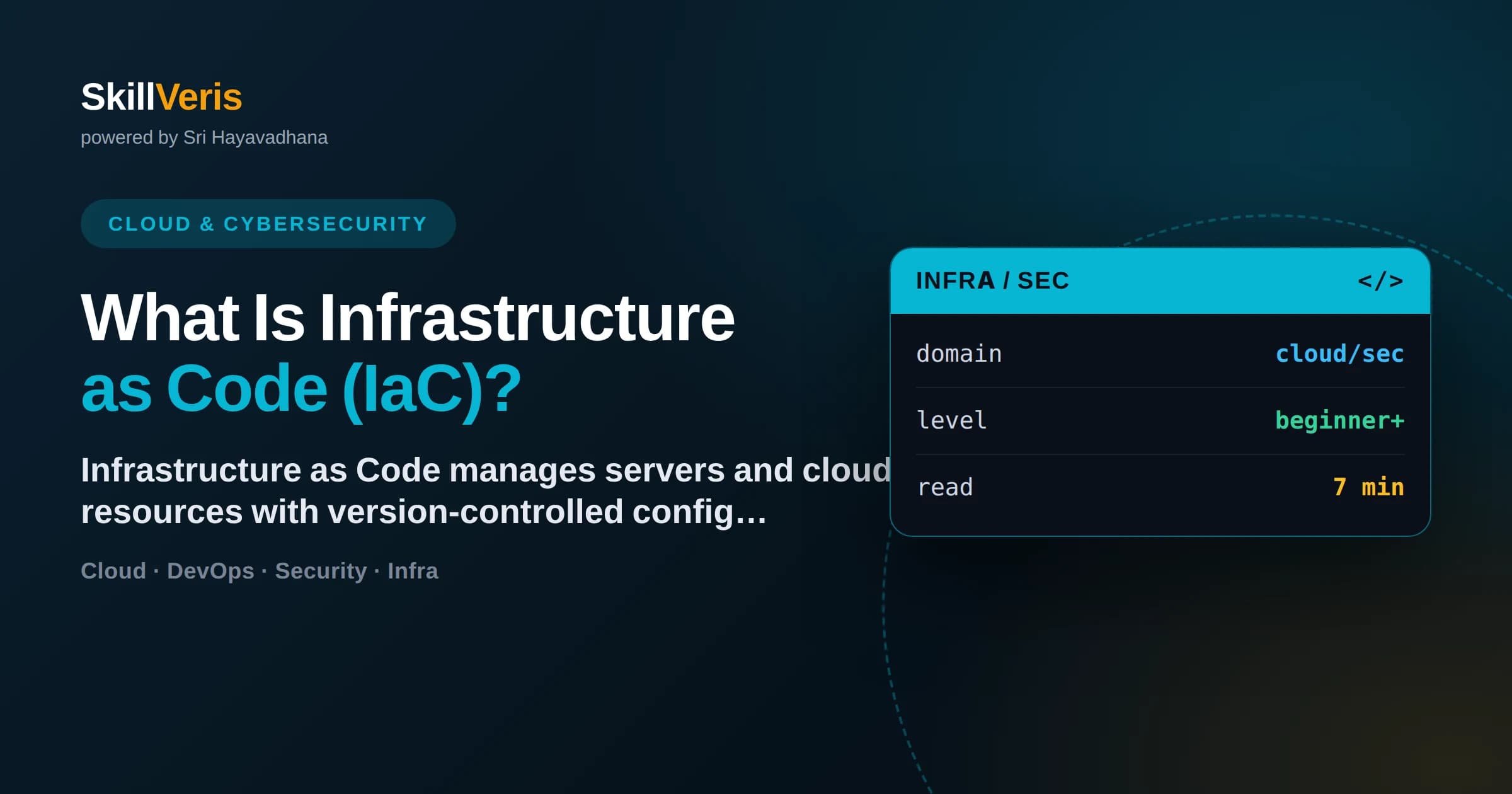
What Is Infrastructure as Code (IaC)?

SV

SkillVeris Team

Cloud & Security Team

Nov 15, 2025 7 min read
Share:
What Is Infrastructure as Code (IaC)?
Key Takeaway

Infrastructure as Code (IaC) means defining and managing your servers, networks, and cloud resources with version-controlled configuration files instead of manual clicks.

In this guide, you'll learn:

  • It makes infrastructure repeatable, reviewable, and versioned — you can rebuild an entire environment from a text file.
  • Declarative tools like Terraform describe the desired end state; imperative tools describe the steps to get there.
  • IaC eliminates configuration drift and the 'it works in staging but not production' problem.
  • Every change goes through version control, so infrastructure gets the same code review and history as application code.

1What Is Infrastructure as Code?

Infrastructure as Code (IaC) is the practice of defining and managing your infrastructure — servers, databases, networks, load balancers — through machine-readable configuration files instead of clicking through a console by hand. You write what you want in code, and a tool creates it for you.

The shift is profound: infrastructure becomes software. You can version it, review it, test it, and reproduce it exactly. Instead of a hand-built server nobody can quite recreate, you have a file that rebuilds the whole environment on demand.

2Why IaC Matters

Manually configuring infrastructure is slow, error-prone, and impossible to reproduce reliably. IaC fixes the fundamental problems of the click-ops approach.

  • Repeatability: spin up identical environments for dev, staging, and production from one definition.
  • Version control: every change is tracked in Git with history, blame, and rollback.
  • Code review: infrastructure changes get reviewed like any pull request before they ship.
  • Speed: provision complex environments in minutes instead of days.
  • Documentation: the code is the source of truth for how everything is set up.

🔑Key Takeaway

IaC turns infrastructure into version-controlled code, so an entire environment can be reviewed, reproduced, and rebuilt from a text file — no more irreplaceable hand-built servers.

3Declarative vs Imperative

IaC tools come in two flavors, distinguished by how you express what you want. The difference shapes how you write and reason about your configs.

  • Declarative: you describe the desired end state ('I want three servers') and the tool figures out how to reach it. Terraform and CloudFormation work this way.
  • Imperative: you write the exact steps to run in order ('create a server, then install X'). Traditional scripts and parts of Ansible work this way.
  • Declarative tools track state, so re-running only changes what differs from the goal.
  • Most modern IaC is declarative because it is idempotent and easier to reason about.

Idempotency

A key benefit of declarative IaC is idempotency: applying the same configuration repeatedly produces the same result. Run it once or ten times and you end up with exactly the resources described — no duplicates, no drift. The tool computes the difference between current and desired state and changes only what is needed.

4How IaC Works in Practice

With a declarative tool like Terraform, you write configuration files describing your resources, then run commands to preview and apply changes. The tool keeps a state file recording what it has created.

  • resource "aws_instance" "web" { # declare a server
  • ami = "ami-0abc123"
  • instance_type = "t3.micro"
  • }
  • # terraform plan -> preview what will change
  • # terraform apply -> create or update the resources

💡Pro Tip

Always run terraform plan before apply. It shows exactly what will be created, changed, or destroyed, so you catch a surprise deletion before it happens instead of after.

5The Main Tools

Several mature tools dominate the IaC landscape, each with different strengths. Many teams use more than one together.

  • Terraform: cloud-agnostic, declarative, the de facto standard for provisioning infrastructure.
  • AWS CloudFormation: AWS-native declarative provisioning, deeply integrated with AWS services.
  • Ansible: strong at configuration management — installing and configuring software on servers.
  • Pulumi: define infrastructure in real programming languages like Python or TypeScript.
  • Provisioning vs configuration: Terraform creates the servers, Ansible sets them up — they complement each other.

State Management

Declarative tools keep a state file that maps your config to real resources. In a team, store this state remotely (for example in an S3 bucket with locking) so everyone shares one source of truth and two people cannot apply conflicting changes at the same time.

6IaC and the CI/CD Pipeline

IaC reaches its full potential when wired into a CI/CD pipeline. Because your infrastructure is code, a change can trigger the same automated workflow as any application change — plan, review, and apply — with a full audit trail of who changed what and when.

A typical setup runs terraform plan on every pull request so reviewers see the exact impact before merging, then runs terraform apply automatically once the change is approved and merged. This gives infrastructure the same safety net of review and automation that application code has long enjoyed.

  • On pull request: run plan and post the diff for reviewers.
  • On merge to main: run apply behind an approval gate for production.
  • Store state remotely with locking so pipeline runs never conflict.
  • Keep credentials in the pipeline's secret store, never in the repo.

7Common Mistakes to Avoid

IaC removes many manual errors but introduces a few new pitfalls of its own.

  • Making manual changes in the console after using IaC, causing drift the code no longer matches.
  • Committing the state file or secrets to Git — state can contain sensitive values.
  • Not using remote state with locking on a team, leading to conflicting applies.
  • Skipping the plan step and applying blindly, risking accidental resource deletion.
  • Hardcoding secrets in config instead of using a secrets manager or variables.

⚠️Watch Out

Never change infrastructure by hand after adopting IaC. Manual tweaks create drift — the real world stops matching your code — and the next apply may undo them or behave unpredictably. Make every change through the code.

8Key Takeaways

The value of IaC comes down to treating infrastructure like software.

  • IaC defines infrastructure in version-controlled config files instead of manual clicks.
  • It makes environments repeatable, reviewable, and reproducible from a single source.
  • Declarative tools describe the desired state and apply only what differs.
  • Terraform, CloudFormation, Ansible, and Pulumi are the leading tools.
  • Avoid manual drift, protect your state file, and always preview changes before applying.

9Frequently Asked Questions

Q: What problem does Infrastructure as Code solve? A: It replaces slow, error-prone manual configuration with version-controlled code, so you can reproduce entire environments exactly, review changes before they ship, and rebuild infrastructure on demand. It eliminates configuration drift and irreplaceable hand-built servers.

Q: What is the difference between declarative and imperative IaC? A: Declarative IaC describes the desired end state and lets the tool figure out how to reach it, while imperative IaC specifies the exact steps to run. Declarative tools like Terraform are idempotent, so re-running the same config only changes what differs from the goal.

Q: Is Terraform better than Ansible? A: They solve overlapping but different problems. Terraform excels at provisioning infrastructure — creating servers and networks — while Ansible excels at configuration management, installing and configuring software on those servers. Many teams use them together rather than choosing one.

Q: What is configuration drift? A: Drift is when the real infrastructure no longer matches what your code says, usually because someone made a manual change in the console. It undermines the reliability of IaC, so the rule is to make every change through the code and never by hand.

📄

Get The Print Version

Download a PDF of this article for offline reading.

About the Publisher

SV

SkillVeris Team

Cloud & Security Team

Our cloud and security experts break down complex infrastructure topics into practical, beginner-friendly guides.

View all posts

Never miss an update

Get the latest tutorials and guides delivered to your inbox.

No spam. Unsubscribe anytime.

Frequently Asked Questions

21 categories · pick one to explore

Does SkillVeris have a tech blog, and what does it cover?
Yes, the SkillVeris blog has over 500 articles covering AI and machine learning, programming, web development, DevOps, cloud, security, databases and career guidance. Articles are practical and answer-first, and many use the Learn Through Hobbies approach, teaching technical concepts through cricket, music, gaming or cooking analogies. Everything is free to read.
What is the SkillVeris tech glossary and how big is it?
The SkillVeris glossary is a free reference of roughly 2,000-plus technology terms, each with a clear plain-language definition. It spans AI, programming, web, DevOps, cloud, security and database vocabulary, so whenever a lesson, article or job description uses jargon you do not recognise, the glossary gives you a fast, reliable answer.
Are the developer cheat sheets on SkillVeris free to download?
The cheat sheets are completely free to use, like everything else on SkillVeris. Each sheet condenses a language or tool into its essential syntax, commands and patterns for quick reference while coding. They are designed for rapid lookup during real work, complementing the deeper explanations found in study notes and courses.
Which programming references and cheat sheets are available?
Cheat sheets cover the platform's main domains, including programming languages, AI and ML tooling, web development, DevOps, cloud, security and databases, matching the topics of the 37 live courses. Each sheet lists related reading links and hashtags, so you can jump from a quick reference into fuller study notes or blog articles.
How do I find the meaning of a technical term quickly?
Search the SkillVeris glossary, which holds around 2,000-plus terms with concise, plain-language definitions. Each entry gets to the point in its first sentence, then links to related reading like blog posts or study notes for deeper context. It is faster and more consistent than sifting through scattered search results.
Is the SkillVeris blog good for beginners learning to code?
Yes, many blog articles are written specifically for beginners, and the Learn Through Hobbies style makes them unusually approachable: you might learn Python concepts through cricket or understand APIs through cooking. With 500-plus articles across skill levels, beginners can start with fundamentals and keep reading as they advance, entirely free.
Can cheat sheets replace full courses for learning a language?
No, cheat sheets are references, not teaching tools; they assume you already understand the concepts and just need syntax or commands fast. To actually learn a language, take a structured SkillVeris course with its 24–40 lessons and assessments, then keep the cheat sheet beside you while practising in Code Lab.
How often are new blog articles published on SkillVeris?
The blog grows regularly and already exceeds 500 articles, with new posts added as courses launch and technologies evolve. Topics track the platform's catalogue across AI, programming, web development, DevOps, cloud and security, so checking the Blog section periodically surfaces fresh tutorials, explainers and career-focused pieces, all free to read.
Does the glossary cover AI and machine learning terms?
Yes, AI and machine learning vocabulary is a major part of the roughly 2,000-plus term glossary, covering everything from foundational terms to modern concepts around LLMs, RAG and MLOps. Definitions are plain-language and answer-first, which helps when dense AI papers or course lessons throw unfamiliar jargon at you.
Are there cheat sheets for interview preparation?
Cheat sheets work well as interview-day refreshers because they compress syntax, commands and key concepts into scannable references. For dedicated preparation, combine them with the SkillVeris interview questions feature, which includes readiness scoring, plus study notes for depth. Reviewing a relevant cheat sheet just before an interview steadies recall under pressure.
Can I read the tech blog without signing up?
Yes, the blog is freely readable, and SkillVeris never charges for content. All 500-plus articles are open, covering tutorials, concept explainers and career advice. Creating a free account adds value elsewhere on the platform, like course progress tracking and certificates, but reading the blog requires no commitment at all.
How is the SkillVeris glossary different from Wikipedia?
The glossary is purpose-built for learners: definitions are short, plain-language and answer-first, sized for a quick lookup mid-lesson rather than a deep encyclopedic read. Entries also cross-link to related SkillVeris study notes, blog posts and courses, so a definition becomes a doorway into structured learning instead of a dead end.
Do blog articles use the Learn Through Hobbies method?
Many blog articles teach technical topics through hobby analogies, a hallmark of the SkillVeris blog, so you will find articles explaining programming through cricket, machine learning through music, or system design through cooking. The analogy is the teaching device; the article still delivers the real technical concept underneath.
Where can I find quick programming references while coding?
Open the SkillVeris cheat sheets, which are built exactly for that moment: compact, scannable references for syntax, commands and common patterns across languages and tools. Keep the relevant sheet in a browser tab while you work in Code Lab or your own editor, and dip into the glossary for terminology.
Is there a glossary entry for terms I meet in job descriptions?
Very likely yes, with roughly 2,000-plus terms across AI, programming, web, DevOps, cloud, security and databases, the glossary covers most jargon that appears in tech job descriptions. Decoding a listing this way helps you judge role fit honestly and prepares you to discuss those terms in interviews.
Are the blog articles written for the Indian tech audience?
The blog serves Indian learners plus a worldwide audience. Content stays globally relevant while acknowledging realities that matter in India, such as free access being essential for students and freshers, and career guidance that connects naturally to the SkillVeris jobs portal, which aggregates roles across India, UK, USA, Germany and Remote.
Can I suggest a topic for the blog or glossary?
SkillVeris content grows in response to what learners need, so feedback is welcome through the platform's support channels. If a term is missing from the glossary or a topic deserves an article, telling the team helps prioritise it. Meanwhile, the AI Mentor can answer the question immediately, 24/7, at any depth.
Do cheat sheets and glossary entries link to deeper learning?
Yes, every cheat sheet and glossary entry carries related reading links into study notes, blog articles and courses, plus concept hashtags for discovering similar content. This cross-linking means a thirty-second lookup can smoothly become a structured learning session whenever you decide you want more than a quick answer.
What makes SkillVeris programming references trustworthy?
The references are written to strict internal quality standards, kept consistent with the platform's 37 live courses, and never padded with invented statistics or hype. Definitions and cheat sheets are reviewed against the same content contracts that govern courses, and the answer-first style makes any inaccuracy easy to spot and correct.
How do the blog, glossary and cheat sheets fit into my learning routine?
Use them as satellites around your main course: read blog articles for context and motivation, hit the glossary the instant jargon appears, and keep cheat sheets open while coding. Together with study notes, Code Lab and the 24/7 AI Mentor, they turn passive reading into a complete, free learning system.

What Learners Say

Real journeys from the SkillVeris community — swipe for more.

SkillVeris taught me Python through Cricket. Now I’m building real projects and feeling confident!
Arjun S. · B.Tech Student
The best platform for hobby-based learning. Concepts finally stick.
Priya R. · Data Analyst
I went from zero coding to a portfolio of projects — all by learning through my love for gaming. Landed my first internship!
Kabir M. · CS Undergraduate
Trending Topics50 popular tags — tap to explore
Trending CoursesAll 37 free courses — tap to browse