What Is IaaS vs PaaS vs SaaS Explained
SkillVeris Team
Cloud & Security Team
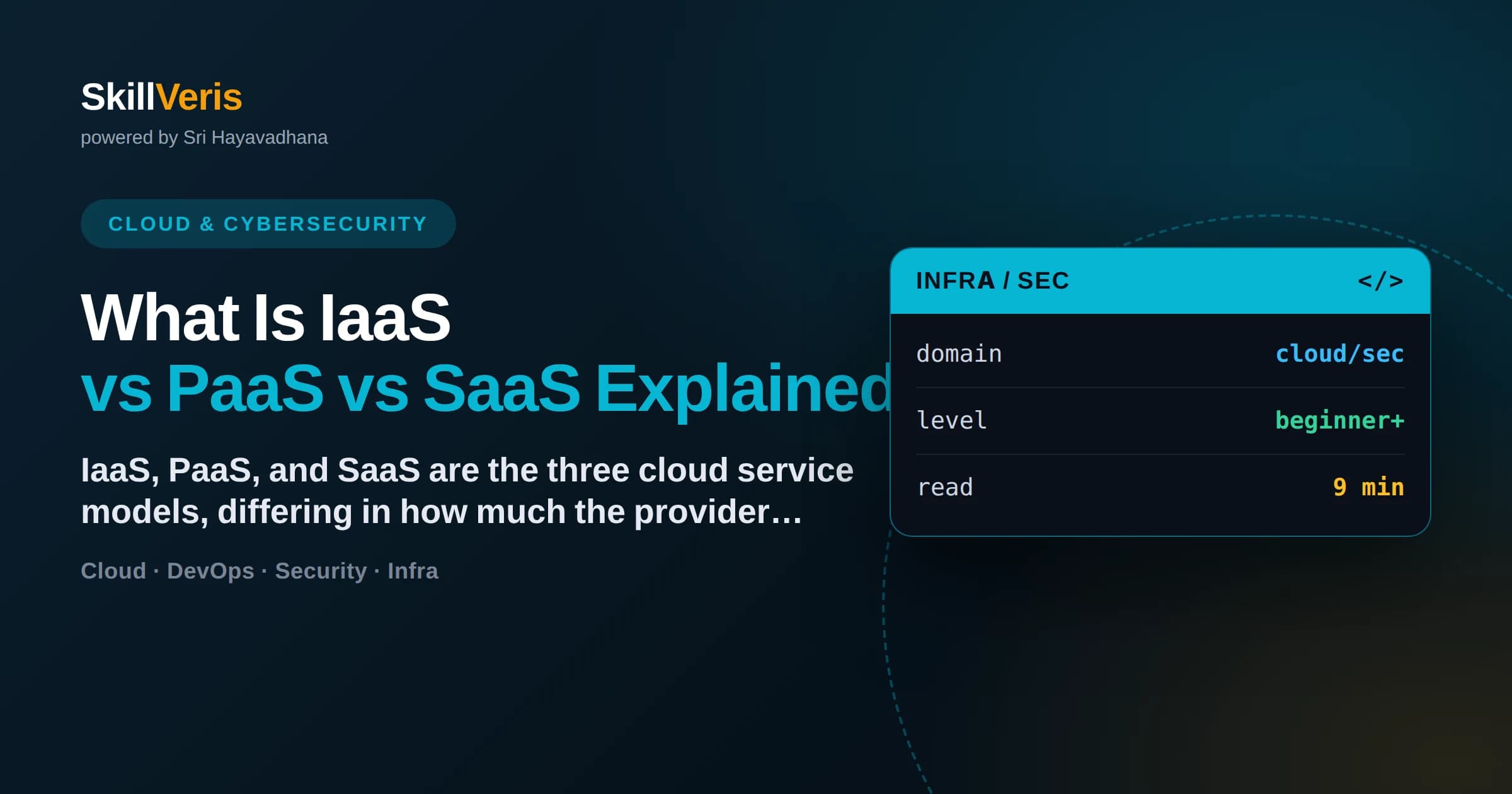
IaaS, PaaS, and SaaS are the three cloud service models, ranging from renting raw infrastructure to using ready-made software, with the provider managing more at each level.
In this guide, you'll learn:
- IaaS gives you virtual servers, storage, and networking while you manage the operating system and everything above it.
- PaaS provides a managed platform to deploy code without handling servers, operating systems, or runtimes.
- SaaS delivers complete software over the internet with nothing for you to install or maintain.
- The shared responsibility model shifts more work to the provider as you move from IaaS to PaaS to SaaS.
1What Are IaaS, PaaS, and SaaS?
IaaS, PaaS, and SaaS are the three main cloud service models, and they differ in how much of the technology stack the provider manages versus you. IaaS (Infrastructure as a Service) rents you raw computing resources, PaaS (Platform as a Service) hands you a ready-to-use platform for running code, and SaaS (Software as a Service) delivers finished applications you simply log into.
A useful analogy is transport: IaaS is leasing a car you drive and maintain yourself, PaaS is a taxi where you choose the destination but not the driving, and SaaS is public transit where everything is handled and you just ride. Each trades control for convenience.
2IaaS: Infrastructure as a Service
IaaS provides virtualized computing resources — servers, storage, and networking — that you rent on demand instead of buying physical hardware. The provider manages the data center, physical machines, and virtualization layer, while you manage the operating system, runtime, and applications on top.
This model offers the most control and flexibility, making it ideal when you need custom configurations or are migrating existing systems to the cloud. Examples include Amazon EC2, Google Compute Engine, and Azure Virtual Machines. You pay for the capacity you provision, typically by the hour or second.
- You manage: OS, runtime, middleware, applications, data.
- Provider manages: physical servers, storage, networking, virtualization.
- Examples: Amazon EC2, Google Compute Engine, Azure VMs.
- Best for: full control, custom environments, lift-and-shift migrations.
3PaaS: Platform as a Service
PaaS provides a managed platform where you deploy your application code and the provider handles the servers, operating system, runtime, and scaling underneath. You focus purely on writing and shipping software, not on patching operating systems or configuring load balancers.
This dramatically speeds up development because there is far less to operate. The trade-off is less low-level control and some constraint to the platform's supported languages and services. Examples include Heroku, Google App Engine, Azure App Service, and AWS Elastic Beanstalk.
💡PaaS for Speed
If your team wants to ship features rather than manage infrastructure, PaaS is often the fastest path from code to production. You trade some flexibility for a big reduction in operational work.
4SaaS: Software as a Service
SaaS delivers complete, ready-to-use software over the internet, usually through a web browser, with the provider managing everything from infrastructure to the application itself. There is nothing to install, patch, or maintain — you just sign in and use it, typically on a subscription.
This is the model most people interact with daily, often without thinking of it as cloud computing. Gmail, Slack, Salesforce, and Dropbox are all SaaS. It offers the least control but the least operational burden, which is exactly why it is so popular for standard business needs.
- You manage: only your data and user settings within the app.
- Provider manages: everything else, from servers to the software.
- Examples: Gmail, Slack, Salesforce, Dropbox.
- Best for: standard needs where you want zero maintenance.
6How to Choose
Pick a model by weighing how much control you need against how much operational work you want to avoid. There is no single best choice — most organizations use all three for different workloads at the same time.
- Choose IaaS when you need deep control or are migrating legacy systems.
- Choose PaaS when you want to deploy code fast without managing servers.
- Choose SaaS when a ready-made application meets your need with no maintenance.
- Mix them: run custom services on IaaS, build apps on PaaS, use SaaS for email and CRM.
7Common Mistakes to Avoid
Choosing the wrong model, or misunderstanding your responsibilities within it, causes cost and security problems.
- Assuming the provider secures layers that are actually your responsibility, especially in IaaS.
- Reaching for IaaS and rebuilding infrastructure when PaaS would have done the job faster.
- Ignoring vendor lock-in when a PaaS or SaaS uses proprietary features.
- Leaving IaaS resources running when idle, driving up unnecessary cost.
- Treating SaaS data as automatically backed up without confirming the provider's policy.
⚠️Know Your Responsibilities
The shared responsibility model is where many breaches originate. An unpatched IaaS server or a misconfigured storage bucket is on you, not the provider. Confirm the boundary for every service.
8Key Takeaways
The three models form a spectrum of control versus convenience.
- IaaS rents raw infrastructure; you manage the OS and up.
- PaaS provides a managed platform; you manage only your code and data.
- SaaS delivers finished software; you manage only your data.
- The provider takes over more of the stack as you move IaaS to PaaS to SaaS.
- Match the model to your need for control versus freedom from maintenance.
9Frequently Asked Questions
Q: What is the main difference between IaaS, PaaS, and SaaS? A: The difference is how much the provider manages. IaaS gives you raw infrastructure and you manage the operating system and applications, PaaS gives you a platform and you manage only your code, and SaaS gives you finished software where you manage only your data.
Q: Is a website hosted on a virtual server IaaS or PaaS? A: If you rent a virtual machine and install and maintain the web server and operating system yourself, that is IaaS. If you push your code to a service that runs and scales it for you without touching the OS, that is PaaS.
Q: What is the shared responsibility model? A: It defines which security and management tasks belong to the provider and which belong to you. As you move from IaaS to SaaS, the provider takes over more layers, but you always remain responsible for your data and often for access control.
Q: Can a company use all three models at once? A: Yes, and most do. A single organization might run custom databases on IaaS, deploy its applications on PaaS, and use SaaS tools like email and CRM, choosing the model that best fits each individual workload.
Related Reading
Get The Print Version
Download a PDF of this article for offline reading.
About the Publisher
SkillVeris Team
Cloud & Security Team
Our cloud and security experts break down complex infrastructure topics into practical, beginner-friendly guides.
View all postsRelated Posts
Never miss an update
Get the latest tutorials and guides delivered to your inbox.
No spam. Unsubscribe anytime.