TypeScript for JavaScript Developers: A Quick Start
SkillVeris Team
Engineering Team
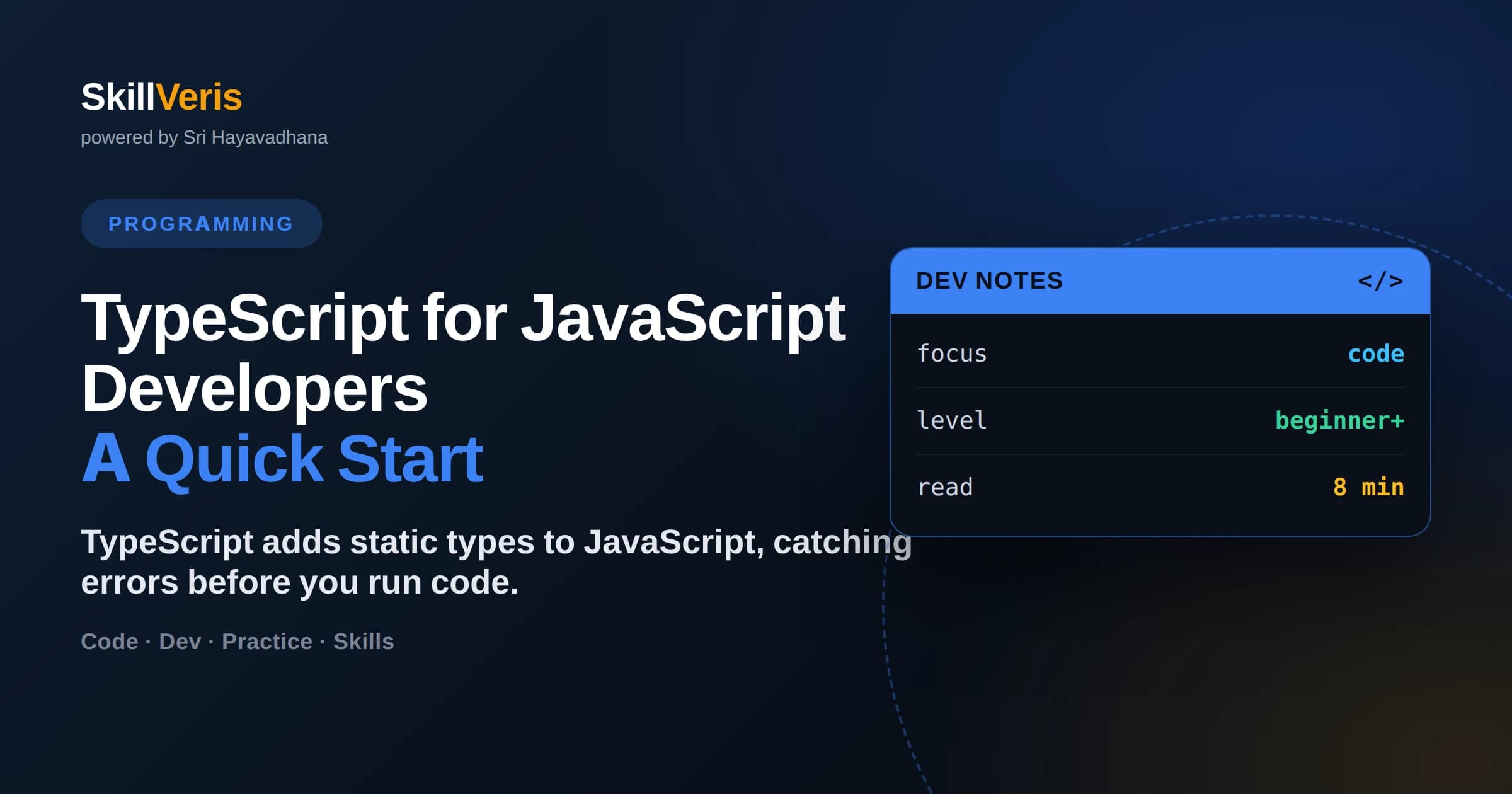
TypeScript is a superset of JavaScript that adds static type checking, catching a large class of bugs at compile time before your code ever runs.
In this guide, you'll learn:
- Every valid JavaScript file is already valid TypeScript, so you can adopt it gradually one file at a time.
- You annotate variables, parameters, and return values with types, and the compiler verifies they are used consistently.
- Interfaces and type aliases describe the shape of objects, giving editors powerful autocompletion and inline error checking.
- Generics let you write reusable, type-safe functions and data structures that work across many types.
1What Is TypeScript?
TypeScript is a superset of JavaScript that adds optional static typing on top of everything you already know. You write code that looks like JavaScript but annotate it with types, and the TypeScript compiler checks that those types are used consistently — surfacing bugs like passing a string where a number is expected before the code ever runs.
Because it is a superset, every valid JavaScript program is already valid TypeScript. That means you can adopt it incrementally, adding types to one file at a time, and the compiler ultimately produces plain JavaScript that runs in any browser or Node environment.
2Why Use TypeScript?
TypeScript's value grows with the size of your project and team. Types act as always-accurate documentation and let your editor catch mistakes as you type, long before they reach production.
- Catch errors early: type mismatches are flagged at compile time, not in production.
- Better tooling: editors offer precise autocompletion, refactoring, and go-to-definition.
- Self-documenting code: a function signature tells you exactly what it expects and returns.
- Safer refactoring: change a type and the compiler shows every place that needs updating.
- Scales to teams: shared type contracts prevent one developer's change from silently breaking another's code.
🔑Gradual Adoption
You do not have to convert everything at once. Rename a .js file to .ts, fix what the compiler flags, and expand from there. TypeScript meets you where you are.
3Basic Types and Annotations
You add a type after a colon on variables, parameters, and return values. TypeScript also infers types automatically when it can, so you often annotate only function boundaries and let inference handle the rest inside.
- let count: number = 5;
- let name: string = 'Ada';
- let active: boolean = true;
- let tags: string[] = ['ts', 'js']; // array of strings
- function add(a: number, b: number): number { return a + b; }
- let inferred = 10; // TypeScript infers number automatically
Union and Optional Types
A union type allows a value to be one of several types, and a question mark marks a parameter or property as optional. These express real-world data far more precisely than plain JavaScript can.
let id: number | string;  // union: either type is allowed
function greet(name?: string) {}  // optional parameter
let value: string | null = null; // explicit nullable4Interfaces and Type Aliases
Interfaces and type aliases describe the shape of objects — what properties they have and of what types. This is where TypeScript pays off most, because your editor then knows exactly what a variable contains and warns you the moment you misspell a property or omit a required field.
- interface User {
- id: number;
- name: string;
- email?: string; // optional
- }
- function sendEmail(user: User) { /* user.name is autocompleted */ }
- type Point = { x: number; y: number }; // type alias alternative
💡Interface vs Type
Both describe object shapes. Interfaces can be extended and merged and read well for public APIs; type aliases handle unions and more complex compositions. For object shapes, either is fine — pick one and stay consistent.
5Generics for Reusable Code
Generics let you write functions and types that work across many types while staying fully type-safe. Instead of locking a function to one type or falling back to the unsafe any, a generic captures the caller's type and threads it through, so the return value keeps its precise type.
- function first<T>(items: T[]): T { return items[0]; }
- first<number>([1, 2, 3]); // returns number
- first(['a', 'b']); // T inferred as string
- interface ApiResponse<T> { data: T; status: number; } // generic interface
6Adding TypeScript to a Project
Getting started takes only a few commands. Install TypeScript, create a configuration file, and compile. The tsconfig.json controls how strict the checker is and where output goes; enabling strict mode is strongly recommended for new projects.
- npm install --save-dev typescript # install the compiler
- npx tsc --init # generate tsconfig.json
- npx tsc # compile .ts files to .js
- // in tsconfig.json enable strict checks
- "strict": true # turns on the full set of safety checks
Turn on Strict Mode
Strict mode enables checks like no implicit any and strict null handling. It surfaces more issues up front, but those issues are real bugs — enabling it early is far easier than retrofitting a large loose codebase later.
7Common Mistakes to Avoid
New TypeScript users often fight the compiler instead of working with it. A few habits smooth the transition and preserve the safety you signed up for.
- Overusing any to silence errors — it disables checking and defeats the purpose.
- Skipping strict mode, which leaves implicit any and null bugs unflagged.
- Writing redundant annotations where inference already knows the type.
- Using type assertions (as) to force types instead of fixing the underlying mismatch.
- Ignoring compiler errors and running anyway — they usually point at a real problem.
⚠️any Is an Escape Hatch
Reaching for any turns off type checking for that value and everything derived from it. Use unknown when a type is genuinely unknown — it forces you to narrow before use.
8Key Takeaways
The fastest path into TypeScript rests on these essentials.
- TypeScript adds static types to JavaScript and compiles to plain JavaScript.
- It is a superset, so you can adopt it gradually, file by file.
- Annotate function boundaries; let inference handle the rest.
- Describe object shapes with interfaces or type aliases for great tooling.
- Use generics for reusable, type-safe code and enable strict mode from the start.
9Frequently Asked Questions
Q: Do I need to rewrite my JavaScript to use TypeScript? A: No. Because TypeScript is a superset of JavaScript, existing files are already valid, and you can rename them to .ts and add types gradually. This incremental path lets you introduce TypeScript into a real project without a big-bang rewrite.
Q: Does TypeScript make my code slower? A: No. TypeScript exists only at development time — it compiles down to plain JavaScript with the types removed, so there is no runtime overhead. The type checking happens during compilation, not while your program runs.
Q: What is the difference between an interface and a type alias? A: Both describe the shape of data. Interfaces can be extended and merged and are conventional for object contracts and public APIs, while type aliases handle unions, intersections, and more complex compositions. For plain object shapes they are largely interchangeable.
Q: Should I use any when I am not sure of a type? A: Prefer unknown over any. any disables type checking entirely for that value, whereas unknown keeps you safe by forcing you to narrow the type before using it. Reserve any for rare interop cases where you truly cannot describe the type.
Related Reading
Get The Print Version
Download a PDF of this article for offline reading.
About the Publisher
SkillVeris Team
Engineering Team
Our engineering writers turn abstract code concepts into hands-on, project-driven learning experiences.
View all postsRelated Posts
Never miss an update
Get the latest tutorials and guides delivered to your inbox.
No spam. Unsubscribe anytime.