SQL Injection Explained and How to Prevent It
SkillVeris Team
Cloud & Security Team
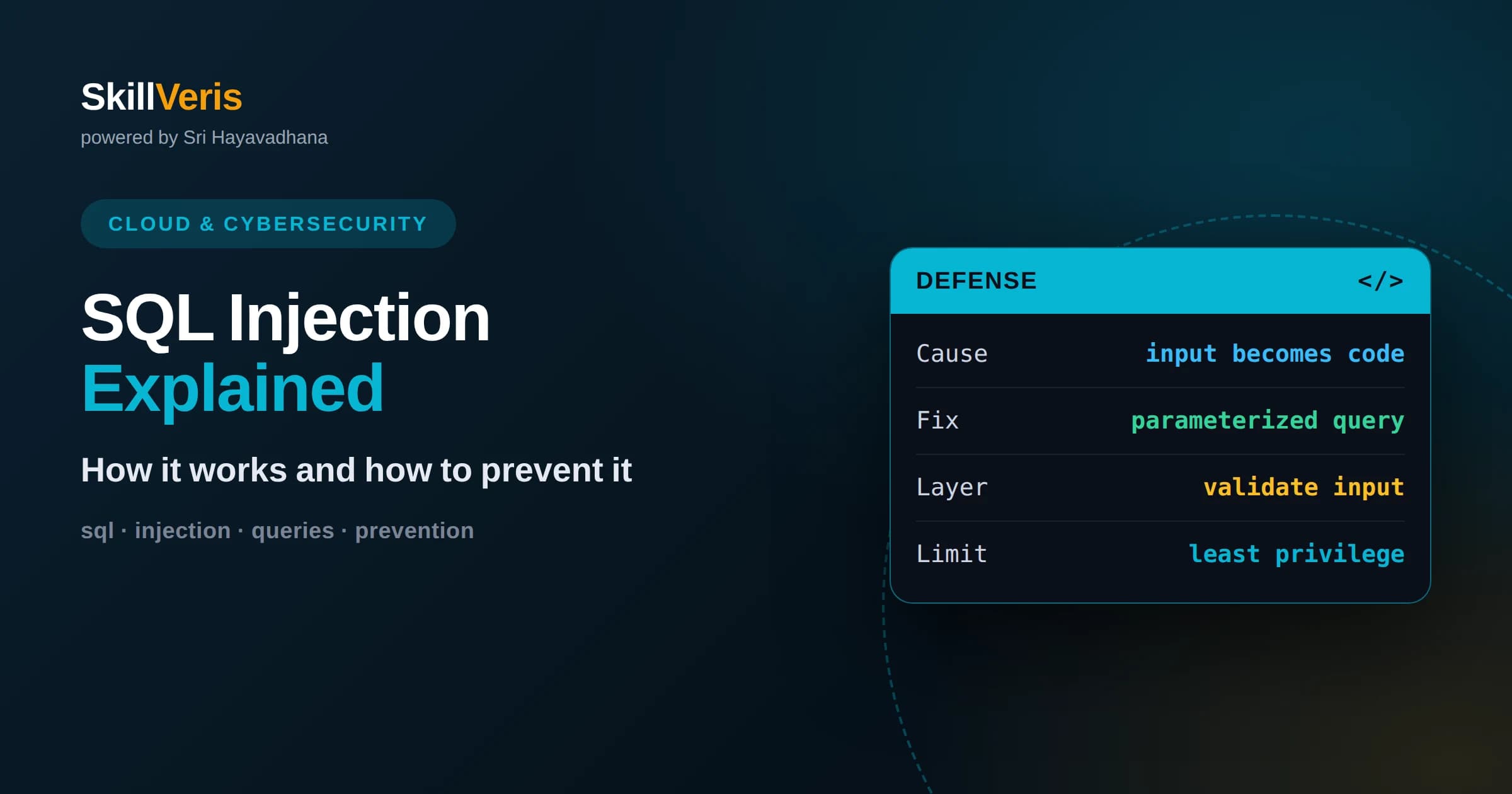
SQL injection happens when untrusted user input is treated as part of a database query instead of as plain data.
In this guide, you'll learn:
- The vulnerability lets attackers read, modify, or delete data and sometimes take over an entire database.
- Parameterized queries and prepared statements are the primary, reliable defense because they keep code and data strictly separate.
- Layered practices like least privilege, input validation, and careful error handling reduce the damage even if a flaw slips through.
1What SQL Injection Is
SQL injection is a vulnerability that occurs when an application builds a database query by mixing untrusted user input directly into the query text, allowing an attacker to change what the query does. Instead of being treated as harmless data, the attacker's input is interpreted as part of the SQL command, letting them read, alter, or destroy data they should never be able to touch.
It remains one of the most dangerous and common web vulnerabilities because databases sit at the heart of most applications and hold their most valuable information. A single injectable query can expose an entire user table, bypass a login, or in severe cases give an attacker broad control over the database. The good news is that the primary defense is simple, well understood, and highly reliable.
This article explains how the flaw arises, walks through how an attack works conceptually, and then focuses on prevention. The central lesson is a single principle repeated throughout: never let user input become part of your query's structure. Keep the command and the data strictly separate, and the vulnerability disappears.
2How Database Queries Normally Work
Applications talk to databases using SQL, a language for asking questions and issuing commands like selecting rows, inserting records, or deleting data. A typical query might ask the database to return the user whose username matches a value the person typed into a login form. The application takes that input and needs to place it into the query somehow.
The dangerous habit is building the query as a plain string and pasting the user's input directly into it. This feels natural and works perfectly for well-behaved input. The problem is that the database has no way to know which parts of the resulting string were intended by the developer and which parts came from an untrusted user, because by the time it arrives, it is all one blended command.
This blending of code and data is the root of the entire vulnerability. The database faithfully executes whatever complete command it receives. If a user can influence the structure of that command, and not just supply values, they can make the database do things the developer never intended.
3How an Attack Works Conceptually
Imagine a login query that looks up a user by the username and password supplied in a form, built by concatenating those values into the query text. A normal user types an ordinary name and the query works as expected. An attacker, however, types input crafted to include SQL syntax that changes the meaning of the surrounding query.
By inserting characters that close the expected value early and then adding their own logic, the attacker can make a condition always evaluate as true, causing the query to return records regardless of the real password. In this way, a login check meant to verify credentials can be turned into a check that always passes, letting the attacker in without knowing any valid password.
The same technique can be extended to extract data from other tables, enumerate the database structure, or issue destructive commands. The details vary, but the core is always the same: the attacker supplies input that the application unwittingly treats as part of the query rather than as a plain value. Understanding this one idea is enough to recognize the risk everywhere it appears.
4Why SQL Injection Is So Dangerous
The impact of SQL injection ranges from serious to catastrophic. At minimum, an attacker can read data they should not see, such as other users' personal information. Worse, they can modify or delete records, corrupting or destroying data. In the most severe cases, depending on database permissions and configuration, they can gain broad control over the database or even the host system.
What makes it especially dangerous is that databases hold the crown jewels of most applications: credentials, personal data, financial records, and business secrets. A single injectable endpoint can compromise all of it at once. Automated tools also make these flaws easy for attackers to find and exploit at scale, so even obscure applications are routinely probed.
There is also a stealth dimension. A well-executed injection may leave little obvious trace, allowing an attacker to extract data quietly over time. This is why prevention, rather than detection after the fact, is the right emphasis. The vulnerability is too damaging and too easily exploited to rely on catching it later.
5The Primary Defense: Parameterized Queries
The reliable, primary defense against SQL injection is to use parameterized queries, also called prepared statements. With this approach, you write the query with placeholders for the values and then supply the user input separately. The database receives the query structure and the data as distinct pieces, so it always treats the input as a value and never as part of the command.
This completely removes the ambiguity that makes injection possible. No matter what characters the user supplies, the input cannot change the meaning of the query, because the query structure was already fixed before the data arrived. Even input full of SQL syntax is treated as a literal string value to search for, not as commands to execute.
Virtually every database library and framework supports parameterized queries, and using them is usually no harder than the unsafe string-building alternative. The key discipline is to use them consistently, for every query that involves any external input, without exception. A single place where you fall back to concatenating input can reintroduce the vulnerability.
6How ORMs and Query Builders Help
Many applications use an object-relational mapper or a query builder, tools that let you interact with the database through code rather than writing raw SQL. These libraries generate parameterized queries under the hood, so when used normally they protect against injection automatically. This is one reason they are popular for building secure applications quickly.
The protection holds only as long as you stay within the tool's safe patterns. Most ORMs offer an escape hatch for writing raw SQL when you need it, and if you build that raw SQL by concatenating user input, you reintroduce the exact vulnerability the ORM was protecting you from. The safe habit is to pass input as parameters even when dropping down to raw queries.
The broader lesson is that tools reduce risk but do not remove your responsibility. An ORM makes the safe path the default path, which is valuable, but you still need to understand what it is protecting against so you recognize when you have stepped outside its safety and need to apply the same principles yourself.
7Input Validation as Defense in Depth
Validating input is a valuable additional layer, though it is not a substitute for parameterized queries. Checking that input matches expected formats, such as ensuring a numeric identifier really is a number or that a value is within an allowed set, reduces the range of malicious input an attacker can supply and catches obviously bad data early.
The important caveat is that validation alone cannot reliably prevent injection, because legitimate data can contain characters that are meaningful in SQL, and trying to filter or escape them by hand is error-prone. Attackers are creative, and hand-rolled filtering has a long history of being bypassed. Validation complements the real defense; it does not replace it.
Use validation to enforce that input is what your application expects and to reject nonsense before it goes any further. Combined with parameterized queries, it forms a layered defense: the parameterization guarantees input cannot become code, and the validation ensures the input is also sensible for its purpose.
8Limiting Damage with Least Privilege
Even with strong prevention, it is wise to limit the potential damage of any single flaw. The principle of least privilege means the database account your application uses should have only the permissions it actually needs. If an application only reads and writes certain tables, its database user should not have the power to drop tables or access unrelated data.
This way, if an injection flaw ever does slip through, the blast radius is contained. An attacker who compromises a query is limited to what that restricted account can do, rather than gaining sweeping control. Least privilege turns a potential catastrophe into a contained incident, which is a meaningful difference when something inevitably goes wrong.
Applying least privilege also encourages clearer thinking about what each part of your system truly requires. It is a general security principle that pays off across many kinds of vulnerabilities, not just injection, and it costs little to set up correctly from the beginning.
9Careful Error Handling
How your application responds to errors can either help or hinder an attacker. Detailed database error messages sent back to the user can reveal the structure of your queries and tables, effectively giving an attacker a map to refine their injection attempts. This is a common way that a small foothold becomes a full compromise.
The defense is to show users generic error messages while logging the detailed technical information privately for developers to review. The user learns only that something went wrong, while your logs capture what they need for debugging. This denies attackers the feedback they rely on to probe and exploit a system.
Thoughtful error handling is a small but meaningful part of a layered defense. On its own it prevents nothing, but combined with parameterized queries and least privilege, it removes another source of information that attackers use to escalate an attack.
10Testing and Code Review
Because SQL injection follows recognizable patterns, it is well suited to catching through review and testing. During code review, look for any place where input is combined with query text through concatenation rather than parameters. Making this a standard review question means the vulnerability rarely survives to production.
Automated security scanning tools can also probe applications for injection flaws, and including such checks in your development pipeline provides an extra safety net. These tools are not perfect, but they catch obvious mistakes and reinforce the habits that keep injection out of your codebase in the first place.
The most durable defense, though, is culture. When a team treats parameterized queries as the only acceptable way to include input, injection stops being a recurring problem. The technical fix is simple; the real work is applying it consistently and making it the unquestioned default across the whole team.
11A Quick Prevention Checklist
To keep SQL injection out of your applications, follow a few clear rules. Always use parameterized queries or prepared statements for any query that involves external input. Rely on your ORM's safe patterns and pass parameters even when writing raw SQL. Validate input to enforce expected formats as an additional layer, without treating it as your main defense.
Then limit the damage of any potential flaw by giving your database account only the permissions it needs, showing users generic error messages while logging details privately, and reviewing code for unsafe query construction. Together these practices make injection both unlikely to occur and limited in impact if it somehow does.
None of these steps is difficult, and applied consistently they eliminate one of the most damaging vulnerabilities on the web. The entire defense really does reduce to one habit repeated everywhere: keep your query structure and your user data strictly separate.
12Practice Preventing Injection on SkillVeris
SQL injection is best understood by doing. Building a deliberately vulnerable query, exploiting it to see how the attack works, and then rewriting it with parameters cements the lesson far more effectively than reading alone. Once you have watched an always-true condition slip past a login and then closed the hole with a prepared statement, you will never write concatenated queries the same way again.
On SkillVeris you can work through hands-on exercises that guide you through injection and its defenses step by step, turning this knowledge into a reliable habit. Keep the prevention checklist close, make parameterized queries your default, and treat every user input as untrusted. With a little practice, preventing SQL injection becomes automatic, and you protect both your data and the people who trust you with it.
Related Reading
Get The Print Version
Download a PDF of this article for offline reading.
About the Publisher
SkillVeris Team
Cloud & Security Team
Our cloud and security experts break down complex infrastructure topics into practical, beginner-friendly guides.
View all postsRelated Posts



Never miss an update
Get the latest tutorials and guides delivered to your inbox.
No spam. Unsubscribe anytime.