Sorting Algorithms Explained: From Bubble to Quicksort
SkillVeris Team
Engineering Team
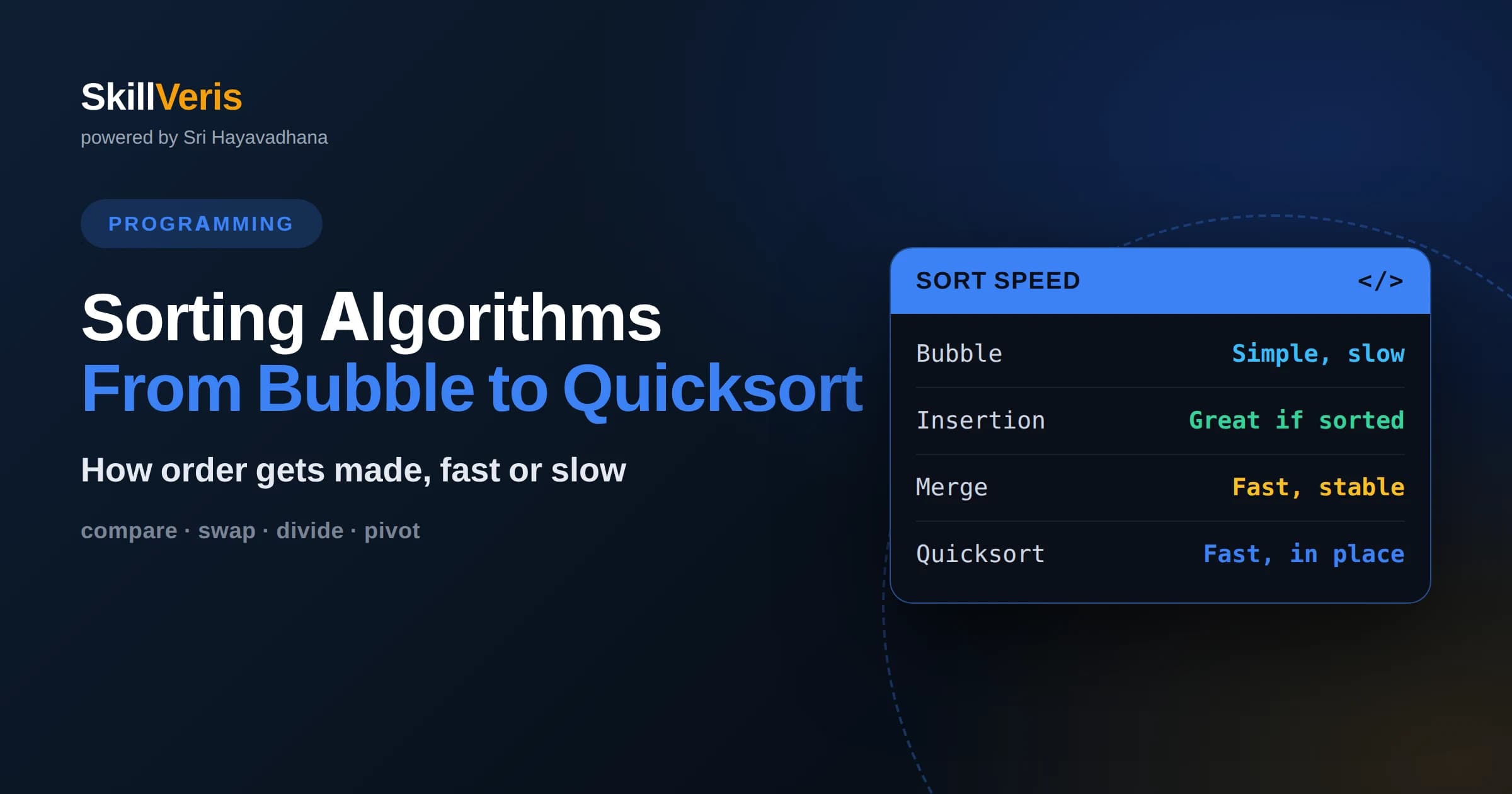
Sorting algorithms put data into a defined order, and their efficiency ranges from very slow to very fast as the amount of data grows.
In this guide, you'll learn:
- Simple algorithms like bubble and insertion sort are easy to understand but scale poorly, doing work that grows with the square of the input size.
- Efficient algorithms like merge sort and quicksort use divide-and-conquer to sort large datasets in near-linear-logarithmic time.
- The best choice depends on data size, how sorted the data already is, memory limits, and whether stable ordering matters.
1What Is a Sorting Algorithm?
A sorting algorithm is a step-by-step procedure that rearranges a collection of items into a defined order, such as numbers from smallest to largest or names alphabetically. Sorting is one of the most common operations in programming because ordered data is easier to search, compare, merge, and present.
What makes sorting interesting is that there are many different algorithms that all produce the same sorted result but do so with wildly different amounts of work. Some are simple to understand but slow on large inputs, while others are more intricate but stay fast even as the data grows enormous.
Understanding these algorithms teaches more than sorting itself. The ideas behind them, especially comparing, swapping, and divide-and-conquer, appear throughout computer science, making sorting one of the best topics for building algorithmic intuition.
2Measuring Sorting Speed
Sorting algorithms are compared using time complexity, which describes how the number of operations grows as the number of items grows. The slow, simple algorithms tend to take time proportional to the square of the input size, meaning that doubling the data roughly quadruples the work. This becomes painful quickly for large collections.
The efficient algorithms take time proportional to the input size multiplied by its logarithm, a growth rate that stays manageable even for millions of items. The gap between these two families is dramatic: on large inputs, a fast algorithm can finish in a blink while a slow one takes an impractically long time.
Memory use matters too. Some algorithms sort in place, using almost no extra space, while others need additional memory proportional to the input. Another quality is stability, which concerns whether items considered equal keep their original relative order. These factors, not just raw speed, shape which algorithm fits a given job.
3Bubble Sort: The Simplest Idea
Bubble sort works by repeatedly stepping through the list, comparing each pair of adjacent items and swapping them if they are in the wrong order. With each full pass, the largest remaining item bubbles up to its correct position at the end. The process repeats until a pass makes no swaps, meaning everything is sorted.
Its great virtue is simplicity. The idea is easy to grasp and easy to implement, which is why it is often the first sorting algorithm people learn. Watching it run gives a clear, intuitive picture of how comparison and swapping gradually bring order to chaos.
Its great weakness is speed. Because it may compare and swap adjacent items many times, its work grows with the square of the input size, making it impractical for anything but small or nearly sorted lists. Bubble sort is a teaching tool more than a production choice.
4Selection Sort: Find the Smallest
Selection sort takes a different simple approach. It scans the unsorted portion of the list to find the smallest remaining item, then moves that item to the front of the unsorted portion. It repeats, each time selecting the next smallest item and extending the sorted region by one.
This method is easy to reason about and performs a predictable number of comparisons regardless of the starting arrangement. It also makes relatively few swaps, which can matter when moving items is expensive.
Like bubble sort, though, its comparison work grows with the square of the input size, so it does not scale to large data. It sits alongside bubble sort as an instructive but slow algorithm, useful for understanding the basics rather than for real workloads.
5Insertion Sort: Build a Sorted Hand
Insertion sort mimics the way many people sort a hand of playing cards. It grows a sorted section one item at a time by taking the next unsorted item and inserting it into its correct place among the already sorted items, shifting larger items aside to make room.
Although its worst-case work also grows with the square of the input, insertion sort has a valuable property: it is very fast when the data is already nearly sorted, because most items only need to move a short distance. It also works well on small lists and can sort data as it arrives.
For these reasons, insertion sort is more than a teaching example. Efficient real-world sorting routines often switch to insertion sort for small sub-lists, combining its low overhead on tiny inputs with faster algorithms for the larger picture.
6Merge Sort: Divide and Combine
Merge sort is the first of the fast, divide-and-conquer algorithms. It splits the list into two halves, recursively sorts each half, and then merges the two sorted halves into one fully sorted list. The merging step is clever: because both halves are already sorted, they can be combined by repeatedly taking the smaller of the two front items.
This approach delivers reliable near-linear-logarithmic performance regardless of the input's initial order, which makes it dependable for large datasets. It is also stable, preserving the original order of equal items, a property that matters when sorting records by one field while keeping another field's order intact.
Its main cost is memory. Merge sort typically needs extra space to hold the merged results, so it uses more memory than in-place algorithms. When predictable performance and stability outweigh memory concerns, especially for very large or external datasets, merge sort is an excellent choice.
7Quicksort: Partition Around a Pivot
Quicksort is another divide-and-conquer algorithm and one of the most widely used in practice. It chooses one item as a pivot, then partitions the rest of the list into those smaller than the pivot and those larger, placing the pivot in its final sorted position between them. It then recursively applies the same process to each partition.
On typical data, quicksort is extremely fast and sorts in place with little extra memory, which is a big part of why it is so popular. Its clever partitioning does most of the sorting work as it goes, and the recursion handles the rest.
Its performance does depend on good pivot choices. A consistently poor pivot can degrade quicksort to the slow, square-growth behavior of the simple algorithms. Practical implementations use smart pivot-selection strategies to make that worst case extremely unlikely, keeping quicksort fast in the real world.
8Stability and In-Place Sorting
Two properties often decide between otherwise similar algorithms. A stable sort keeps items that compare as equal in their original relative order. This matters when you sort by one attribute and want ties broken by the order the data already had, such as sorting a list of people by age while keeping those of the same age in their prior order.
An in-place sort rearranges the data using only a small, fixed amount of extra memory rather than allocating a second copy. In-place algorithms are valuable when memory is tight or the dataset is huge, since they avoid the overhead of duplicating everything.
These properties sometimes pull in opposite directions. Merge sort is stable but uses extra memory, while quicksort is in place but not naturally stable. Knowing which property your task needs helps you pick the right algorithm rather than defaulting to whichever is most famous.
9Choosing the Right Algorithm
The right sorting algorithm depends on the situation. For small lists, the simple algorithms are perfectly fine and their low overhead can even beat fancier ones. For large lists, a divide-and-conquer algorithm is essential to keep performance acceptable.
Consider the data's starting state as well. If it is already nearly sorted, insertion sort can be remarkably fast. If you need stable ordering, merge sort is a natural fit. If memory is scarce and average speed is the priority, quicksort is hard to beat.
In everyday programming you rarely implement these yourself, because languages provide highly optimized built-in sorts. Those built-ins typically combine several algorithms to get the best of each, which is why understanding the trade-offs still helps you predict and trust their behavior.
A helpful way to lock in the choice is to think in terms of the dominant cost you want to minimize. If comparisons are cheap but moving items is expensive, favor an algorithm that moves data less. If the data arrives in a stream or is almost ordered, favor one that exploits existing order. Framing the decision this way turns a long list of algorithms into a short set of clear questions.
10Why Built-In Sorts Usually Win
Modern programming languages ship with sorting functions that have been carefully tuned over many years. These built-in sorts often blend algorithms, using a fast divide-and-conquer approach for large portions and switching to insertion sort for small sub-lists where its low overhead is an advantage.
They also handle edge cases, take advantage of existing order in the data, and are tested extensively for correctness and speed. Reimplementing sorting yourself rarely beats them and usually introduces bugs, so the practical advice is to use the built-in sort for real work.
The value of studying the individual algorithms is understanding, not reinvention. Knowing how sorting works lets you reason about performance, choose comparison functions wisely, and recognize when your data has properties that a particular approach handles especially well or poorly.
11A Glimpse Beyond Comparison Sorts
All the algorithms described so far work by comparing items to each other, and there is a fundamental limit to how fast any comparison-based sort can be. For general data, that near-linear-logarithmic speed is essentially the best achievable, which is why the fast algorithms cluster around it.
Some specialized algorithms sidestep comparisons entirely by exploiting structure in the data, such as sorting integers within a known range by counting or distributing them into buckets. These can be faster than the comparison limit, but only for particular kinds of data that meet their assumptions.
You do not need these specialized methods often, but knowing they exist rounds out the picture. It shows that the comparison-sort speed limit is not the end of the story when the data has extra structure you can take advantage of.
12Hybrid and Adaptive Sorts
The sorting routines shipped in modern languages are rarely a single textbook algorithm. They are usually hybrids that combine ideas to get the best behavior across many situations, switching strategies based on the size and shape of the data they encounter.
A typical hybrid uses a fast divide-and-conquer approach for large portions of the data and falls back to insertion sort for small sub-lists, where its low overhead and speed on nearly ordered data pay off. Some are also adaptive, meaning they detect existing runs of ordered data and exploit them to finish faster.
This blending is why real-world sorts often outperform any single pure algorithm. It also reinforces a practical lesson: understanding the individual algorithms is what lets you appreciate why these combined approaches are designed the way they are.
13Sort It Out on SkillVeris
Sorting algorithms become intuitive when you watch them run and trace their steps. Try implementing bubble sort and insertion sort by hand on a short list, then step through merge sort and quicksort to see how divide-and-conquer splits and recombines the data. Comparing their behavior on the same input makes the speed differences vivid.
On SkillVeris, guided lessons and exercises take you from the simplest swaps to the elegance of divide-and-conquer, with clear walkthroughs of how each algorithm works and when to use it. Building and comparing your own sorts is the best way to turn these classic algorithms into lasting understanding.
Get The Print Version
Download a PDF of this article for offline reading.
About the Publisher
SkillVeris Team
Engineering Team
Our engineering writers turn abstract code concepts into hands-on, project-driven learning experiences.
View all postsRelated Posts




Never miss an update
Get the latest tutorials and guides delivered to your inbox.
No spam. Unsubscribe anytime.