Serverless Computing Explained
SkillVeris Team
Cloud & Security Team
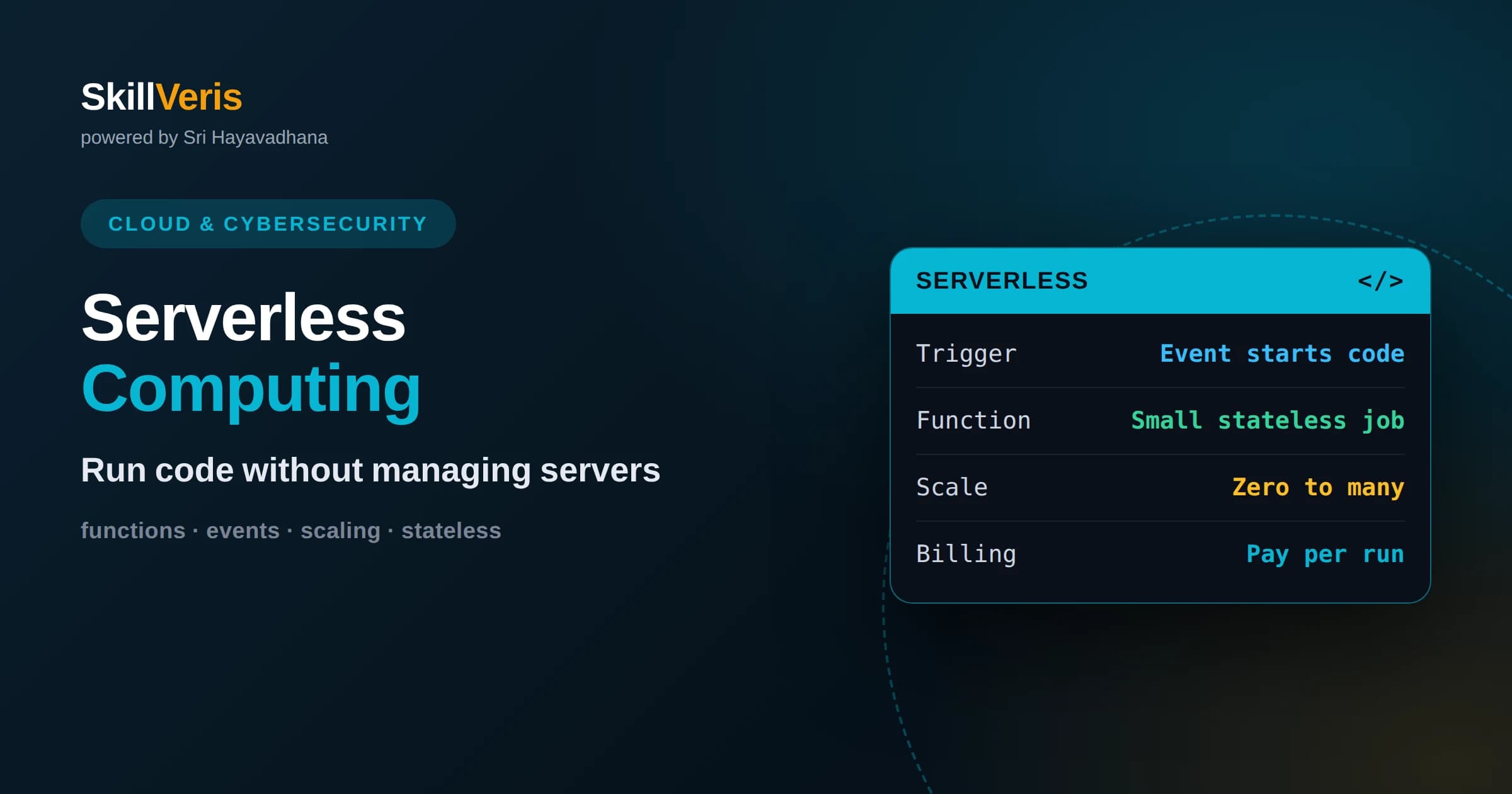
Serverless means the cloud provider runs and scales your code for you, so you never provision or patch servers yourself.
In this guide, you'll learn:
- You are billed only while your code executes, which can make small and spiky workloads dramatically cheaper.
- Functions are event-driven and stateless, so you design around triggers and external storage rather than long-running processes.
- Serverless shines for event processing and glue logic, but cold starts and execution limits make it a poor fit for some workloads.
1What Serverless Really Means
Serverless computing lets you run code without provisioning or managing any servers, because the cloud provider handles the infrastructure, scaling, and maintenance for you. You write a function, upload it, and the provider runs it whenever it is triggered, automatically adding capacity when demand rises and charging you only while your code actually runs.
The name is a little misleading, because servers still exist. The point is that they are invisible to you. You never choose a server size, patch an operating system, or worry about capacity. Those responsibilities shift entirely to the provider, letting you focus on your application logic.
This is a step beyond renting virtual machines. With traditional servers you pay for uptime whether or not anyone uses the app. With serverless you pay per execution, so an idle app costs essentially nothing. That pricing model reshapes how you think about building and running software.
2Functions as a Service
The most common form of serverless is functions as a service, where you deploy individual functions that run in response to events. Each function is a small, focused piece of code that does one job, like resizing an uploaded image or handling a single API request.
Because functions are small and independent, you can build an application as a collection of them, each triggered by a specific event. This encourages a modular design where pieces can be developed, deployed, and scaled separately.
Providers keep your function ready to run and spin up as many parallel copies as needed to handle incoming events. If a thousand requests arrive at once, the platform can run a thousand copies of your function concurrently, then scale back to zero when the burst is over.
This model rewards composing many small functions rather than building one large program. Each function is easier to reason about, test, and change in isolation, and a bug in one is far less likely to bring down the others. The trade-off is that you now think about how these pieces communicate and coordinate.
3The Event-Driven Mindset
Serverless is fundamentally event-driven. Your code does not run continuously waiting for work; it runs because something happened. That something might be an HTTP request, a file landing in storage, a message on a queue, a database change, or a scheduled timer.
This changes how you architect applications. Instead of a single always-on process, you connect small functions to the events that should trigger them. A file upload event triggers a processing function; a new order event triggers a notification function. The system becomes a web of triggers and responses.
Thinking in events takes practice if you are used to long-running programs, but it maps well to how many real systems behave. Most applications are, at heart, reacting to things happening, and serverless makes that reaction the central organizing idea.
Events often flow through connectors that decouple the source from the function, such as queues and streams. This buffering means a sudden flood of events can be absorbed and processed steadily rather than overwhelming anything, and a brief failure downstream does not lose the work. Designing around these connectors is a big part of building robust serverless systems.
4Statelessness and External Storage
Serverless functions are stateless, meaning they do not keep data in memory between invocations. Each time a function runs, it should assume it starts fresh, because the platform may run it on a different underlying machine each time and may discard everything afterward.
Since you cannot rely on local memory to remember things, any state that must persist lives in external services: a database, an object store, or a cache. A function reads what it needs at the start, does its work, and writes results back out before finishing.
This constraint feels limiting at first but brings real benefits. Stateless functions are easy to scale horizontally because any copy can handle any request. It also forces a clean separation between compute and data, which tends to produce more resilient designs.
There is a nuance worth knowing. Platforms sometimes reuse a warm function instance for several invocations, so leftover data can occasionally linger in memory. You should never rely on this, but being aware of it explains surprising behavior and reinforces the habit of treating every invocation as fresh.
5Automatic Scaling to Zero
One of serverless computing's defining features is scaling that goes all the way from zero to very high and back automatically. When no events arrive, no copies of your function run and you pay nothing for compute. When events flood in, the platform launches as many copies as needed.
This elasticity is handled entirely by the provider, with no configuration of server counts or load balancers on your part. You do not predict capacity or provision for peaks; the platform simply matches supply to demand in real time.
For workloads with unpredictable or bursty traffic, this is transformative. You are never paying for idle capacity during quiet periods, yet you are never caught short during a spike. That combination is hard and expensive to achieve with traditional servers.
Automatic scaling does shift some responsibility to the things your functions depend on. If a thousand function copies suddenly all query the same database, that database must handle the load or become the bottleneck. Scaling well means making sure the whole chain, not just the functions, can keep up with the demand the platform lets through.
6The Pay-Per-Execution Model
Serverless billing is usually based on how many times your functions run and how long each run takes, often measured in fractions of a second, combined with the memory allocated. If your code does not run, you generally do not pay for compute at all.
This makes serverless extremely cost-effective for low-volume or intermittent workloads. A function that runs a few thousand times a day may cost almost nothing, whereas an equivalent always-on server would bill around the clock regardless of use.
At very high, steady volume, the economics can shift, and a continuously running server may become cheaper per unit of work. The lesson is to match the model to the workload: serverless wins decisively for spiky and light traffic, and you weigh the trade-off as usage grows large and constant.
7Understanding Cold Starts
A cold start happens when a function has to be initialized from scratch before it can handle a request, because no ready copy exists. This adds a short delay, since the platform must set up the environment and load your code before running it.
After a function runs, the platform often keeps it warm for a while, so subsequent requests are fast. Cold starts mostly affect the first request after a period of inactivity or when scaling up rapidly. For many applications this occasional delay is unnoticeable.
Cold starts matter more when consistent low latency is critical, such as user-facing requests with tight response requirements. You can reduce their impact by keeping functions lean and their startup work small, and some platforms offer ways to keep copies warm. Knowing this trade-off helps you decide where serverless fits.
8Where Serverless Shines
Serverless excels at event processing and glue logic. Resizing images when they are uploaded, transforming data as it flows through a pipeline, sending notifications, and running scheduled cleanup tasks are all natural fits. These jobs are short, event-triggered, and variable in volume.
It is also excellent for lightweight APIs and backends, especially early-stage projects where you want to move fast without managing infrastructure. You can build a functional backend from a handful of functions and managed services, and it scales automatically as your users grow.
Prototyping benefits enormously too. Because you pay only for what runs and there is nothing to provision, you can stand up an idea quickly and cheaply, then evolve it. The low operational overhead lets small teams punch far above their weight.
Scheduled and background work rounds out the sweet spot. Nightly reports, periodic data syncs, and cleanup jobs run perfectly as functions triggered on a timer, costing nothing when idle. For all these cases the pattern is the same: short, well-defined, event-driven work that varies in volume over time.
9Where Serverless Struggles
Serverless is not a universal answer. Long-running tasks fit poorly because functions typically have a maximum execution time, after which they are cut off. Workloads that need to run for many minutes or hours belong on other compute models.
Applications needing very low, perfectly consistent latency can be tripped up by cold starts. Likewise, workloads that keep large amounts of state in memory or need specialized hardware often do not map cleanly onto stateless, ephemeral functions.
There is also the matter of lock-in and complexity. Heavy use of a specific provider's serverless features can tie you to that provider, and a sprawl of tiny functions can become hard to understand without discipline. Weigh these trade-offs rather than assuming serverless is always simpler.
10Serverless Beyond Functions
Serverless is broader than just functions. Many managed services follow the same philosophy of no servers to manage and pay for what you use, including serverless databases, storage, message queues, and even container platforms that scale to zero.
Building a serverless application usually means composing several of these managed pieces. Functions provide the logic, a serverless database holds state, object storage keeps files, and a messaging service connects components. Each part scales independently and bills by usage.
This composition is where serverless becomes powerful. Rather than one big system you operate, you assemble managed building blocks and write only the small amount of custom code that makes your application unique. The provider carries the operational weight.
The mindset that follows is to reach for a managed building block before writing and running your own. Every piece you can hand to the provider is a piece you no longer have to scale, patch, or monitor, which frees your attention for the parts of the product that actually differentiate it.
11Designing Serverless Well
Good serverless design keeps functions small, focused, and fast to start. A function should do one clear job, pull in only the dependencies it needs, and avoid heavy initialization. Lean functions cost less, start faster, and are easier to reason about.
Because functions are distributed and event-driven, observability matters more than usual. Logging, tracing, and monitoring help you understand a system whose parts run briefly and independently. Without them, debugging a web of functions can be frustrating.
Finally, design for failure. Events can arrive twice, functions can time out, and downstream services can be briefly unavailable. Making your functions safe to retry and tolerant of partial failure turns a fragile collection of pieces into a robust system.
12Get Hands-On With Serverless
The concepts click fastest when you build something. Write a single function that responds to an event, connect it to a trigger like a file upload or an HTTP request, and watch it run and scale without any server on your part. That first working function makes the whole model concrete.
From there, add a managed database to hold state, chain a second function, and introduce a queue between them. Each small addition teaches you how event-driven, stateless pieces fit together into a real application.
SkillVeris offers guided, hands-on practice that walks you from your first function to a composed serverless application, so you learn by doing rather than just reading. Start small, experiment freely since idle costs are near zero, and let the pay-per-use model reward your curiosity.
As you build, pay attention to the moments where serverless feels awkward as well as where it shines, because that instinct is exactly what tells you when to reach for it and when to choose something else. Understanding both sides makes you a stronger engineer than treating any single approach as the answer to everything.
Related Reading
Get The Print Version
Download a PDF of this article for offline reading.
About the Publisher
SkillVeris Team
Cloud & Security Team
Our cloud and security experts break down complex infrastructure topics into practical, beginner-friendly guides.
View all postsRelated Posts
Never miss an update
Get the latest tutorials and guides delivered to your inbox.
No spam. Unsubscribe anytime.