React Router Basics for Beginners
SkillVeris Team
Engineering Team
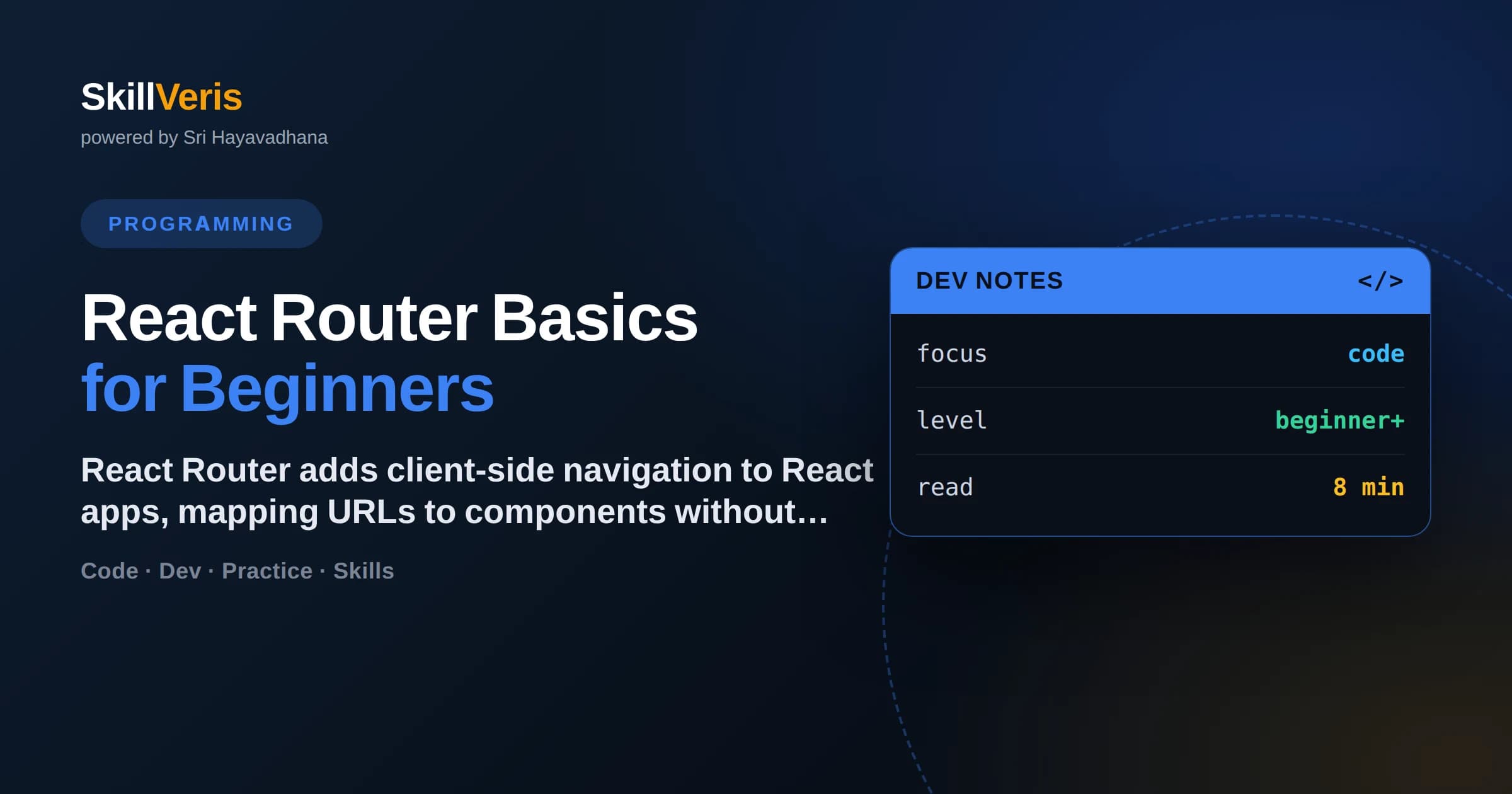
React Router maps URL paths to components so a single-page app can show different views without a full page reload.
In this guide, you'll learn:
- You define routes with Routes and Route, and navigate with Link and NavLink instead of plain anchor tags.
- Dynamic segments like /users/:id let one route render for many URLs, read via the useParams hook.
- Nested routes with an Outlet let a shared layout wrap many child pages cleanly.
- useNavigate lets you change routes in code, such as after a form submission.
1What Is React Router?
React Router is the standard library for adding navigation to a React single-page application. It maps URL paths to components, so visiting /about renders your About page and /contact renders Contact — all without the browser doing a full page reload. The app swaps components in place and updates the URL.
This is called client-side routing. Because React apps typically load one HTML file, React Router intercepts navigation, renders the matching component, and keeps the browser's address bar, history, and back button in sync. Users get instant transitions and shareable URLs.
2Setting Up Routes
You wrap your app in a router and declare each path with a Route inside a Routes element. The router matches the current URL against your routes and renders the best match.
- import { BrowserRouter, Routes, Route } from 'react-router-dom'
- <BrowserRouter> wraps your whole app once, usually in main.jsx.
- <Routes> holds all your Route definitions and renders the first match.
- <Route path='/about' element={<About />} /> # map a path to a component
- <Route path='*' element={<NotFound />} /> # catch-all 404 route
💡One Router at the Root
Wrap your app in BrowserRouter exactly once, at the top level. Nesting multiple routers causes confusing behavior with history and matching.
4Dynamic Routes and Params
A dynamic segment, written with a colon like /users/:id, lets one route match many URLs. The route renders for /users/1, /users/2, and so on, and you read the value with the useParams hook.
This is how detail pages work. A single UserProfile component serves every user; it pulls the id from the URL and fetches the matching record. Query strings, read with useSearchParams, handle optional filters like ?sort=name.
- <Route path='/users/:id' element={<UserProfile />} />
- const { id } = useParams() # read the :id segment
- const [params] = useSearchParams() # read ?key=value query strings
- params.get('sort') # get a single query parameter
🔑One Component, Many URLs
Dynamic segments keep your route table small. Instead of a route per user, one :id route plus useParams serves every profile in the app.
5Nested Routes and Layouts
Nested routes let a parent layout wrap several child pages. You define child Route elements inside a parent, and the parent renders an Outlet where the matched child appears. This is perfect for dashboards with a shared sidebar.
Defining the Nesting
The parent route provides the layout; children fill the Outlet. A default child uses the index prop.
<Route path='/dashboard' element={<DashboardLayout />}>
  <Route index element={<Overview />} />
  <Route path='settings' element={<Settings />} />
</Route>
Rendering the Child
The layout renders shared UI and drops an Outlet where children go, so the sidebar and header stay put while the inner page changes.
function DashboardLayout() {
  return (<div><Sidebar /><main><Outlet /></main></div>);
}7Best Practices
A few habits keep routing clean and your app fast as the number of pages grows.
- Use Link or NavLink for internal navigation; reserve <a> for external links.
- Add a catch-all path='*' route so unknown URLs show a friendly 404 page.
- Lazy-load heavy route components with React.lazy and Suspense to shrink the initial bundle.
- Group related pages under a nested layout to avoid repeating shared chrome.
- Keep route definitions in one place so the app's URL map is easy to scan.
8Key Takeaways
React Router turns a single-page app into a multi-page experience. Keep these fundamentals in hand.
- React Router maps URLs to components without full page reloads.
- Define routes with Routes and Route; navigate with Link and NavLink.
- Dynamic :id segments plus useParams serve many URLs from one component.
- Nested routes with Outlet share a layout across child pages.
- useNavigate handles code-driven navigation like post-login redirects.
9Frequently Asked Questions
Q: What is the difference between Link and an anchor tag? A: A plain <a> tag triggers a full page reload, which reloads all your JavaScript and loses app state. React Router's Link intercepts the click and swaps components in place, keeping the app fast and preserving state while still updating the URL.
Q: How do I read a URL parameter like an id? A: Define the route with a dynamic segment such as path='/users/:id', then call the useParams hook inside the component to get an object like { id }. For query strings, use the useSearchParams hook instead.
Q: What is an Outlet for? A: An Outlet marks where a nested child route should render inside a parent layout. The parent renders shared UI such as a sidebar and places an Outlet where the matched child page appears, so the layout stays fixed while inner content changes.
Q: How do I navigate after a form submits? A: Call the useNavigate hook to get a navigate function, then invoke navigate('/somewhere') in your submit handler after the request succeeds. Passing { replace: true } avoids adding the form page to the back-button history.
Related Reading
Get The Print Version
Download a PDF of this article for offline reading.
About the Publisher
SkillVeris Team
Engineering Team
Our engineering writers turn abstract code concepts into hands-on, project-driven learning experiences.
View all postsRelated Posts

Never miss an update
Get the latest tutorials and guides delivered to your inbox.
No spam. Unsubscribe anytime.