100% Free Forever
AI-Powered Learning
Industry Expert Content
Certificates & Badges
Learn At Your Own Pace
HomeBlogReact Props and Component Composition
Programming

React Props and Component Composition

SV

SkillVeris Team

Engineering Team

Jul 25, 2025 8 min read
Share:
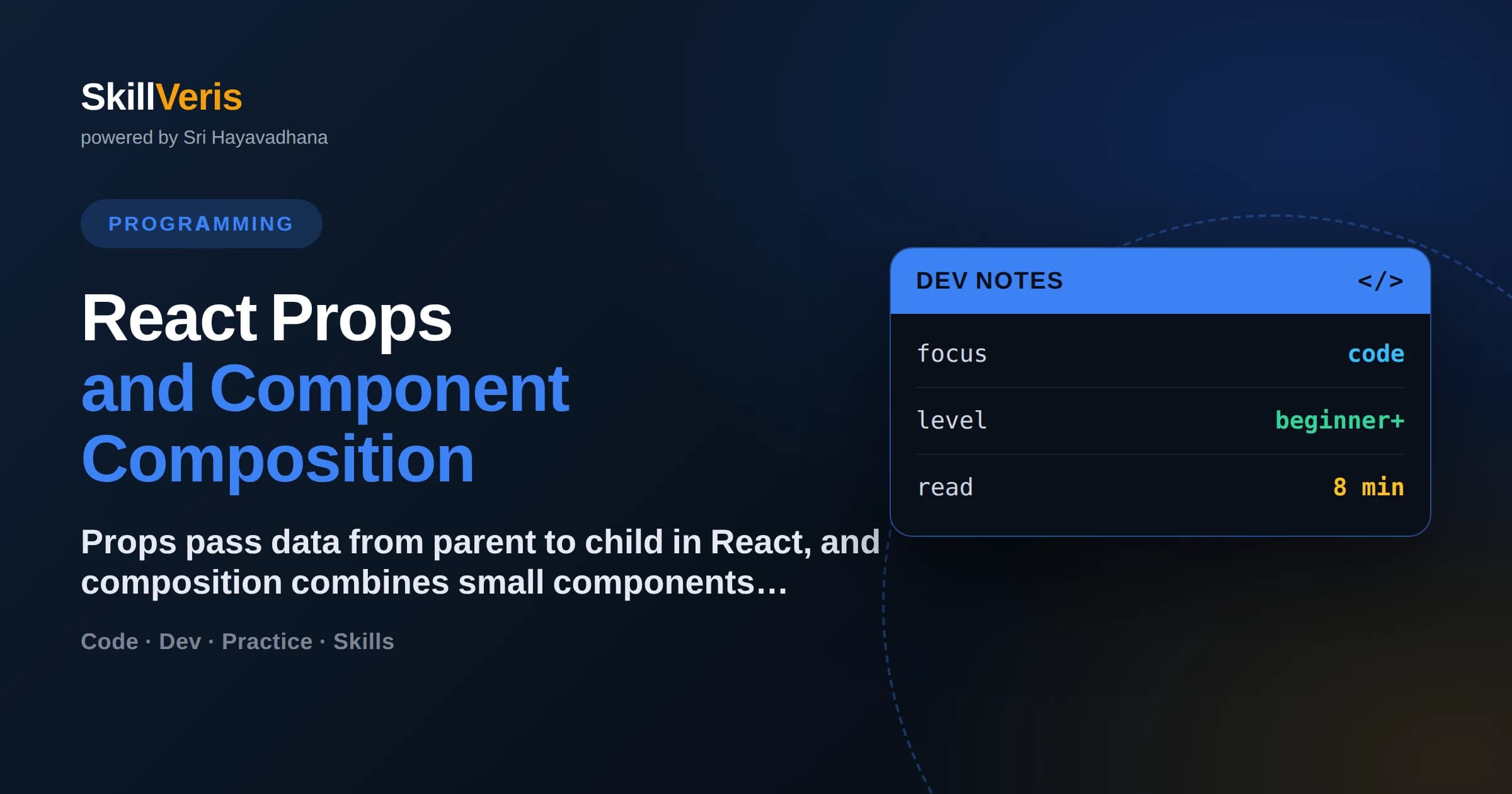
React Props and Component Composition
Key Takeaway

Props are read-only inputs a parent passes to a child component, letting one component configure another without sharing mutable state.

In this guide, you'll learn:

  • Composition means building complex UIs by nesting and combining small, focused components rather than one giant component.
  • The children prop lets a component wrap arbitrary content, which is the foundation of layout and container components.
  • Passing components or render functions as props keeps components flexible without deep prop drilling.
  • Props flow one way — down the tree — which makes data flow predictable and easier to debug.

1What Are Props in React?

Props (short for properties) are the read-only inputs a parent component passes to a child. They let you configure a component from the outside, so the same component can render different data or behavior depending on what it receives. A Button might take a label prop and an onClick prop, for example.

The crucial rule is that props are immutable inside the receiving component. A child never modifies its own props; it simply reads them to decide what to render. This one-way flow is what makes React data flow predictable — you always know a value came from a parent above.

2Passing and Reading Props

You pass props as attributes in JSX and read them from the function's parameter object. Destructuring keeps the code clean and documents exactly what a component expects.

  • function Greeting({ name, excited }) { ... } # destructure props in the parameter
  • <Greeting name='Sam' excited={true} /> # pass props like HTML attributes
  • excited={true} can be shortened to just excited # boolean shorthand
  • <Greeting name={user.firstName} /> # pass any JS expression inside braces

💡Default Values

Give props sensible defaults with destructuring defaults, like function Badge({ color = 'gray' }). This avoids scattered undefined checks throughout the component.

3The Children Prop

The children prop is a special prop containing whatever you place between a component's opening and closing tags. It is the key to building wrapper and layout components that do not need to know their contents in advance.

A Card component can render a border, padding, and shadow, then drop {children} in the middle. Any markup you nest inside <Card>...</Card> appears there. This inverts control: the parent decides the content, the child decides the frame.

  • function Card({ children }) { return <div className='card'>{children}</div>; }
  • <Card><h2>Title</h2><p>Body text</p></Card> # children is the h2 and p
  • children can be text, elements, arrays, or even a function.
  • Multiple slots: pass named props like header and footer for more structure.

4Component Composition Patterns

Composition is the practice of building larger UIs by combining smaller components. Instead of one Page component with hundreds of lines, you assemble a Header, Sidebar, and Content that each do one job. Several patterns make composition flexible.

Containment

A generic container uses children to hold content it does not control. Modals, cards, and layout shells are containment components. They handle structure and styling while remaining agnostic about what goes inside.

Specialization

A specific component renders a generic one with fixed props. A WelcomeDialog can render a generic Dialog with a preset title and message. This is composition standing in for inheritance — you configure by wrapping, not by extending a class.

Slots via Props

When a component needs several distinct regions, pass elements through named props: <Layout sidebar={<Nav />} main={<Feed />} />. Each slot is just a prop that happens to hold JSX, keeping the arrangement explicit.

5Prop Drilling and Its Alternatives

Prop drilling happens when you pass a prop through several intermediate components that do not use it, just to reach a deep child. A little drilling is fine and explicit; a lot becomes tedious and fragile.

  • Composition first: pass the rendered element down instead of the raw data, so intermediates never touch it.
  • Context API: share values like the current theme or user across a subtree without threading props.
  • State libraries: reach for tools like Zustand or Redux only when app-wide state grows complex.
  • Keep the tree shallow: co-locate state near where it is used to reduce how far anything travels.

🔑Composition Beats Context Sometimes

Before reaching for Context, ask whether passing children down solves the problem. Often a component just needs to render content the parent already has.

6Best Practices

Well-designed props and composition make components a joy to reuse. These habits keep component APIs clean as a codebase grows.

  • Keep props minimal and specific; a component with fifteen boolean flags usually wants to be split.
  • Prefer composition over configuration — expose slots instead of endless options.
  • Name props for intent, not implementation: onSubmit reads better than handleFormButtonClick.
  • Treat props as immutable; never mutate an object or array you received.
  • Document expected shapes with TypeScript or PropTypes so misuse fails loudly.

⚠️Do Not Mutate Props

Changing a prop object inside a child breaks React's assumptions and causes hard-to-trace bugs. Copy the data if you need a modified version.

7Passing Functions as Props

Props are not limited to data; you can pass functions down so a child can communicate back up. This is how children request changes without owning state, keeping the one-way data flow intact.

A parent passes a callback like onSelect, and the child calls it when something happens. The parent decides what the action means. This pattern, often called lifting state up, keeps shared state in one place while letting many children trigger updates to it.

  • <Item onSelect={handleSelect} /> # pass a callback down
  • The child calls onSelect(item) on click; the parent updates its state.
  • Name callbacks for the event: onSelect, onSubmit, onClose.
  • Wrap callbacks in useCallback when passing them to memoized children.

💡Lift State Up

When two siblings need the same data, move it to their common parent and pass it down plus a callback to change it. Shared state lives in one owner.

8Key Takeaways

Props and composition are the core of how React apps are structured. A few principles carry most of the value.

  • Props are read-only inputs passed from parent to child, flowing one direction down the tree.
  • The children prop lets components wrap arbitrary content, powering layouts and containers.
  • Composition builds complex UIs from small, focused components instead of monoliths.
  • Pass elements as props or children to avoid deep prop drilling before reaching for Context.
  • Favor many small components with clear props over one component controlled by many flags.

9Frequently Asked Questions

Q: Can a child component change its props? A: No. Props are read-only inside the child. If a value needs to change, the parent owns that state and passes an updated prop, or it passes a callback the child can call to request a change.

Q: What is the difference between props and state? A: Props are passed in from a parent and are immutable within the component. State is owned and managed by the component itself and can change over time. Props configure a component; state tracks its internal, changing data.

Q: What is prop drilling and is it bad? A: Prop drilling is passing a prop through intermediate components that do not use it to reach a deeper one. A small amount is fine and explicit. Excessive drilling is a signal to use composition or the Context API.

Q: When should I use children versus named props for content? A: Use children for a single primary content region, like the body of a card or modal. Use named props like header or footer when a component has several distinct slots that need to be filled independently.

📄

Get The Print Version

Download a PDF of this article for offline reading.

About the Publisher

SV

SkillVeris Team

Engineering Team

Our engineering writers turn abstract code concepts into hands-on, project-driven learning experiences.

View all posts

Never miss an update

Get the latest tutorials and guides delivered to your inbox.

No spam. Unsubscribe anytime.

Frequently Asked Questions

21 categories · pick one to explore

Does SkillVeris have a tech blog, and what does it cover?
Yes, the SkillVeris blog has over 500 articles covering AI and machine learning, programming, web development, DevOps, cloud, security, databases and career guidance. Articles are practical and answer-first, and many use the Learn Through Hobbies approach, teaching technical concepts through cricket, music, gaming or cooking analogies. Everything is free to read.
What is the SkillVeris tech glossary and how big is it?
The SkillVeris glossary is a free reference of roughly 2,000-plus technology terms, each with a clear plain-language definition. It spans AI, programming, web, DevOps, cloud, security and database vocabulary, so whenever a lesson, article or job description uses jargon you do not recognise, the glossary gives you a fast, reliable answer.
Are the developer cheat sheets on SkillVeris free to download?
The cheat sheets are completely free to use, like everything else on SkillVeris. Each sheet condenses a language or tool into its essential syntax, commands and patterns for quick reference while coding. They are designed for rapid lookup during real work, complementing the deeper explanations found in study notes and courses.
Which programming references and cheat sheets are available?
Cheat sheets cover the platform's main domains, including programming languages, AI and ML tooling, web development, DevOps, cloud, security and databases, matching the topics of the 37 live courses. Each sheet lists related reading links and hashtags, so you can jump from a quick reference into fuller study notes or blog articles.
How do I find the meaning of a technical term quickly?
Search the SkillVeris glossary, which holds around 2,000-plus terms with concise, plain-language definitions. Each entry gets to the point in its first sentence, then links to related reading like blog posts or study notes for deeper context. It is faster and more consistent than sifting through scattered search results.
Is the SkillVeris blog good for beginners learning to code?
Yes, many blog articles are written specifically for beginners, and the Learn Through Hobbies style makes them unusually approachable: you might learn Python concepts through cricket or understand APIs through cooking. With 500-plus articles across skill levels, beginners can start with fundamentals and keep reading as they advance, entirely free.
Can cheat sheets replace full courses for learning a language?
No, cheat sheets are references, not teaching tools; they assume you already understand the concepts and just need syntax or commands fast. To actually learn a language, take a structured SkillVeris course with its 24–40 lessons and assessments, then keep the cheat sheet beside you while practising in Code Lab.
How often are new blog articles published on SkillVeris?
The blog grows regularly and already exceeds 500 articles, with new posts added as courses launch and technologies evolve. Topics track the platform's catalogue across AI, programming, web development, DevOps, cloud and security, so checking the Blog section periodically surfaces fresh tutorials, explainers and career-focused pieces, all free to read.
Does the glossary cover AI and machine learning terms?
Yes, AI and machine learning vocabulary is a major part of the roughly 2,000-plus term glossary, covering everything from foundational terms to modern concepts around LLMs, RAG and MLOps. Definitions are plain-language and answer-first, which helps when dense AI papers or course lessons throw unfamiliar jargon at you.
Are there cheat sheets for interview preparation?
Cheat sheets work well as interview-day refreshers because they compress syntax, commands and key concepts into scannable references. For dedicated preparation, combine them with the SkillVeris interview questions feature, which includes readiness scoring, plus study notes for depth. Reviewing a relevant cheat sheet just before an interview steadies recall under pressure.
Can I read the tech blog without signing up?
Yes, the blog is freely readable, and SkillVeris never charges for content. All 500-plus articles are open, covering tutorials, concept explainers and career advice. Creating a free account adds value elsewhere on the platform, like course progress tracking and certificates, but reading the blog requires no commitment at all.
How is the SkillVeris glossary different from Wikipedia?
The glossary is purpose-built for learners: definitions are short, plain-language and answer-first, sized for a quick lookup mid-lesson rather than a deep encyclopedic read. Entries also cross-link to related SkillVeris study notes, blog posts and courses, so a definition becomes a doorway into structured learning instead of a dead end.
Do blog articles use the Learn Through Hobbies method?
Many blog articles teach technical topics through hobby analogies, a hallmark of the SkillVeris blog, so you will find articles explaining programming through cricket, machine learning through music, or system design through cooking. The analogy is the teaching device; the article still delivers the real technical concept underneath.
Where can I find quick programming references while coding?
Open the SkillVeris cheat sheets, which are built exactly for that moment: compact, scannable references for syntax, commands and common patterns across languages and tools. Keep the relevant sheet in a browser tab while you work in Code Lab or your own editor, and dip into the glossary for terminology.
Is there a glossary entry for terms I meet in job descriptions?
Very likely yes, with roughly 2,000-plus terms across AI, programming, web, DevOps, cloud, security and databases, the glossary covers most jargon that appears in tech job descriptions. Decoding a listing this way helps you judge role fit honestly and prepares you to discuss those terms in interviews.
Are the blog articles written for the Indian tech audience?
The blog serves Indian learners plus a worldwide audience. Content stays globally relevant while acknowledging realities that matter in India, such as free access being essential for students and freshers, and career guidance that connects naturally to the SkillVeris jobs portal, which aggregates roles across India, UK, USA, Germany and Remote.
Can I suggest a topic for the blog or glossary?
SkillVeris content grows in response to what learners need, so feedback is welcome through the platform's support channels. If a term is missing from the glossary or a topic deserves an article, telling the team helps prioritise it. Meanwhile, the AI Mentor can answer the question immediately, 24/7, at any depth.
Do cheat sheets and glossary entries link to deeper learning?
Yes, every cheat sheet and glossary entry carries related reading links into study notes, blog articles and courses, plus concept hashtags for discovering similar content. This cross-linking means a thirty-second lookup can smoothly become a structured learning session whenever you decide you want more than a quick answer.
What makes SkillVeris programming references trustworthy?
The references are written to strict internal quality standards, kept consistent with the platform's 37 live courses, and never padded with invented statistics or hype. Definitions and cheat sheets are reviewed against the same content contracts that govern courses, and the answer-first style makes any inaccuracy easy to spot and correct.
How do the blog, glossary and cheat sheets fit into my learning routine?
Use them as satellites around your main course: read blog articles for context and motivation, hit the glossary the instant jargon appears, and keep cheat sheets open while coding. Together with study notes, Code Lab and the 24/7 AI Mentor, they turn passive reading into a complete, free learning system.

What Learners Say

Real journeys from the SkillVeris community — swipe for more.

SkillVeris taught me Python through Cricket. Now I’m building real projects and feeling confident!
Arjun S. · B.Tech Student
The best platform for hobby-based learning. Concepts finally stick.
Priya R. · Data Analyst
I went from zero coding to a portfolio of projects — all by learning through my love for gaming. Landed my first internship!
Kabir M. · CS Undergraduate
Trending Topics50 popular tags — tap to explore
Trending CoursesAll 37 free courses — tap to browse