Object-Oriented Programming: The Four Pillars
SkillVeris Team
Engineering Team
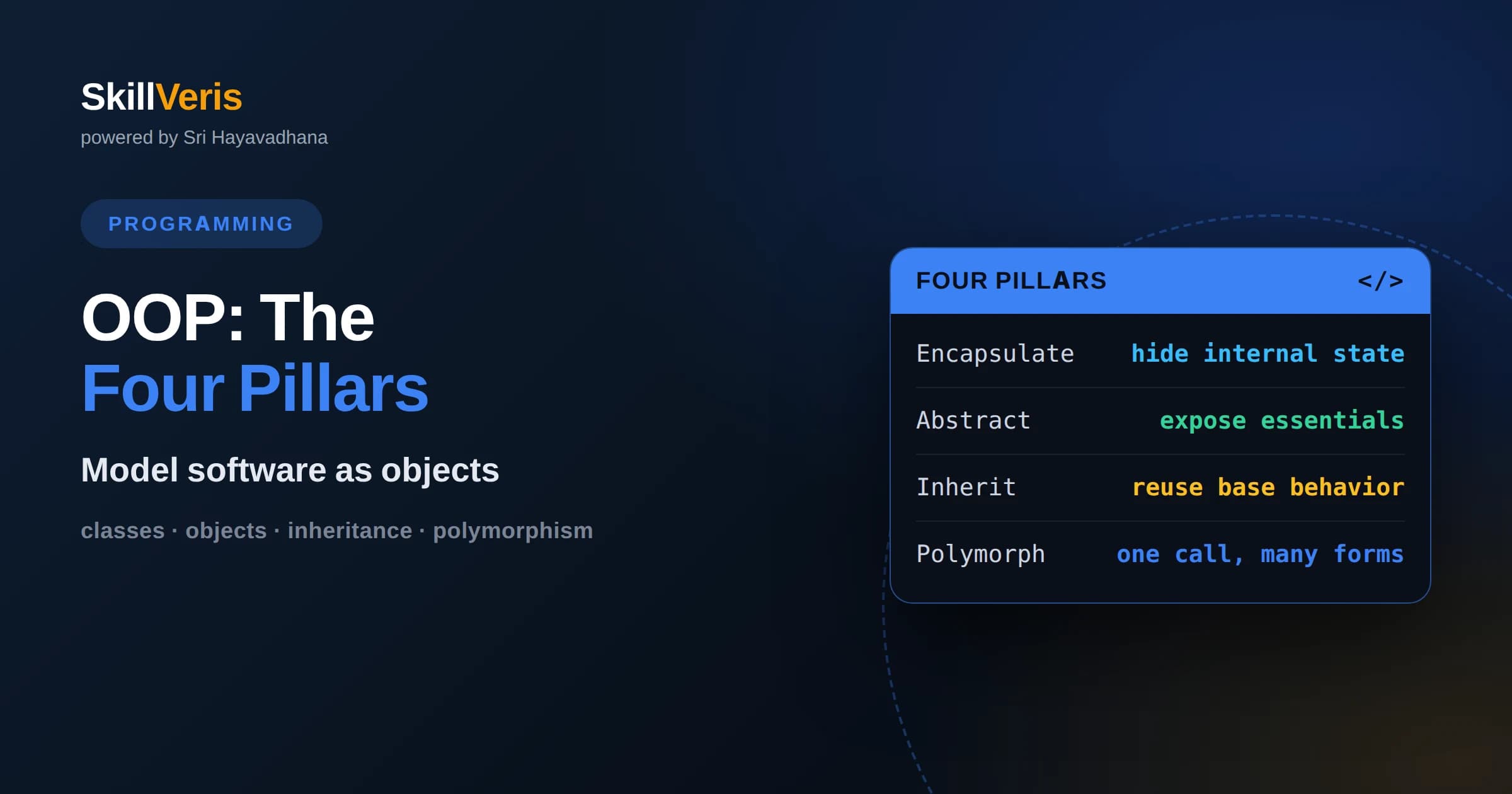
Object-oriented programming models software as interacting objects that bundle data and the behavior that operates on it.
In this guide, you'll learn:
- The four pillars are encapsulation, abstraction, inheritance, and polymorphism, and together they make code modular and reusable.
- Classes are blueprints and objects are the concrete instances built from them, each with its own state.
- Used well, OOP tames complexity in large systems, but it is a tool to apply thoughtfully rather than a rule to follow blindly.
1What Is Object-Oriented Programming
Object-oriented programming, or OOP, is a way of structuring software around objects that combine data with the functions that act on that data. Instead of scattering related information and logic across a program, you group them into self-contained units that model real or conceptual things, such as a user, an invoice, or a game character. Those units interact by sending messages, or calling each other's methods, to accomplish work.
The four pillars of OOP are encapsulation, abstraction, inheritance, and polymorphism. Encapsulation hides internal details behind a clean interface. Abstraction lets you work with simplified concepts instead of overwhelming detail. Inheritance lets one type build on another. Polymorphism lets different types respond to the same instruction in their own way. Master these four ideas and you understand the heart of OOP.
OOP rose to prominence because it maps well to how people think about the world as collections of things with properties and behaviors. It is not the only paradigm, and modern programming often blends it with functional ideas, but its vocabulary is so widespread that understanding it is essential for reading and writing code in most mainstream languages.
2Classes And Objects
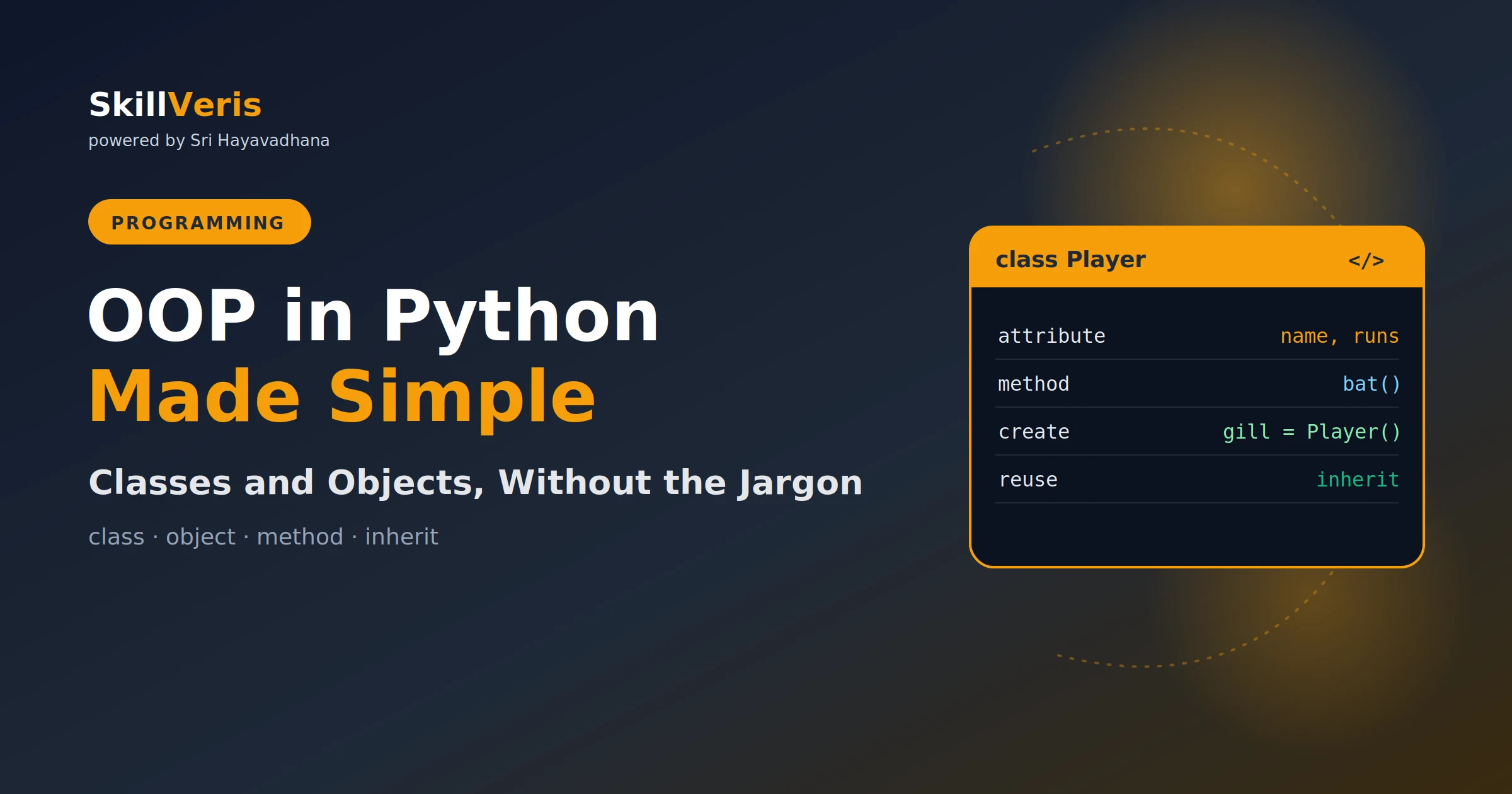
A class is a blueprint that describes what a certain kind of object looks like and what it can do. It defines attributes, the data each object will hold, and methods, the actions each object can perform. A class named Car might declare attributes like color and speed and methods like accelerate and brake. On its own, the class does nothing; it is a template waiting to be used.
An object is a concrete instance created from a class. When you instantiate the Car class, you get an actual car with its own color and its own speed, independent of any other car you create from the same blueprint. Two objects of the same class share behavior but keep separate state, so changing one does not affect the other. This distinction between blueprint and instance is the foundation everything else builds on.
The moment of creation, called instantiation, usually runs a special setup method, often named the constructor, that initializes the object's starting state. Understanding that a class is a definition while an object is a living, stateful thing built from that definition prevents a surprising amount of confusion for newcomers.
3Encapsulation
Encapsulation is the practice of bundling data and the methods that operate on it into a single unit and controlling access to that data from the outside. Rather than letting any part of a program reach in and change an object's internals directly, you expose a deliberate interface of methods and keep the internal details private. Callers ask the object to do something rather than manipulating its raw fields.
The benefit is safety and flexibility. If a bank account object keeps its balance private and only allows changes through deposit and withdraw methods, those methods can enforce rules like refusing overdrafts. Because outsiders never touch the balance directly, you can later change how the balance is stored without breaking any code that uses the account, as long as the methods keep working the same way.
Encapsulation is often described as information hiding, and the phrase captures the intent well. By hiding the messy internals and exposing only what callers truly need, you shrink the surface area where bugs can creep in and make each object easier to reason about in isolation.
4Abstraction
Abstraction is the discipline of exposing only the essential features of something while hiding the complicated details underneath. When you call a method named sendEmail, you do not think about sockets, protocols, and retries; you think in terms of the simple idea of sending a message. The method presents a clean concept and takes care of the messy reality on your behalf.
Abstraction and encapsulation are closely related but not identical. Encapsulation is about hiding data and controlling access, while abstraction is about hiding complexity and presenting a simpler model. In practice they work together: a well-encapsulated object naturally offers an abstract interface, and a good abstraction usually relies on encapsulation to keep its internals private.
Good abstractions let you build tall towers of software without collapsing under detail. Each layer trusts the layer below to handle its own complexity, so you can reason about a small piece at a time. Choosing the right abstractions, ones that hide the right details at the right level, is one of the most valuable and difficult skills in software design.
5Inheritance
Inheritance lets one class build upon another, reusing its attributes and methods while adding or changing behavior. The class being extended is the parent or base class, and the class that extends it is the child or derived class. A base class named Animal might define a method called breathe, and specific classes like Dog and Cat inherit that method automatically while adding their own, such as bark or meow.
The appeal of inheritance is reuse and shared structure. Common behavior lives once in the parent, and specialized classes get it for free, which reduces duplication and keeps related types consistent. When you fix a bug in the parent method, every child benefits at once. This models the natural is-a relationship: a dog is an animal, so it makes sense for Dog to inherit from Animal.
Inheritance is powerful but easy to overuse. Deep chains of classes can become rigid and hard to change, because a small tweak in a distant parent can ripple through many descendants. Modern guidance often favors composition, where objects contain other objects, over deep inheritance for flexibility. Reach for inheritance when a genuine is-a relationship exists, not merely to share a few lines of code.
6Polymorphism
Polymorphism, meaning many forms, lets objects of different types respond to the same method call in their own way. If several classes each define a method named area, you can loop over a mixed list of shapes and call area on each without knowing or caring whether it is a circle, a square, or a triangle. Each object runs its own version, and the calling code stays blissfully simple.
This ability is what makes code extensible. You can add a new shape class with its own area method, and the existing loop keeps working without a single change, because it only relies on the shared method name, not on the concrete type. Polymorphism turns long chains of type-checking conditionals into clean, uniform calls, which is a major reason OOP scales to large systems.
There are different flavors of polymorphism, including overriding a parent's method in a child class and defining methods that behave differently based on their inputs. The common thread is that one interface serves many underlying types, letting you write general code that adapts automatically to whatever objects you feed it.
7How The Pillars Connect
The four pillars are not isolated features but a reinforcing set. Encapsulation hides an object's internals so it can present a clean face to the world. Abstraction defines what that clean face should be, focusing on essential behavior. Inheritance shares that behavior across related types, and polymorphism lets those types be used interchangeably through a common interface.
In a well-designed system you feel all four working together. A payment system might abstract the idea of a payment method, encapsulate the details of each provider, inherit shared logic from a base class, and rely on polymorphism so the checkout code treats every provider identically. Remove any pillar and the design becomes harder to extend or maintain.
Seeing the pillars as a team rather than a checklist is what separates someone who memorizes definitions from someone who designs well. The goal is not to use every pillar in every class but to reach for the right one when it genuinely reduces complexity.
8OOP In Practice
In everyday coding, OOP shows up as classes that model the nouns of your domain and methods that model the verbs. A shopping application might have Product, Cart, and Order classes, each holding relevant data and offering methods that enforce the rules of the business. The cart knows how to add items and compute totals, and it protects its contents so no outside code corrupts them.
Designing these classes is an iterative craft. You start with obvious objects, notice repeated behavior, and refactor shared logic into base classes or separate helper objects. You watch for classes that try to do too much and split them, and for anemic classes that hold data with no behavior and consider whether the logic belongs there instead. Good object design emerges from this steady refinement.
The payoff is a codebase where each part has a clear responsibility and a clear boundary. When a change is needed, you can usually find the one object responsible and modify it with confidence that the rest of the system will keep working, because encapsulation and abstraction have kept the ripple effects contained.
9Common Pitfalls
A frequent trap is over-engineering: creating deep inheritance hierarchies, needless interfaces, and layers of abstraction for problems that a simple function would solve. OOP is a tool for managing complexity, so applying it to code that has little complexity only adds ceremony. When a plain function reads more clearly than a class, prefer the function.
Another pitfall is leaky encapsulation, where an object exposes its internals through poorly chosen methods or public fields, letting outside code depend on details that should be hidden. Once callers rely on those details, you lose the freedom to change them, and the benefits of encapsulation evaporate. Keep interfaces small and intentional to avoid this slow erosion.
Finally, beginners sometimes force inheritance where composition fits better, creating brittle chains just to reuse a method or two. If a class does not truly represent a more specific version of its parent, that inheritance is a warning sign. Favoring composition keeps designs flexible and avoids the fragility of tall class trees.
10OOP Versus Other Paradigms
OOP is one of several programming paradigms, and it is worth knowing where it sits. Procedural programming organizes code as sequences of steps and functions without bundling data and behavior, which suits simple scripts and straightforward pipelines. Functional programming emphasizes pure functions and immutable data, avoiding shared mutable state, and it excels at data transformation and concurrency.
Most modern languages are multi-paradigm, letting you mix approaches within one program. You might model your domain with objects while transforming collections with functional-style operations that avoid side effects. Rather than treating paradigms as rival camps, skilled developers pick the style that fits each part of the problem, using OOP where modeling stateful things helps and functional techniques where clean data flow matters.
Understanding the alternatives makes you a better object-oriented programmer, because it clarifies what OOP is genuinely good at. Its strength is organizing complex, stateful systems into manageable pieces, and recognizing that strength helps you know when to reach for it and when a simpler style will serve you better.
11Why OOP Still Matters
Despite decades of debate, OOP remains foundational because so much of the software world is built on it. Major frameworks, libraries, and languages assume you understand classes, objects, and the four pillars, so reading professional code requires that fluency. Even when a team leans functional, they interact with object-oriented libraries and must think in objects at the boundaries.
OOP also endures because it genuinely helps with large, evolving systems. When many people work on a big codebase over years, the discipline of clear objects with well-defined responsibilities keeps the code navigable. New team members can learn one object at a time, and features can be added by extending existing types rather than rewriting everything.
The healthiest view is that OOP is a valuable tool rather than a universal answer. It solves the specific problem of organizing complex, stateful behavior into understandable units. Knowing its strengths, its costs, and its alternatives lets you apply it where it shines and set it aside where something simpler would do.
12Practice The Four Pillars
The pillars click into place only when you build something with them. Try modeling a small domain you understand well, such as a library with books and members, and give each class private data, clean methods, a sensible base class, and shared behavior expressed through polymorphism. Then extend it, add a new type, and watch how good design lets you do so without rewriting everything.
SkillVeris offers hands-on lessons that walk you from your first class to designing systems with all four pillars working together, complete with exercises that reward clean encapsulation and punish leaky abstractions. Working through those tasks turns definitions into instincts, so choose a project, model it in objects, and refactor until the design feels natural.
Get The Print Version
Download a PDF of this article for offline reading.
About the Publisher
SkillVeris Team
Engineering Team
Our engineering writers turn abstract code concepts into hands-on, project-driven learning experiences.
View all postsRelated Posts
Never miss an update
Get the latest tutorials and guides delivered to your inbox.
No spam. Unsubscribe anytime.