Linked Lists vs Arrays: When to Use Each
SkillVeris Team
Engineering Team
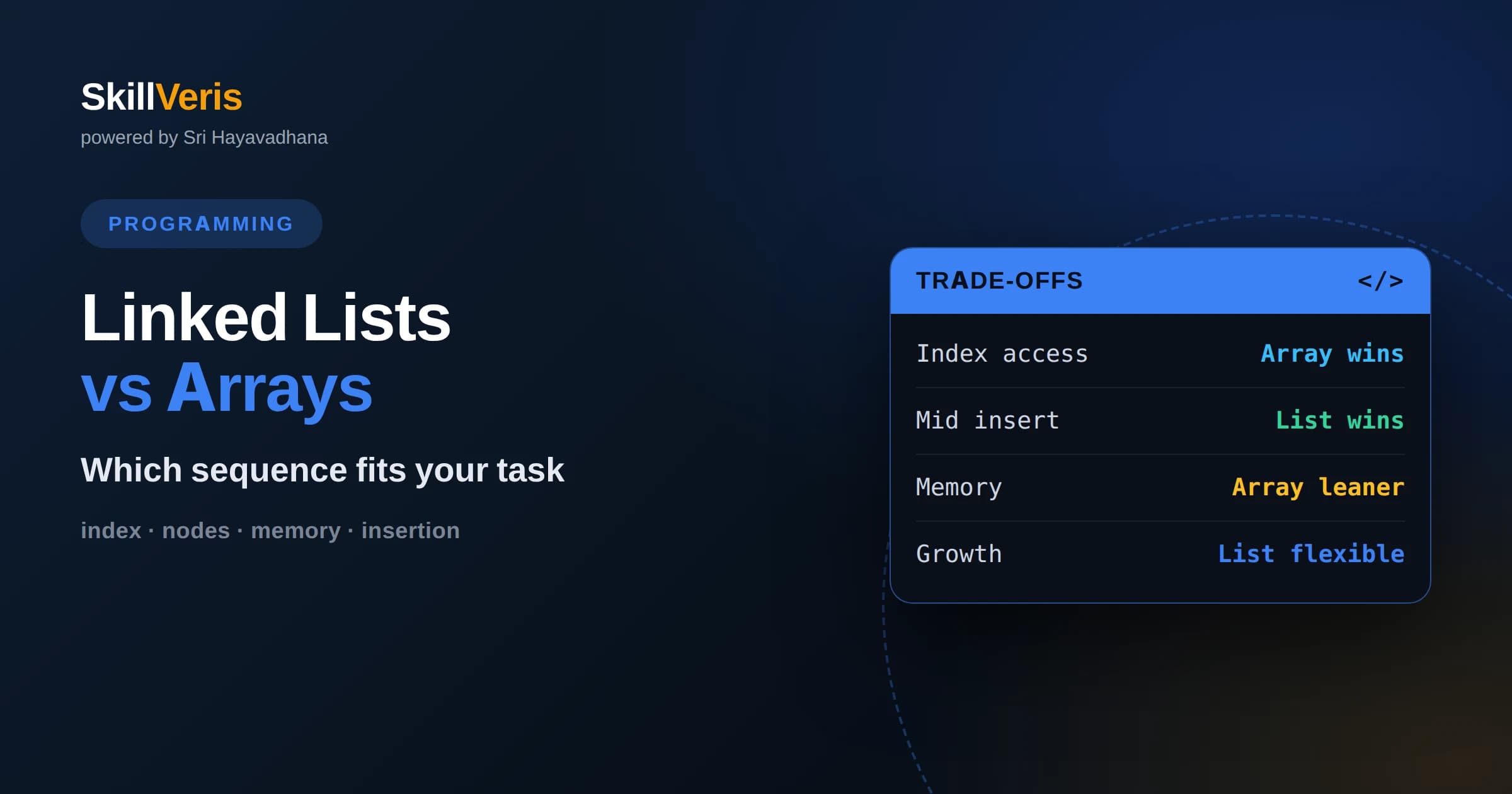
Arrays store elements in a contiguous block of memory, giving instant access by index but slow insertions and deletions in the middle.
In this guide, you'll learn:
- Linked lists store elements as separate nodes joined by references, giving cheap insertions and removals but no direct index access.
- Arrays are cache-friendly and compact, while linked lists trade memory overhead for structural flexibility.
- The right choice depends on whether you access by position, how often you insert or remove, and where those changes happen.
1The Core Question
Arrays and linked lists both store an ordered sequence of elements, but they organize memory in opposite ways, and that difference decides which one is faster for a given task. In short, arrays give you instant access to any element by its position but make inserting and removing in the middle slow, while linked lists make insertions and removals cheap but give up direct positional access.
Choosing between them is one of the most common data-structure decisions a programmer makes. Because the two have mirror-image strengths and weaknesses, the right answer depends entirely on which operations your program performs most often.
Understanding how each stores data in memory is the key to choosing well. Once you see the underlying layout, the trade-offs stop being arbitrary rules to memorize and become obvious consequences of the design.
2How Arrays Store Data
An array holds its elements in a single contiguous block of memory, one after another with no gaps. Because the elements are laid out in a predictable, evenly spaced sequence, the computer can compute the exact memory location of any element directly from its index using simple arithmetic.
This direct computation is why reading or writing an element by its index takes constant time regardless of the array's size. Reaching the first element and reaching the millionth element cost the same, since both are just a calculation followed by a single memory access.
The contiguous layout also brings a hidden performance benefit. Modern hardware loads memory in chunks and predicts sequential access, so scanning through an array in order is very fast. This friendliness to the hardware often makes arrays outperform other structures even when the theory looks even.
3How Linked Lists Store Data
A linked list stores each element in its own separate node, and each node contains both the element's value and a reference pointing to the next node. These nodes can live anywhere in memory, scattered rather than contiguous, and the references are what thread them together into an ordered sequence.
Because the nodes are joined only by references, the list has no built-in notion of position that the computer can calculate. To reach a particular element you must start at the first node and follow the chain of references one link at a time until you arrive.
This design means a linked list carries some extra memory overhead, since every node must store a reference in addition to its value. The scattered layout is also less friendly to the hardware than an array's neat block, which affects real-world speed even when the step counts match.
4Access by Index
When your program frequently reads elements by their position, arrays win decisively. An array reaches any index in constant time through direct calculation, so random access is effectively free no matter how large the array is.
A linked list, by contrast, must walk from the beginning to reach a given position, following references one by one. Reaching an element deep in the list takes time proportional to how far in it sits, which makes positional access slow, especially for large lists.
If your workload is dominated by looking up elements by index, jumping around to arbitrary positions, or scanning many times, the array's instant access is a major advantage and usually the deciding factor.
5Insertions and Deletions
Here the advantage flips. Inserting or removing an element in the middle of an array requires shifting every following element to keep the block contiguous, which takes time proportional to how many elements must move. For large arrays with frequent middle changes, this shifting is costly.
A linked list handles the same operation cheaply once you are positioned at the right spot. Inserting or removing an element only requires rewiring a couple of references to splice the node in or out, without touching any other elements. The rest of the list stays exactly where it is.
The important nuance is that this cheap operation assumes you already have a reference to the location. If you must first find the spot by walking the list, the search itself takes time, and the overall cost may not beat an array. Linked lists win most clearly when you are already at the point of change.
6Growing and Shrinking
Linked lists grow and shrink naturally, adding or removing nodes one at a time without needing to know a maximum size in advance. Each new element simply becomes a new node linked into the chain, so the structure expands smoothly as far as memory allows.
A fixed-size array cannot grow beyond its allocated capacity. Many languages provide dynamic arrays that grow automatically, but they do so by allocating a larger block and copying all existing elements into it when they run out of room. This occasional copy is efficient on average but represents work that linked lists avoid.
For workloads where the size changes constantly and unpredictably, especially with frequent additions and removals at the ends, a linked list's effortless growth can be appealing. For stable or predictable sizes, an array's simplicity is usually preferable.
7Memory Considerations
Arrays are memory-efficient because they store only the elements themselves in a tight block, with no per-element overhead. This compactness saves space and, just as importantly, keeps the data close together so the hardware can process it quickly.
Linked lists pay a memory tax for their flexibility. Every node needs extra space for its reference, and in a doubly linked variant, for two references. Scattered across memory, these nodes also make less efficient use of the hardware's caching, which can slow real-world traversal even when the algorithm looks equivalent on paper.
For large collections of small elements, this overhead is significant, and arrays are often the leaner choice. The gap narrows when each element is large, since the reference overhead becomes a smaller fraction of the total.
8Variations of Linked Lists
Linked lists come in a few flavors that adjust their trade-offs. A singly linked list has each node point only to the next, allowing forward traversal. A doubly linked list adds a reference to the previous node as well, enabling movement in both directions at the cost of extra memory per node.
A circular linked list joins the last node back to the first, forming a loop that is handy for cycling repeatedly through a set of items. Each variation exists to make certain operations, like removing a node or traversing backward, more convenient.
These variations do not change the fundamental comparison with arrays, but they show that a linked list can be tailored to a task. Choosing the right variant is a second-level decision once you have decided a linked structure fits at all.
9What Programs Actually Use
In everyday programming, arrays and their dynamic-array cousins are the default choice for most sequences, and for good reason. Their instant index access, compact memory use, and hardware friendliness make them fast and simple for the majority of tasks, including the common case of building a list and iterating over it.
Linked lists tend to appear inside other structures and in specific scenarios rather than as an everyday general-purpose list. They are useful when you need to splice elements in and out frequently at known positions, or as the internal backbone of queues and certain specialized collections.
This is why many experienced programmers reach for a dynamic array first and only switch to a linked list when a clear pattern of frequent, positioned insertions and removals justifies it. The array's practical advantages often outweigh the linked list's theoretical strengths.
10Making the Decision
To choose between them, start by identifying which operations your program performs most. If you mostly access elements by position, scan repeatedly, or need compact fast storage, choose an array. If you mostly insert and remove elements at known points and rarely need positional access, a linked list may serve better.
Also weigh how the size behaves and how large the elements are. Predictable sizes and small elements favor arrays, while highly dynamic sizes with frequent structural changes lean toward linked lists. Memory tightness usually favors the array's low overhead.
When in doubt, default to a dynamic array, because its all-around strengths cover most situations well. Reach for a linked list deliberately, when a specific access pattern makes its cheap insertions and removals genuinely worthwhile.
It also helps to think a step ahead about how the collection will be used later, not just how it is built. A structure that is convenient to fill but awkward to read from repeatedly may cost you more overall than one that takes slightly more effort up front. Matching the structure to the whole lifecycle of the data leads to the most maintainable choice.
11Common Misconceptions
A common misconception is that linked lists are always faster for insertions. They are cheap only once you are positioned at the insertion point; if finding that point requires walking the list, the search cost can erase the advantage. Arrays sometimes win in practice even for insertions near the end.
Another misconception is that the theoretical step counts tell the whole story. Real performance is heavily shaped by how well data fits the hardware's memory behavior, and arrays' contiguous layout frequently makes them faster than their linked-list counterparts even when the abstract analysis looks similar.
Recognizing that theory and real-world speed can diverge is a mark of maturity. The abstract trade-offs are a starting point, and measuring on your actual data is the way to be sure when it truly matters.
12Building Blocks for Bigger Structures
Both arrays and linked lists serve as foundations for more complex structures, which is another reason to understand them well. Stacks and queues, for example, can be built on either one, and the choice of foundation shapes their performance characteristics.
Dynamic arrays, the resizable lists you use constantly, are built on plain arrays with automatic growth logic layered on top. Meanwhile, linked structures underpin certain queues, adjacency representations for graphs, and specialized collections that need cheap splicing at known points.
Seeing these two simple structures as building blocks rather than isolated topics helps the rest of data structures fall into place. Much of what looks advanced is really a clever arrangement of these fundamentals, each chosen for the access pattern it handles best.
13Compare Them on SkillVeris
The trade-offs between arrays and linked lists become clear when you build both and use them. Try implementing a simple linked list, then perform the same insertions and lookups on an array, and notice where each feels natural and where each fights you. That hands-on contrast teaches more than any table of pros and cons.
On SkillVeris, guided lessons and exercises walk you through both structures with clear explanations and practical examples of when to choose each. Developing a feel for these fundamental building blocks will sharpen every decision you make as you tackle larger and more demanding programs.
Get The Print Version
Download a PDF of this article for offline reading.
About the Publisher
SkillVeris Team
Engineering Team
Our engineering writers turn abstract code concepts into hands-on, project-driven learning experiences.
View all postsRelated Posts



Never miss an update
Get the latest tutorials and guides delivered to your inbox.
No spam. Unsubscribe anytime.