JWT Explained: How Token Authentication Works
SkillVeris Team
Cloud & Security Team
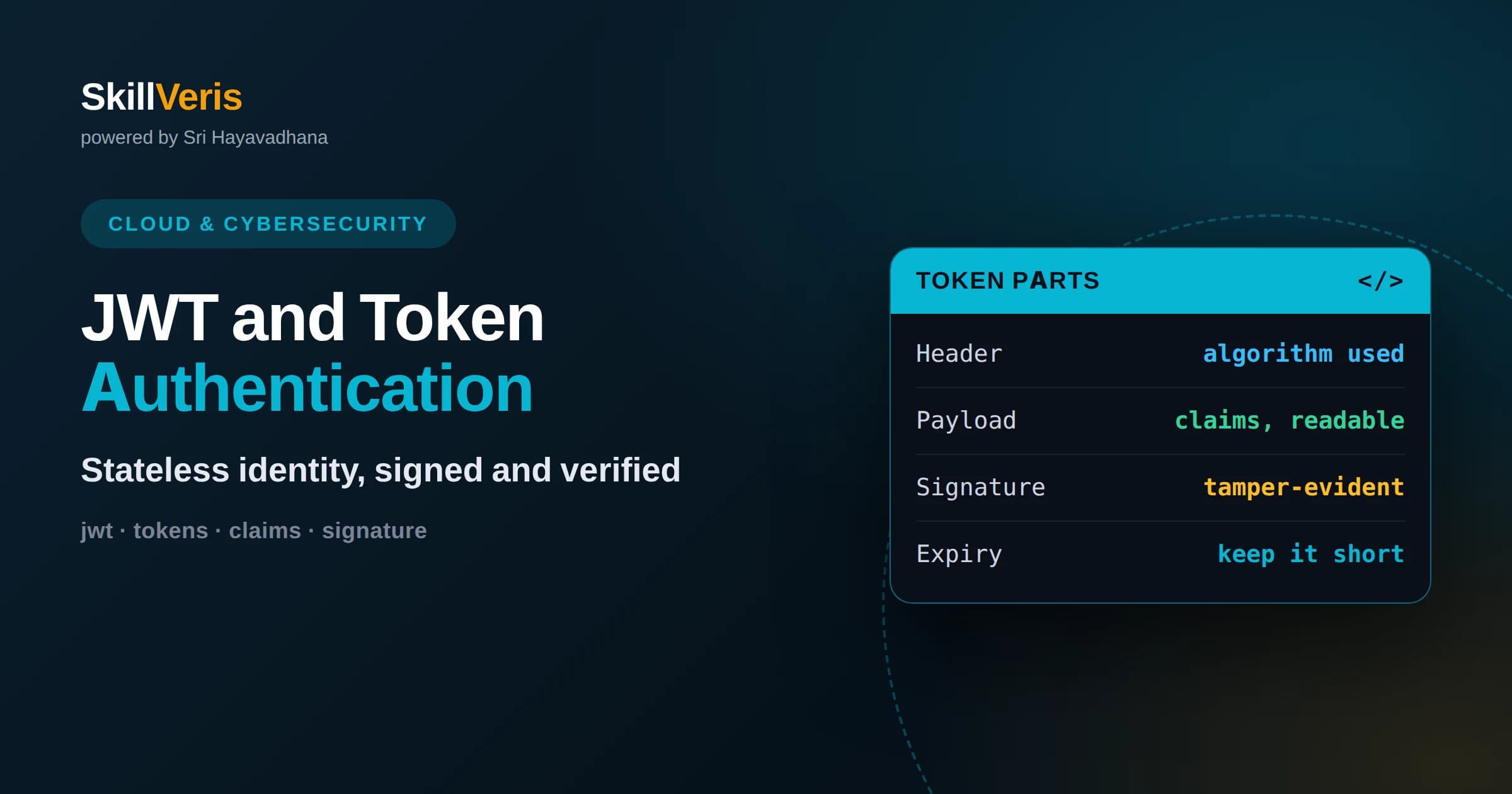
A JWT is a compact, signed token that carries claims about a user, letting servers verify identity without storing session state.
In this guide, you'll learn:
- Its three parts, header, payload, and signature, make the token self-contained and tamper-evident but not secret.
- The signature proves the token was issued by a trusted party and has not been altered, which is the heart of JWT security.
- Common mistakes like storing sensitive data in the payload or mishandling expiration cause most real-world JWT vulnerabilities.
1What a JWT Actually Is
A JSON Web Token, or JWT, is a compact, self-contained token that carries verified claims about a user, such as their identity, in a form a server can validate without looking anything up in a database. After a user logs in, the server issues a signed token, and the client sends that token with each subsequent request to prove who it is. This enables stateless authentication.
The defining feature of a JWT is that it is signed. The signature lets any server holding the right key confirm that the token was genuinely issued by a trusted party and has not been tampered with. This means the token itself carries the proof of its own authenticity, so the server does not need to store session records to trust it.
It is essential to understand from the start that a JWT is signed, not encrypted. Its contents are readable by anyone who holds the token; the signature only guarantees they have not been changed. This single fact drives many of the correct-usage rules covered later, especially the rule never to place secrets in a token's payload.
2The Three Parts of a Token
A JWT is made of three parts separated by dots: a header, a payload, and a signature. Each of the first two parts is a small piece of JSON that has been encoded into a compact, URL-safe text form. When you look at a raw token, it appears as a long string of characters, but it decomposes cleanly into these three meaningful sections.
The header describes the token itself, primarily which signing algorithm was used. The payload contains the claims, the actual statements about the user and the token, such as who the user is and when the token expires. The signature is computed over the header and payload using a secret or key, binding them together so any change is detectable.
Because the header and payload are merely encoded, not encrypted, anyone can decode and read them. This is by design and is not a flaw, but it is the reason the payload must never contain sensitive information. The security of a JWT comes entirely from the signature, not from any secrecy of its contents.
3Understanding Claims in the Payload
The payload holds claims, which are simply statements about the user or the token. Some claims are standardized, such as the subject identifying the user, the expiration time after which the token is no longer valid, and the issued-at time recording when it was created. Others are custom claims your application defines, such as a user's role.
Claims are what make a JWT useful for authorization as well as authentication. Once the server has verified the signature, it can trust the claims inside, using the subject to know who the user is and custom claims to inform permission decisions. This lets a single verified token carry both identity and relevant context.
The discipline here is to include only what is necessary and never anything sensitive. Because the payload is readable by anyone with the token, it should hold identifiers and non-secret metadata, not passwords, personal secrets, or confidential data. Keeping the payload minimal also keeps tokens small, which matters since they travel with every request.
4How the Signature Provides Trust
The signature is the security core of a JWT. It is produced by running the header and payload through a signing algorithm together with a key known to the issuer. When a server receives a token, it recomputes the signature using its key and checks that it matches. If it does, the server knows the token was issued by a holder of the key and that its contents are unchanged.
This is what makes the token tamper-evident. If an attacker alters even a single character of the payload, perhaps trying to change their role to administrator, the signature no longer matches when the server verifies it, and the token is rejected. Without the signing key, an attacker cannot produce a valid signature for their modified token.
Signing can use a shared secret, where the same key both creates and verifies the signature, or a key pair, where a private key signs and a corresponding public key verifies. The choice affects how keys are distributed across services, but the principle is the same: only a holder of the signing key can create a token the servers will trust.
5Why Stateless Authentication Matters
Traditional session authentication stores a record of each logged-in user on the server, and the client holds only a reference to it. JWTs invert this: the token carries the information itself, so the server can verify it using only a key, without a lookup. This is called stateless authentication because the server keeps no per-session state.
The practical benefit is scalability and simplicity in distributed systems. Because any server holding the verification key can validate a token independently, requests can be handled by any instance without sharing a central session store. This makes JWTs popular for architectures with many services or servers behind a load balancer.
Statelessness comes with a significant trade-off, however. Because the server does not track tokens, it cannot easily revoke one before it expires. A traditional session can be destroyed instantly on the server, but a valid JWT remains valid until its expiration time, which shapes how you must design around logout and compromised tokens.
6The Token Lifecycle in Practice
The typical flow begins when a user logs in with their credentials. The server authenticates them and, on success, creates a JWT containing the appropriate claims, signs it, and returns it to the client. The client stores the token and includes it with each subsequent request, commonly in an authorization header, to prove its identity.
On each request, the server verifies the signature and checks the claims, particularly that the token has not expired. If verification passes, the server treats the request as coming from the identified user and proceeds to its authorization checks. If verification fails, the request is rejected as unauthenticated. All of this happens without any database lookup for the session.
When the token expires, the user must obtain a new one. To avoid forcing frequent logins, many systems issue a short-lived access token alongside a longer-lived refresh token, using the refresh token to obtain new access tokens quietly. This pattern balances security, since access tokens expire quickly, with a smooth user experience.
7Expiration and Refresh Tokens
Expiration is a crucial security feature of JWTs, precisely because they cannot easily be revoked. A short lifetime limits how long a stolen token remains useful. If a token is compromised, the damage window closes on its own when the token expires, which is why keeping access token lifetimes short is a common and sensible practice.
The refresh token pattern reconciles short lifetimes with usability. The access token, used on every request, expires quickly, while a separate refresh token, stored more carefully and used only to request new access tokens, lasts longer. Because the refresh token is used rarely and can be tracked or revoked server-side, it offers a control point that pure access tokens lack.
This design gives you the best of both approaches: the scalability of stateless access tokens for everyday requests, and a measure of revocability through the refresh token. Handling refresh securely, and being able to invalidate refresh tokens when needed, is an important part of a robust JWT-based system.
8Common JWT Mistakes to Avoid
Several recurring mistakes cause most JWT vulnerabilities. The first is putting sensitive data in the payload, forgetting that it is readable by anyone with the token. Passwords, secrets, and confidential information must never go there. The payload is for identifiers and non-secret claims only, because encoding is not encryption.
A second class of mistakes involves signature verification. Failing to verify the signature, or accepting a token that claims to use no signature at all, lets attackers forge tokens freely. Servers must always verify the signature using the expected algorithm and key, and reject tokens that do not meet those expectations rather than trusting them blindly.
A third pitfall is ignoring expiration or making tokens long-lived to avoid re-authentication. This maximizes the damage of any stolen token. Always set and check expiration, keep access tokens short-lived, and use refresh tokens for a smooth experience. Each of these mistakes is easy to make and easy to avoid once you know to watch for it.
9Storing and Transmitting Tokens Safely
How and where a client stores a token affects its security. Tokens must be transmitted only over encrypted connections, because a token sent over plain HTTP can be captured and reused by anyone watching the network. Since the token is the credential, protecting it in transit is as important as protecting a password.
On the client, storage choices involve trade-offs around exposure to different kinds of attacks, such as those that steal data through malicious scripts or those that trick a browser into sending credentials. There is no single perfect answer, and the right choice depends on your application's threat model, but the decision deserves deliberate thought rather than a default.
The unifying principle is that a JWT is a bearer token: whoever holds it can use it. That makes protecting the token, in transit and at rest, essential. Combined with short lifetimes and careful handling, treating the token as the sensitive credential it is closes many practical avenues of attack.
10When JWTs Are the Right Choice
JWTs shine in scenarios where stateless, scalable authentication across multiple services is valuable, such as distributed systems and communication between services. Their self-contained nature means any component with the verification key can validate a request independently, which simplifies architecture at scale and reduces reliance on a shared session store.
They are less ideal when you need immediate, reliable revocation, such as instantly logging a user out everywhere or cutting off a compromised account. Because a valid JWT stays valid until it expires, achieving strong revocation requires extra mechanisms that partly reintroduce the state JWTs were meant to avoid. For some applications, traditional server sessions remain simpler and safer.
The honest conclusion is that JWTs are a tool with clear strengths and clear trade-offs, not a universal upgrade over sessions. Choosing them should be a deliberate decision based on your needs for scalability, revocation, and architecture, made with full awareness of what statelessness gives and what it costs.
11Verifying Tokens Correctly
Correct verification is where JWT security lives or dies. On every request, the server must check that the signature is valid using the expected algorithm and key, that the token has not expired, and that any other required claims meet expectations. Skipping or weakening any of these checks can turn a strong scheme into an open door.
Rely on well-maintained libraries to handle verification rather than implementing the cryptography yourself, and configure them to enforce the algorithm you expect so an attacker cannot downgrade or alter it. Reject anything that does not verify cleanly, defaulting to denial rather than guessing. A token that fails any check is not partially trustworthy; it is untrusted.
This rigor is not burdensome once it is in place, and it is the whole point of using signed tokens. The value of a JWT comes entirely from disciplined verification, so making that verification thorough and consistent is the single most important habit in building a secure token-based system.
12Build Token Authentication Hands-On
JWTs click into place once you build with them. Issuing a token on login, decoding it to see the header and payload, tampering with the payload to watch verification reject it, and adding expiration and refresh flows all turn abstract structure into concrete understanding. Seeing a modified token get rejected by the signature check is the moment the security model becomes obvious.
On SkillVeris you can work through hands-on exercises that guide you through implementing token authentication step by step, reinforcing the structure, the signature, and the common pitfalls through real practice. Keep the core rules in mind, never store secrets in the payload, always verify the signature, and keep tokens short-lived, and JWTs become a reliable, well-understood tool in your security toolkit rather than a source of subtle bugs.
Related Reading
Get The Print Version
Download a PDF of this article for offline reading.
About the Publisher
SkillVeris Team
Cloud & Security Team
Our cloud and security experts break down complex infrastructure topics into practical, beginner-friendly guides.
View all postsRelated Posts



Never miss an update
Get the latest tutorials and guides delivered to your inbox.
No spam. Unsubscribe anytime.