100% Free Forever
AI-Powered Learning
Industry Expert Content
Certificates & Badges
Learn At Your Own Pace
HomeBlogJavaScript Map, Filter and Reduce Explained
Programming

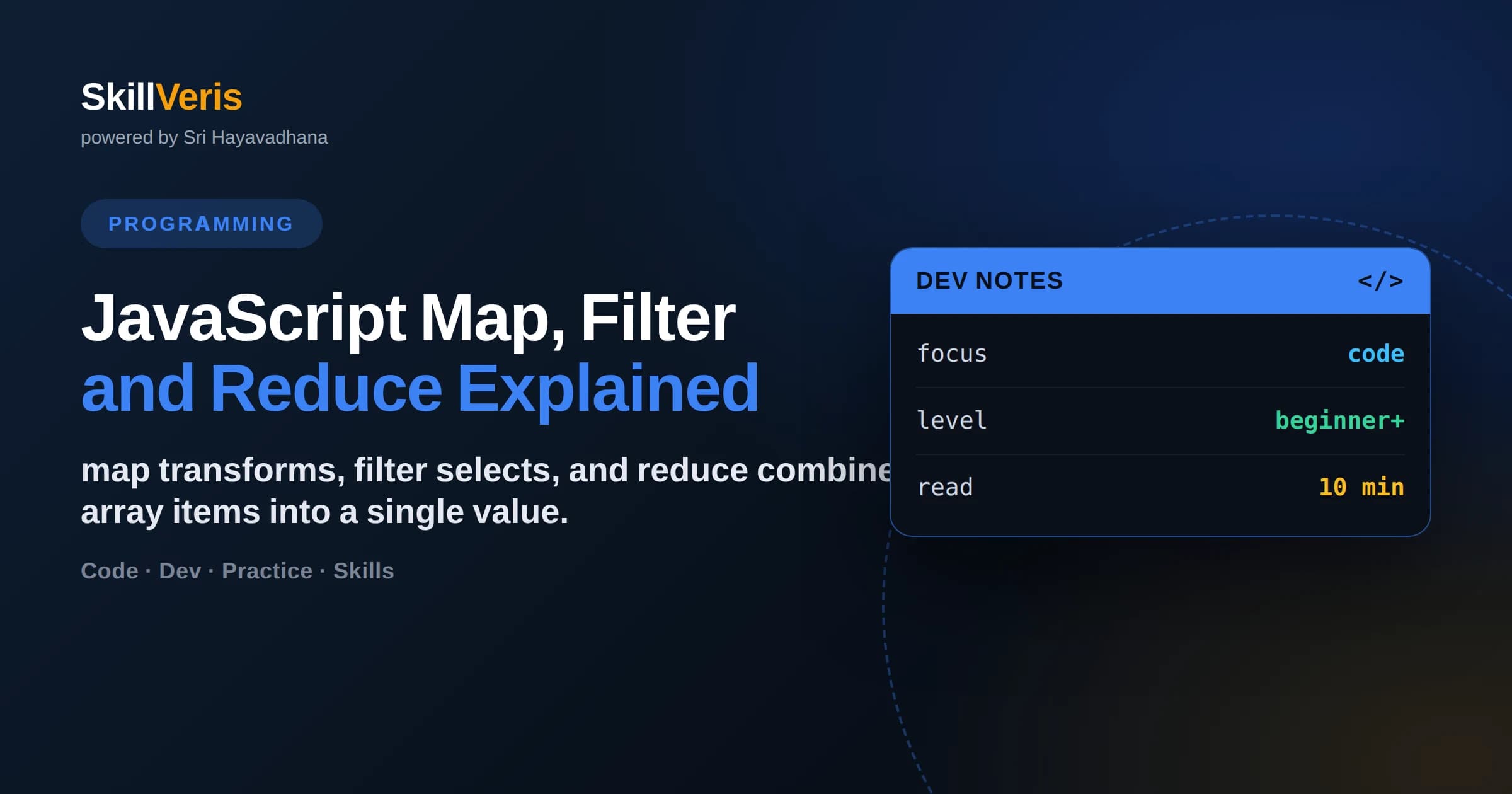
JavaScript Map, Filter and Reduce Explained

SV

SkillVeris Team

Engineering Team

Jul 27, 2025 10 min read
Share:
JavaScript Map, Filter and Reduce Explained
Key Takeaway

map, filter, and reduce are array methods that transform, select, and combine elements without manual loops, returning new values instead of mutating the original.

In this guide, you'll learn:

  • map creates a new array by applying a function to every element, always the same length as the original.
  • filter creates a new array containing only the elements that pass a test.
  • reduce boils an array down to a single value — a sum, an object, or even another array — using an accumulator.
  • Because they return new arrays, these methods chain naturally and support immutable data patterns.

1What Are map, filter, and reduce?

map, filter, and reduce are three built-in array methods that let you process data declaratively instead of with manual for loops. map transforms each element into a new one, filter keeps only the elements that pass a test, and reduce combines all elements into a single result. Each takes a callback and, except for reduce's single value, returns a new array without changing the original.

Together they cover most array work you will ever do. Rather than writing a loop, a temporary array, and an index, you describe what you want — transform, select, or combine — and the method handles the mechanics. The result is shorter, clearer code that reads like a description of intent.

2map: Transform Every Element

map produces a new array by running a function on each element of the original. The new array is always the same length — one output per input. Use it whenever you want to convert a list into another list of the same size, such as extracting a field or reshaping objects.

  • const doubled = [1, 2, 3].map(n => n * 2) # [2, 4, 6]
  • const names = users.map(u => u.name) # pull one field from each
  • const cards = users.map(u => ({ id: u.id, label: u.name })) # reshape objects

💡Pro Tip

If your callback does not return a value for every element, map fills those slots with undefined. Reach for filter instead when you want to drop items, not transform them.

3filter: Keep What Matches

filter builds a new array from only the elements for which the callback returns a truthy value. The callback is a test — return true to keep an element, false to drop it. The result can be shorter than the original, or even empty, but it never transforms the values it keeps.

  • const evens = [1, 2, 3, 4].filter(n => n % 2 === 0) # [2, 4]
  • const active = users.filter(u => u.isActive) # keep active users
  • const found = items.filter(i => i.name.includes(query)) # simple search

4reduce: Combine Into One Value

reduce is the most powerful and the most misunderstood of the three. It walks through the array carrying an accumulator, combining each element into that running result, and returns the final accumulator. It takes two arguments: the reducer callback and the initial value of the accumulator.

Although reduce is often shown summing numbers, it can build almost anything — an object, a grouped structure, a flattened array, or a maximum. Whenever you need to turn many values into one, reduce is the tool. Always provide the initial value to avoid surprising behaviour on empty arrays.

  • const sum = [1, 2, 3].reduce((acc, n) => acc + n, 0) # 6
  • const total = cart.reduce((acc, item) => acc + item.price, 0)
  • const byRole = users.reduce((acc, u) => { (acc[u.role] ||= []).push(u); return acc }, {})

The Accumulator

The accumulator is the value carried from one step to the next. Its starting value, the second argument to reduce, also decides the result type — 0 for a sum, {} for an object, [] for an array. Forgetting to return the accumulator from the callback is the classic reduce bug.

5Chaining Them Together

Because map and filter each return a new array, you can chain them into a readable pipeline. A common pattern filters a list down, transforms what remains, and reduces it to a single figure — all in one expression that reads top to bottom like a description of the data flow.

Chaining keeps intermediate steps out of your way, though each link does create a new array. For very large datasets that matters, but for the everyday collections most apps handle, the clarity is well worth it.

  • const total = orders
  • .filter(o => o.status === 'paid') # keep paid orders
  • .map(o => o.amount) # take the amounts
  • .reduce((acc, n) => acc + n, 0) # sum them

7Common Mistakes to Avoid

These methods are approachable, but a few pitfalls catch people out, especially with reduce.

  • Forgetting to return the accumulator in a reduce callback, which yields undefined.
  • Omitting reduce's initial value, causing errors or wrong results on empty arrays.
  • Using map when you mean filter — map keeps the length and inserts undefined for skipped items.
  • Relying on map or forEach for side effects when a plain for loop would be clearer.
  • Mutating the original array inside a callback instead of returning new values.

⚠️Watch Out

map always returns an array of the same length. If you find yourself returning undefined for some elements to skip them, you actually want filter, or filter then map.

8Key Takeaways

These three methods replace most manual loops with clear, intention-revealing code.

  • map transforms every element and returns a new array of the same length.
  • filter keeps only elements that pass a test, returning a possibly shorter array.
  • reduce combines all elements into one value using an accumulator and an initial value.
  • They return new values, so they chain naturally and support immutable patterns.
  • Always return the accumulator and provide an initial value when using reduce.

9Frequently Asked Questions

Q: What is the difference between map and filter? A: map transforms every element and always returns an array of the same length. filter tests each element and returns a new array containing only those that pass, so it can be shorter. Use map to change values and filter to select them.

Q: When should I use reduce instead of a loop? A: Use reduce when you are combining an array into a single result — a sum, an object, a grouping. It expresses that intent clearly. For plain side effects with no accumulated result, a for loop or forEach is often clearer.

Q: Why does my reduce return undefined? A: The most common cause is forgetting to return the accumulator from the callback. Each step must return the value that carries into the next. Also make sure you passed an initial value as the second argument.

Q: Do map, filter, and reduce change the original array? A: No. All three leave the original array untouched and return new values. That immutability is why they chain well and fit patterns in frameworks like React that avoid mutating data.

📄

Get The Print Version

Download a PDF of this article for offline reading.

About the Publisher

SV

SkillVeris Team

Engineering Team

Our engineering writers turn abstract code concepts into hands-on, project-driven learning experiences.

View all posts

Never miss an update

Get the latest tutorials and guides delivered to your inbox.

No spam. Unsubscribe anytime.

Frequently Asked Questions

21 categories · pick one to explore

Does SkillVeris have a tech blog, and what does it cover?
Yes, the SkillVeris blog has over 500 articles covering AI and machine learning, programming, web development, DevOps, cloud, security, databases and career guidance. Articles are practical and answer-first, and many use the Learn Through Hobbies approach, teaching technical concepts through cricket, music, gaming or cooking analogies. Everything is free to read.
What is the SkillVeris tech glossary and how big is it?
The SkillVeris glossary is a free reference of roughly 2,000-plus technology terms, each with a clear plain-language definition. It spans AI, programming, web, DevOps, cloud, security and database vocabulary, so whenever a lesson, article or job description uses jargon you do not recognise, the glossary gives you a fast, reliable answer.
Are the developer cheat sheets on SkillVeris free to download?
The cheat sheets are completely free to use, like everything else on SkillVeris. Each sheet condenses a language or tool into its essential syntax, commands and patterns for quick reference while coding. They are designed for rapid lookup during real work, complementing the deeper explanations found in study notes and courses.
Which programming references and cheat sheets are available?
Cheat sheets cover the platform's main domains, including programming languages, AI and ML tooling, web development, DevOps, cloud, security and databases, matching the topics of the 37 live courses. Each sheet lists related reading links and hashtags, so you can jump from a quick reference into fuller study notes or blog articles.
How do I find the meaning of a technical term quickly?
Search the SkillVeris glossary, which holds around 2,000-plus terms with concise, plain-language definitions. Each entry gets to the point in its first sentence, then links to related reading like blog posts or study notes for deeper context. It is faster and more consistent than sifting through scattered search results.
Is the SkillVeris blog good for beginners learning to code?
Yes, many blog articles are written specifically for beginners, and the Learn Through Hobbies style makes them unusually approachable: you might learn Python concepts through cricket or understand APIs through cooking. With 500-plus articles across skill levels, beginners can start with fundamentals and keep reading as they advance, entirely free.
Can cheat sheets replace full courses for learning a language?
No, cheat sheets are references, not teaching tools; they assume you already understand the concepts and just need syntax or commands fast. To actually learn a language, take a structured SkillVeris course with its 24–40 lessons and assessments, then keep the cheat sheet beside you while practising in Code Lab.
How often are new blog articles published on SkillVeris?
The blog grows regularly and already exceeds 500 articles, with new posts added as courses launch and technologies evolve. Topics track the platform's catalogue across AI, programming, web development, DevOps, cloud and security, so checking the Blog section periodically surfaces fresh tutorials, explainers and career-focused pieces, all free to read.
Does the glossary cover AI and machine learning terms?
Yes, AI and machine learning vocabulary is a major part of the roughly 2,000-plus term glossary, covering everything from foundational terms to modern concepts around LLMs, RAG and MLOps. Definitions are plain-language and answer-first, which helps when dense AI papers or course lessons throw unfamiliar jargon at you.
Are there cheat sheets for interview preparation?
Cheat sheets work well as interview-day refreshers because they compress syntax, commands and key concepts into scannable references. For dedicated preparation, combine them with the SkillVeris interview questions feature, which includes readiness scoring, plus study notes for depth. Reviewing a relevant cheat sheet just before an interview steadies recall under pressure.
Can I read the tech blog without signing up?
Yes, the blog is freely readable, and SkillVeris never charges for content. All 500-plus articles are open, covering tutorials, concept explainers and career advice. Creating a free account adds value elsewhere on the platform, like course progress tracking and certificates, but reading the blog requires no commitment at all.
How is the SkillVeris glossary different from Wikipedia?
The glossary is purpose-built for learners: definitions are short, plain-language and answer-first, sized for a quick lookup mid-lesson rather than a deep encyclopedic read. Entries also cross-link to related SkillVeris study notes, blog posts and courses, so a definition becomes a doorway into structured learning instead of a dead end.
Do blog articles use the Learn Through Hobbies method?
Many blog articles teach technical topics through hobby analogies, a hallmark of the SkillVeris blog, so you will find articles explaining programming through cricket, machine learning through music, or system design through cooking. The analogy is the teaching device; the article still delivers the real technical concept underneath.
Where can I find quick programming references while coding?
Open the SkillVeris cheat sheets, which are built exactly for that moment: compact, scannable references for syntax, commands and common patterns across languages and tools. Keep the relevant sheet in a browser tab while you work in Code Lab or your own editor, and dip into the glossary for terminology.
Is there a glossary entry for terms I meet in job descriptions?
Very likely yes, with roughly 2,000-plus terms across AI, programming, web, DevOps, cloud, security and databases, the glossary covers most jargon that appears in tech job descriptions. Decoding a listing this way helps you judge role fit honestly and prepares you to discuss those terms in interviews.
Are the blog articles written for the Indian tech audience?
The blog serves Indian learners plus a worldwide audience. Content stays globally relevant while acknowledging realities that matter in India, such as free access being essential for students and freshers, and career guidance that connects naturally to the SkillVeris jobs portal, which aggregates roles across India, UK, USA, Germany and Remote.
Can I suggest a topic for the blog or glossary?
SkillVeris content grows in response to what learners need, so feedback is welcome through the platform's support channels. If a term is missing from the glossary or a topic deserves an article, telling the team helps prioritise it. Meanwhile, the AI Mentor can answer the question immediately, 24/7, at any depth.
Do cheat sheets and glossary entries link to deeper learning?
Yes, every cheat sheet and glossary entry carries related reading links into study notes, blog articles and courses, plus concept hashtags for discovering similar content. This cross-linking means a thirty-second lookup can smoothly become a structured learning session whenever you decide you want more than a quick answer.
What makes SkillVeris programming references trustworthy?
The references are written to strict internal quality standards, kept consistent with the platform's 37 live courses, and never padded with invented statistics or hype. Definitions and cheat sheets are reviewed against the same content contracts that govern courses, and the answer-first style makes any inaccuracy easy to spot and correct.
How do the blog, glossary and cheat sheets fit into my learning routine?
Use them as satellites around your main course: read blog articles for context and motivation, hit the glossary the instant jargon appears, and keep cheat sheets open while coding. Together with study notes, Code Lab and the 24/7 AI Mentor, they turn passive reading into a complete, free learning system.

What Learners Say

Real journeys from the SkillVeris community — swipe for more.

SkillVeris taught me Python through Cricket. Now I’m building real projects and feeling confident!
Arjun S. · B.Tech Student
The best platform for hobby-based learning. Concepts finally stick.
Priya R. · Data Analyst
I went from zero coding to a portfolio of projects — all by learning through my love for gaming. Landed my first internship!
Kabir M. · CS Undergraduate
Trending Topics50 popular tags — tap to explore
Trending CoursesAll 37 free courses — tap to browse