How to Secure Your Cloud Infrastructure
SkillVeris Team
Cloud & Security Team
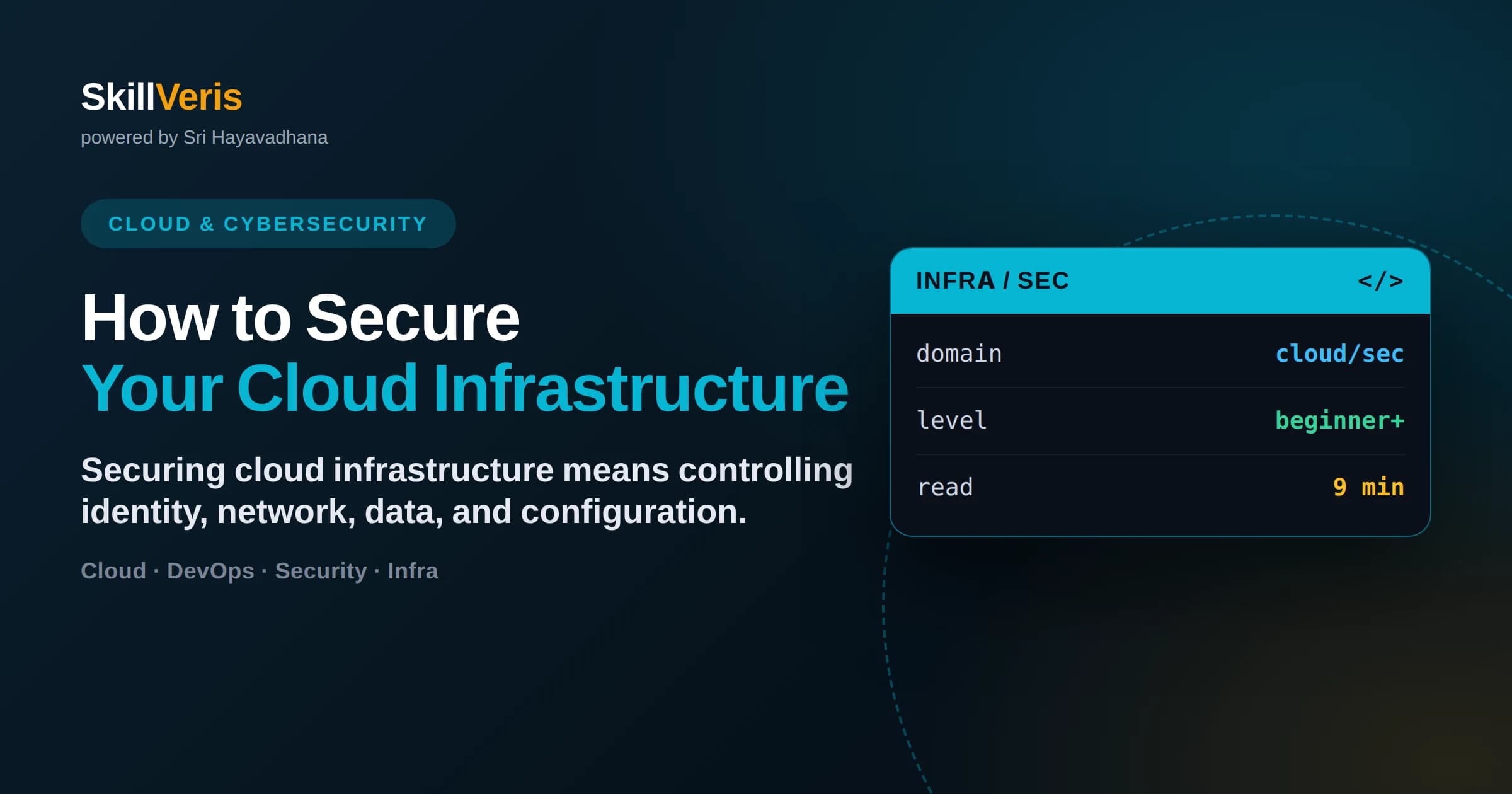
Securing cloud infrastructure means locking down identity, network, data, and configuration under the shared responsibility model.
In this guide, you'll learn:
- The provider secures the cloud itself; you are responsible for security in the cloud — your data, access, and settings.
- Identity and access management with least privilege and MFA is the single highest-impact control you can apply.
- Most cloud breaches come from misconfiguration — public storage buckets, open ports, and over-permissive roles.
- Encrypt data in transit and at rest, and centralize logging so you can detect and investigate incidents.
1How to Secure Cloud Infrastructure
Securing cloud infrastructure means systematically controlling four things: who can access it (identity), how systems connect (network), how information is protected (data), and how everything is set up (configuration). Because the cloud is programmable, most of these controls are settings you configure rather than hardware you install — which makes them powerful but easy to get wrong.
The good news is that the biggest wins are well understood. Tight identity management, private-by-default networking, encryption, and automated configuration checks eliminate the majority of real-world risk. The rest is disciplined, continuous attention rather than any single silver bullet.
3Lock Down Identity First
Identity and access management (IAM) is the most important control in the cloud, because stolen or over-privileged credentials are behind a huge share of incidents. Get identity right and you close the most common door.
Least Privilege
Grant each user, service, and role only the permissions it genuinely needs, and nothing more. Avoid wildcard permissions and broad administrator roles. Review access regularly and remove what is unused.
Strong Authentication
Require multi-factor authentication for every human, especially administrators. Use short-lived credentials and roles for applications instead of long-lived access keys, and never embed secrets in code or container images.
4Harden the Network
A well-designed network limits what an attacker can reach even if they get a foothold. The principle is private by default: expose only what must be public.
- Place databases and internal services in private subnets with no direct internet route.
- Restrict security groups to specific ports and source ranges — never leave SSH or RDP open to 0.0.0.0/0.
- Put a load balancer or web application firewall in front of public services.
- Use private endpoints so traffic to cloud services never traverses the public internet.
- Segment environments so development cannot reach production.
💡Pro Tip
Run a periodic scan for publicly exposed resources. Cloud providers offer built-in tools that flag open buckets, public IPs, and overly broad firewall rules automatically.
5Protect Your Data
Data protection ensures that even if someone reaches your storage, the contents remain useless to them. Encryption and access control work together here.
Enable encryption at rest for all storage and databases — most providers make this a single setting or even a default. Enforce encryption in transit with HTTPS and TLS everywhere. Manage encryption keys with a dedicated key management service, and keep tightly controlled, tested backups so ransomware or accidental deletion can't wipe you out.
- Encryption at rest: enable it on every bucket, disk, and database.
- Encryption in transit: enforce TLS on all endpoints.
- Key management: use the provider's KMS with rotation and access policies.
- Backups: automated, encrypted, and periodically restore-tested.
6Configuration and Monitoring
Since misconfiguration is the leading cause of cloud incidents, catching mistakes automatically is essential. Pair that with logging so you can see what happened when something goes wrong.
- Enable audit logging (such as CloudTrail or its equivalents) across all accounts and regions.
- Centralize logs so they can't be tampered with and are searchable during an incident.
- Use cloud security posture tools to continuously flag risky configurations.
- Set alerts for suspicious activity like new admin users or unusual data egress.
- Define baselines with infrastructure as code so every environment is consistent.
Automate With Infrastructure as Code
Defining your infrastructure in code with Terraform or similar tools makes security repeatable. Reviewers can catch an open port in a pull request, and scanning tools can check the code before anything is deployed — far cheaper than fixing it in production.
7Common Mistakes to Avoid
The same handful of errors appear in breach after breach. Guarding against them removes most of your exposure.
- Leaving storage buckets or databases publicly accessible.
- Using long-lived access keys and hardcoding them in code or repositories.
- Granting broad administrator permissions instead of least privilege.
- Skipping MFA on administrator and root accounts.
- Disabling or never reviewing audit logs, leaving you blind during an incident.
⚠️Watch Out
Your cloud root account is the keys to the kingdom. Enable MFA on it, avoid using it for daily work, and create separate least-privilege accounts for everything else.
8Key Takeaways
Securing the cloud comes down to a few high-leverage practices.
- Understand the shared responsibility model — the provider secures the platform, you secure what's on it.
- Identity is the top priority: least privilege plus MFA everywhere.
- Keep the network private by default and expose only what must be public.
- Encrypt data in transit and at rest, and back it up reliably.
- Automate configuration and logging so security is continuous and repeatable.
9Frequently Asked Questions
Q: Whose responsibility is cloud security? A: It is shared. The provider secures the underlying infrastructure — data centers, hardware, and core services — while you are responsible for your data, access controls, network configuration, and application settings. The exact split depends on the service type.
Q: What causes most cloud breaches? A: Misconfiguration and identity problems, not sophisticated hacking. Publicly exposed storage, over-permissive access, leaked credentials, and missing MFA account for a large share of real-world cloud incidents.
Q: Do I need to encrypt data if it is already in the cloud? A: Yes. The provider's physical security does not protect your data from stolen credentials or misconfiguration. Enable encryption at rest and in transit and manage your keys — it is usually a simple setting with a big payoff.
Q: What is the single most impactful thing I can do? A: Get identity right. Enforcing least-privilege access and requiring multi-factor authentication, especially for administrators and the root account, closes the most commonly exploited path into cloud environments.
Related Reading
Get The Print Version
Download a PDF of this article for offline reading.
About the Publisher
SkillVeris Team
Cloud & Security Team
Our cloud and security experts break down complex infrastructure topics into practical, beginner-friendly guides.
View all postsRelated Posts
Never miss an update
Get the latest tutorials and guides delivered to your inbox.
No spam. Unsubscribe anytime.