How to Optimize React Performance
SkillVeris Team
Engineering Team
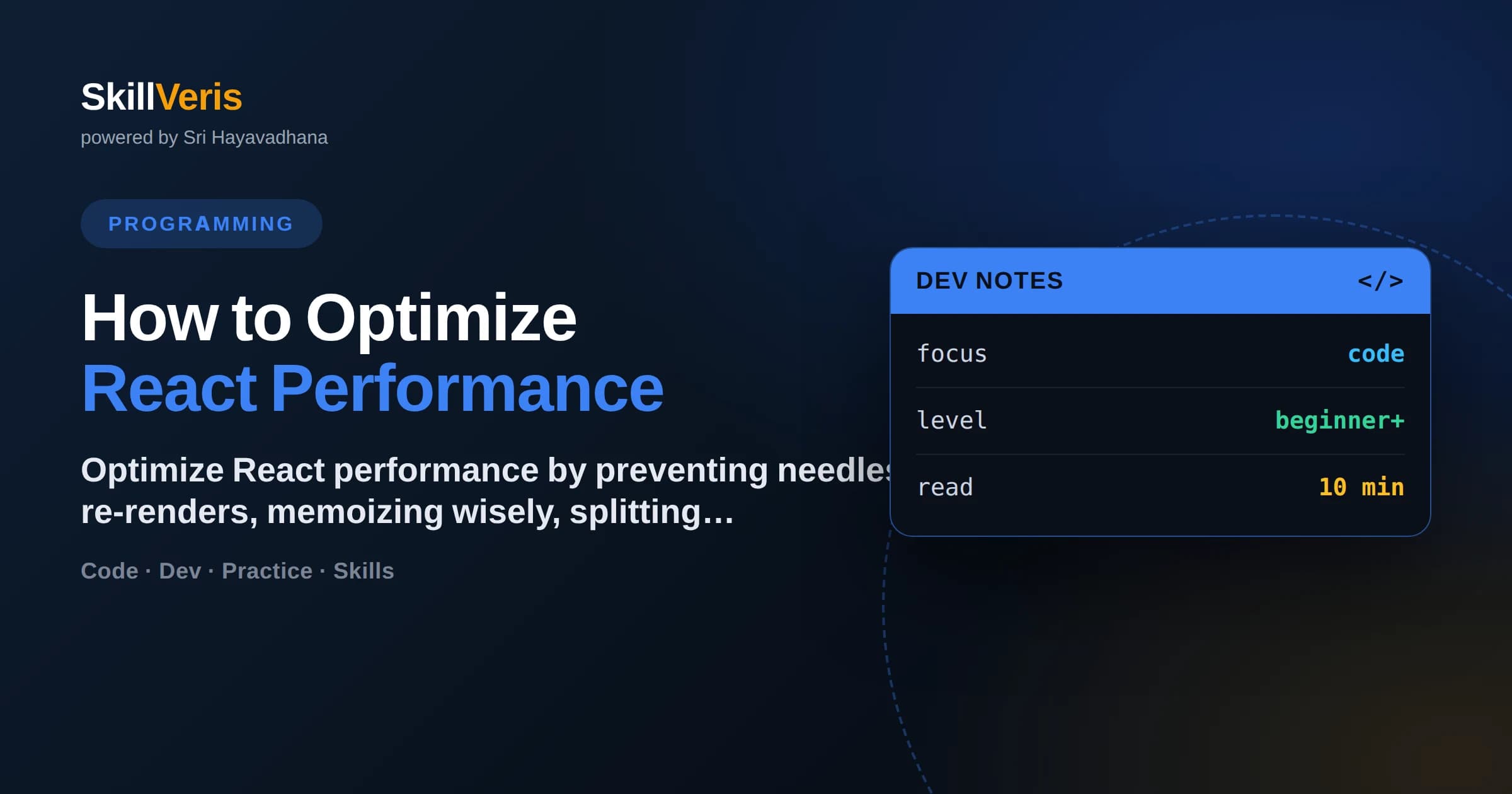
Optimize React performance by measuring first, then cutting unnecessary re-renders, splitting code, and virtualizing long lists.
In this guide, you'll learn:
- React.memo, useMemo, and useCallback prevent wasted work, but only help when a render is genuinely expensive.
- Code splitting with React.lazy and Suspense shrinks the initial bundle so pages load faster.
- Virtualize long lists so only visible rows render instead of thousands of DOM nodes.
- Stable keys and avoiding inline object props keep the reconciler efficient.
1How to Optimize React Performance
You optimize React performance by first measuring where time actually goes, then eliminating unnecessary re-renders, reducing bundle size with code splitting, and virtualizing large lists. The order matters: profile before you change anything, because most perceived slowness comes from a few hotspots, not the whole app.
React is fast by default, so optimization is about avoiding waste rather than squeezing microseconds. Unnecessary component re-execution, oversized JavaScript bundles, and rendering thousands of DOM nodes are the usual culprits, and each has a well-known fix.
2Measure Before You Optimize
Guessing at performance problems wastes effort and adds complexity. The React DevTools Profiler records renders and shows exactly which components rendered, how long they took, and what triggered them.
- Open the Profiler tab in React DevTools and record an interaction.
- Look for components that render often or take a long time in the flame graph.
- Check 'why did this render' to see whether props, state, or a parent caused it.
- Use the browser Performance panel and Lighthouse for load-time and Core Web Vitals data.
🔑Profile, Then Fix
Optimizations add code and complexity. Only apply them where the profiler proves a real cost, or you trade readability for no measurable gain.
3Cut Unnecessary Re-Renders
The most common React slowdown is components re-rendering when their output has not changed. React re-renders a component when its state or props change, or when its parent re-renders, and that can cascade down a tree.
React.memo
Wrapping a component in React.memo skips its re-render when its props are unchanged by reference. It helps for components that are expensive to render or that re-render often due to an unrelated parent update.
const Row = React.memo(function Row({ item }) { ... });
Only re-renders when item changes by reference.
Pointless if the component is cheap or its props change every render anyway.
useMemo and useCallback
useMemo caches an expensive computed value, and useCallback caches a function reference so memoized children do not re-render. Both take a dependency array like useEffect.
const sorted = useMemo(() => heavySort(items), [items]);
const handleClick = useCallback(() => doThing(id), [id]);
Pass stable callbacks to React.memo children so the memo actually holds.4Split Your Bundle
A large JavaScript bundle delays the first paint because the browser must download and parse it all before the app runs. Code splitting breaks the bundle into chunks loaded on demand, so users only download what a page needs.
- const Dashboard = React.lazy(() => import('./Dashboard')) # lazy-load a route
- <Suspense fallback={<Spinner />}><Dashboard /></Suspense> # show a fallback while loading
- Split by route so each page is its own chunk.
- Defer heavy, rarely used widgets like rich editors or charts until they are opened.
💡Split by Route First
Route-based splitting gives the biggest win for the least effort. Each page loads its own chunk, so the landing page no longer ships the entire app's code.
5Virtualize Long Lists
Rendering thousands of rows creates thousands of DOM nodes, which is slow to mount and scroll. List virtualization renders only the rows currently visible in the viewport plus a small buffer, recycling nodes as you scroll.
Libraries handle the math for you. The result is a list that feels instant whether it has a hundred rows or a hundred thousand, because the DOM only ever holds a screenful at a time.
- react-window: lightweight virtualization for lists and grids.
- react-virtuoso: virtualization with dynamic row heights and grouping.
- TanStack Virtual: a headless virtualizer that works with any markup.
- Combine virtualization with pagination or infinite scroll for very large datasets.
6Common Mistakes to Avoid
Optimization can backfire when applied blindly. These mistakes either add complexity for nothing or actively hurt performance.
- Memoizing everything before measuring, adding overhead and clutter with no real gain.
- Passing inline objects or arrow functions as props, breaking React.memo on children.
- Using array index as a key, which defeats efficient list reconciliation.
- Storing derived data in state instead of computing it during render.
- Shipping large libraries when a small utility or native feature would do.
⚠️Premature Optimization Costs
Wrapping cheap components in memo and useCallback adds its own bookkeeping cost and makes code harder to read. Optimize the hotspots the profiler reveals, not everything.
7Place State Wisely
Where state lives has a big effect on how much re-renders. State high in the tree re-renders everything below it on every change, even components that do not use that state. Moving state down to where it is actually used shrinks the affected subtree.
Two techniques help. Colocate state in the smallest component that needs it, and lift it up only when siblings must share. When a fast-changing value is trapped high in the tree, extract the piece that uses it into its own component so only that piece re-renders.
- Colocate state in the component that uses it to limit re-render scope.
- Lift state only as high as the nearest common parent that needs to share it.
- Push frequently updating state into a small child component.
- Use composition to pass children through, so a re-rendering parent does not re-render static children.
🔑Children Skip Re-renders
A parent that re-renders does not re-render children it received via props, because those elements were created by the grandparent. Passing children down is a free optimization.
8Key Takeaways
React performance work is mostly about avoiding waste in the right places. These principles cover the essentials.
- Measure with the Profiler before optimizing; fix proven hotspots only.
- Cut needless re-renders with React.memo, useMemo, and useCallback where a render is costly.
- Split the bundle by route with React.lazy and Suspense to speed up first load.
- Virtualize long lists so only visible rows render.
- Use stable keys and avoid inline object props to keep reconciliation efficient.
9Frequently Asked Questions
Q: When should I use React.memo? A: Use React.memo on components that are expensive to render or that re-render frequently because of an unrelated parent, and whose props stay the same by reference. For cheap components or ones whose props change every render, memo adds overhead without benefit.
Q: What is the difference between useMemo and useCallback? A: useMemo caches a computed value so an expensive calculation does not run on every render. useCallback caches a function reference so memoized children do not re-render. useCallback(fn, deps) is essentially useMemo(() => fn, deps).
Q: How do I make a huge list scroll smoothly? A: Use list virtualization with a library like react-window or TanStack Virtual so only the rows visible in the viewport render, instead of creating thousands of DOM nodes. Combine it with pagination or infinite scroll for very large datasets.
Q: Does code splitting really speed things up? A: Yes, for initial load. Splitting by route means the browser only downloads the JavaScript for the page a user visits, rather than the whole app. This shrinks the first bundle and improves metrics like Largest Contentful Paint.
Related Reading
Get The Print Version
Download a PDF of this article for offline reading.
About the Publisher
SkillVeris Team
Engineering Team
Our engineering writers turn abstract code concepts into hands-on, project-driven learning experiences.
View all postsRelated Posts

Never miss an update
Get the latest tutorials and guides delivered to your inbox.
No spam. Unsubscribe anytime.