Hash Tables Explained: The Data Structure You Use Daily
SkillVeris Team
Engineering Team
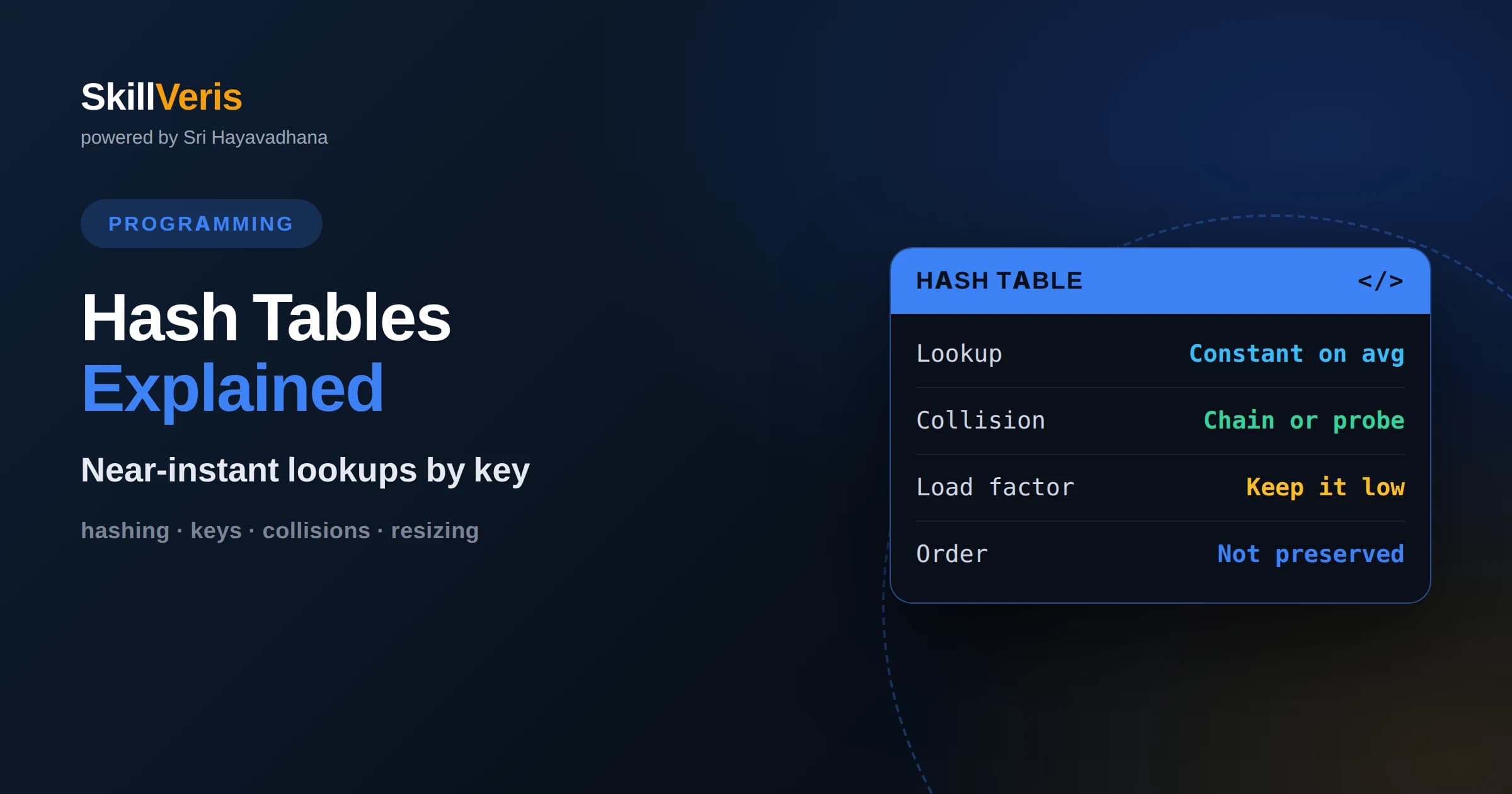
A hash table stores key-value pairs and retrieves any value almost instantly by running its key through a hash function that computes where to look.
In this guide, you'll learn:
- Lookups, insertions, and deletions are typically constant time on average, which is why hash tables underpin dictionaries and maps in nearly every language.
- Collisions, where two keys map to the same slot, are unavoidable and are handled by strategies like chaining or open addressing.
- Good performance depends on a solid hash function, keeping the table from getting too full, and resizing as it grows.
1What Is a Hash Table?
A hash table is a data structure that stores pairs of keys and values and lets you retrieve a value almost instantly using its key. You give it a key, such as a username, and it returns the associated value, such as that user's profile, in roughly constant time no matter how many entries the table holds.
The magic comes from a hash function, which takes a key and computes a number that points to a specific slot in an underlying array. Because the position is calculated directly from the key rather than searched for, the table can jump straight to where a value lives instead of scanning through everything.
This combination of key-based access and near-instant speed makes the hash table one of the most useful structures in all of programming. It is the workhorse behind lookups, caches, deduplication, and countless features you use without noticing.
2You Already Use Them Every Day
Even if you have never written the words hash table, you use them constantly. Dictionaries, maps, and associative arrays built into programming languages are hash tables underneath, and objects in many languages store their properties in hash-table-like structures. Whenever you look something up by a name or identifier, a hash table is likely doing the work.
Beyond your own code, hash tables power the systems around you. Databases use them to index records, caches use them to remember recent results, and network systems use them to route and deduplicate data. Their fingerprints are everywhere in software.
This ubiquity is exactly why they are worth understanding deeply. A structure you rely on dozens of times a day rewards even a little knowledge of how it works and where its limits lie.
3The Hash Function
At the heart of a hash table is the hash function, a procedure that turns a key of any kind into a number within the range of the table's underlying array. This number, often called a hash code, is then reduced to a valid slot index, typically by taking the remainder when divided by the array's size.
A good hash function spreads keys evenly across the available slots, so that different keys tend to land in different places. It should also be fast to compute, since it runs on every lookup and insertion. When these qualities hold, the table's operations stay close to constant time.
A poor hash function that clumps many keys into a few slots destroys performance, because the table degenerates toward scanning. Fortunately, the built-in hash tables you use every day come with well-designed hash functions, so you usually benefit from this quality without having to build it yourself.
4How a Lookup Works
To retrieve a value, the hash table runs the key through the hash function to compute a slot, then goes directly to that slot in the underlying array. If the key stored there matches the one you asked for, it returns the value. This direct jump is what gives hash tables their signature speed.
Insertion works the same way. The table computes the slot for the new key and stores the key-value pair there. Deletion also computes the slot and removes the entry. In each case the hash function does the hard work of turning a key into a location, so the table avoids searching.
Because every operation begins with a single computation and a direct access, the average cost does not grow as the table fills, which is the property that makes hash tables so valuable. The catch, addressed next, is what happens when two keys want the same slot.
5Collisions Are Unavoidable
Because a hash function squeezes a vast range of possible keys into a limited number of slots, it is inevitable that two different keys will sometimes compute the same slot. This is called a collision, and it is not a bug but a fundamental fact of hashing that every table must handle.
Collisions are not rare curiosities either. Even with a good hash function and a table that is only partly full, some collisions will occur, and their frequency rises as the table gets more crowded. A hash table's design is largely about handling collisions gracefully so that performance stays strong.
Two main strategies exist for dealing with collisions, and understanding them explains most of how real hash tables behave. Both aim to keep operations fast even when several keys compete for the same location.
6Collision Strategy One: Chaining
The first strategy, called separate chaining, stores a small collection, often a linked list, at each slot instead of a single entry. When multiple keys hash to the same slot, they all go into that slot's collection, and a lookup scans the short collection to find the exact key it wants.
Chaining is simple and robust. As long as the collections stay short, which they do when the table is not too full, lookups remain fast because each collection holds only a handful of entries. It also handles a growing number of entries gracefully without complex bookkeeping.
The downside is a little extra memory for the collections and slightly slower access than a direct hit, since a short scan is sometimes needed. Even so, chaining is a common and dependable choice, especially when the number of entries is hard to predict in advance.
7Collision Strategy Two: Open Addressing
The second strategy, called open addressing, keeps every entry directly in the array itself. When a key's preferred slot is already taken, the table probes other slots in a defined sequence until it finds an empty one, and it uses the same sequence later to find the key again.
Open addressing can be very memory-efficient and cache-friendly because everything lives in one contiguous array with no separate collections. When the table has plenty of empty slots, probing finds a home quickly and performance is excellent.
Its sensitivity is to fullness. As the array approaches capacity, probes take longer because empty slots become scarce, and performance degrades faster than with chaining. Open-addressed tables therefore rely heavily on keeping a healthy fraction of the array empty.
8Load Factor and Resizing
The fraction of a hash table's slots that are occupied is called the load factor. As the load factor rises, collisions become more frequent and operations slow down. Keeping the load factor below a sensible threshold is essential to preserving the table's near-constant-time performance.
To manage this, hash tables resize themselves. When the table gets too full, it allocates a larger underlying array and rehashes all existing entries into it, recomputing each one's slot for the new size. This spreads the entries out again and restores fast operations.
Resizing is occasionally expensive because every entry must be moved, but it happens rarely enough that the average cost per operation stays low over the life of the table. This is why hash tables can grow smoothly from a few entries to millions while keeping lookups fast.
9Keys, Equality, and Immutability
For a hash table to work, keys must support two things: computing a stable hash code and comparing for equality. The hash code decides which slot to check, and equality confirms whether a stored key truly matches the one you asked for, which is what makes chaining and probing correct.
A crucial rule is that a key's hash code must not change while it is in the table. If you use a mutable object as a key and then modify it in a way that changes its hash, the table will compute a different slot and lose track of the entry. This is why simple, immutable values like strings and numbers make ideal keys.
Two keys that are considered equal must also produce the same hash code, or the table cannot find them reliably. Respecting these rules keeps a hash table correct, and violating them causes mysterious bugs where values seem to vanish.
10Strengths and Limitations
Hash tables excel at fast lookups, insertions, and deletions by key, and that strength covers an enormous range of everyday programming needs. When your main operation is finding a value by its identifier, few structures come close.
Their limitation is ordering. Hash tables do not keep entries in any meaningful order, so they are poor at tasks that need sorted traversal, finding the smallest or largest key, or answering range queries. For those needs, a tree-based structure is a better fit.
The average constant-time performance is also a statistical promise, not an absolute guarantee. A bad hash function or an unlucky pattern of keys can slow things down, though well-built tables make this extremely uncommon in practice.
It is worth remembering that the constant-time promise describes the average across many operations, not every single one. An occasional resize or a burst of collisions can make one particular operation slower, even though the long-run average stays low. For the vast majority of applications this smoothing is exactly what you want.
11When to Reach for a Hash Table
Reach for a hash table whenever you need to associate keys with values and look them up quickly, which is a surprisingly frequent need. Counting occurrences, caching results, removing duplicates, grouping items by a property, and building fast indexes are all classic hash-table jobs.
If instead you need to keep data sorted, repeatedly find minimums or maximums, or ask range questions, prefer an ordered structure like a balanced tree. And if you only ever access items by position in a sequence, a plain array is simpler and more compact.
Matching the structure to the operation you perform most is the core skill. For key-based access, the hash table is almost always the right and obvious answer, which is exactly why you use it every day.
13Explore Hashing on SkillVeris
Hash tables make the most sense when you build one and watch it behave. Try implementing a small hash table with chaining, deliberately force some collisions, and observe how the load factor and resizing affect its speed. Then compare using a built-in dictionary for a counting or caching task to feel its convenience.
On SkillVeris, guided lessons and exercises walk you through hashing, collision handling, and resizing with clear, hands-on examples. Building your intuition for how this everyday structure works under the hood will make you a sharper, more confident programmer across every project you take on.
Get The Print Version
Download a PDF of this article for offline reading.
About the Publisher
SkillVeris Team
Engineering Team
Our engineering writers turn abstract code concepts into hands-on, project-driven learning experiences.
View all postsRelated Posts


Never miss an update
Get the latest tutorials and guides delivered to your inbox.
No spam. Unsubscribe anytime.