Go vs Python for Backend Development
SkillVeris Team
Engineering Team
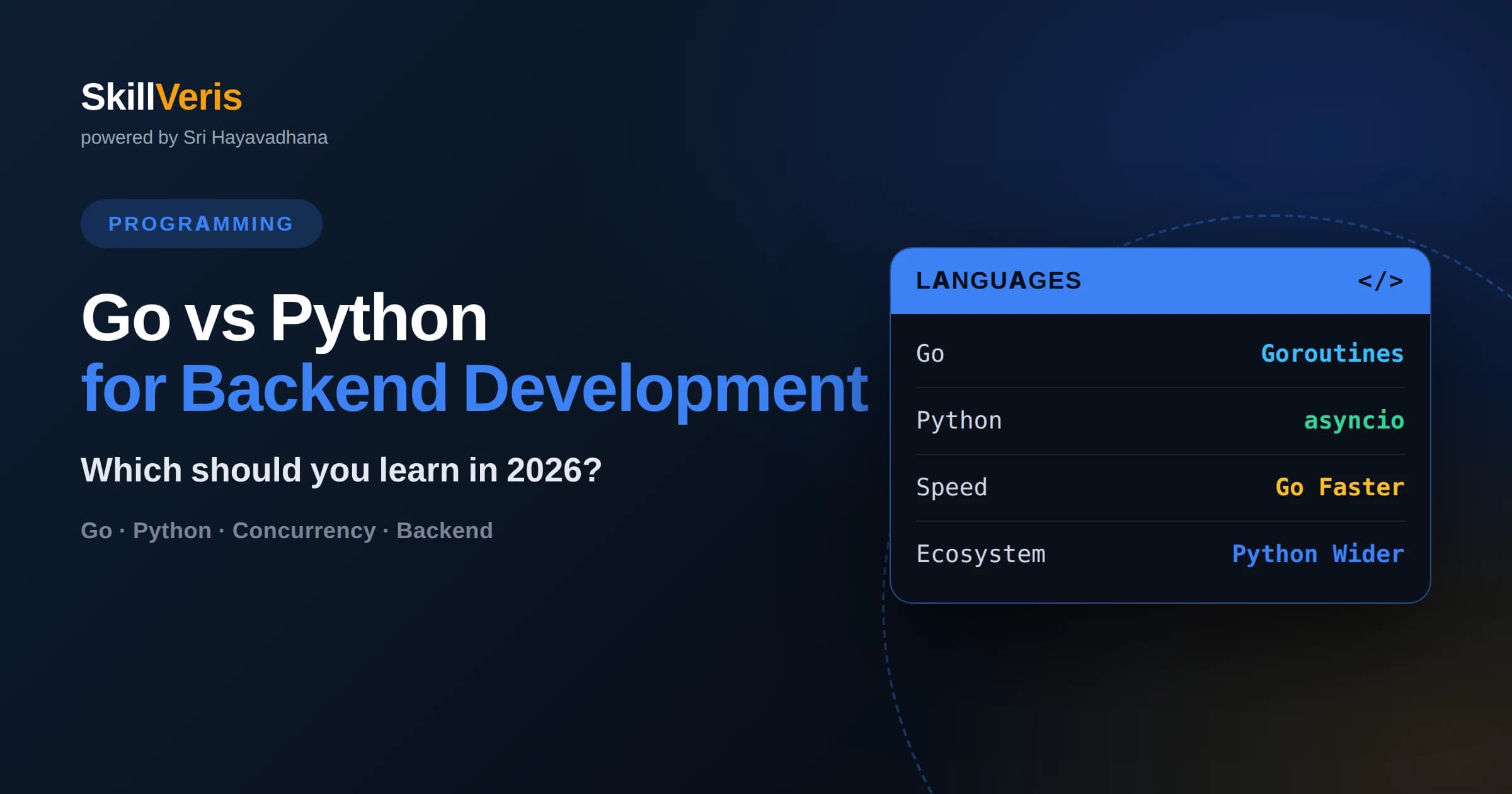
Go compiles to a single static binary and was designed by Google specifically for concurrent, networked backend services.
In this guide, you'll learn:
- Python trades raw execution speed for developer velocity, readability, and the largest general-purpose library ecosystem in software.
- Goroutines let Go handle tens of thousands of concurrent connections with a fraction of the memory overhead of OS threads.
- Python's Global Interpreter Lock (GIL) limits true CPU-bound parallelism within a single process, though asyncio handles I/O-bound concurrency well.
- Go dominates infrastructure tooling, cloud-native platforms, and CLI utilities, while Python dominates data pipelines, machine learning, and rapid API prototyping.
1Go vs Python for Backend Development: Which Should You Learn First?
Learn Python first if you want faster ramp-up, broader job options, and a bridge into data and AI work; learn Go first if you know you're headed toward high-performance infrastructure, distributed systems, or cloud platform engineering.
Both languages are excellent, mature choices for backend development in 2026, and both show up constantly in job postings, but they solve different problems well. Go was built at Google in 2009 specifically to make concurrent network services fast, safe, and easy to deploy. Python has spent three decades becoming the most approachable general-purpose language in the world, with a library ecosystem that touches nearly every domain of computing.
This guide breaks down the real differences that matter when you're choosing what to learn: how the languages think about correctness and typing, how they handle concurrency and performance under load, how quickly you can actually ship working code, where each one dominates in production systems today, and a concrete decision framework based on your career goals rather than abstract language trivia.
2How Do Go and Python Differ in Language Philosophy?
Go and Python differ philosophically because Go is a statically typed, compiled language that prioritizes explicitness and predictability, while Python is a dynamically typed, interpreted language that prioritizes expressiveness and speed of writing.
Go requires you to declare types for variables, function parameters, and return values, and the compiler checks all of it before your program ever runs. This catches an entire category of bugs — passing a string where an integer is expected, forgetting to handle an error path — at compile time instead of in production. Go also intentionally has a small feature set: no inheritance, no generics until relatively recently, no exceptions (errors are explicit return values you must check). The language designers optimized for code that many engineers can read and modify safely, even years after the original author has moved on.
Python takes the opposite bet. Variables don't need declared types, functions can return different shapes of data depending on context, and the language gives you multiple paradigms — object-oriented, functional, procedural — often in the same file. Type hints exist and are increasingly used in serious codebases via tools like mypy and pydantic, but they're optional annotations checked by external tooling, not the compiler. This makes Python faster to prototype in and more forgiving for beginners, at the cost of certain classes of bugs only surfacing at runtime, sometimes in production.
- Go: compiled, statically typed, explicit error handling, minimal syntax surface
- Python: interpreted, dynamically typed, exception-based error handling, expressive multi-paradigm syntax
- Go favors long-term codebase stability over short-term writing speed
- Python favors short-term writing speed and optionally adds type safety via mypy/pydantic
3Which Language Performs Better for Concurrent Backend Workloads?
Go performs better than Python for CPU-bound and highly concurrent workloads because it compiles to native machine code and uses lightweight goroutines instead of OS threads, while Python's Global Interpreter Lock restricts true multi-core parallelism within a single process.
Concurrency is where the golang vs python conversation gets most concrete. Go's goroutines are managed by the Go runtime rather than the operating system, so you can spin up thousands of them with minimal memory overhead, and the built-in scheduler multiplexes them efficiently across CPU cores. Combined with channels for safe communication between goroutines, Go makes it straightforward to write a server that handles a large number of simultaneous connections without the complexity of manual thread pools or callback chains.
Python's concurrency story is more nuanced. The GIL means only one thread executes Python bytecode at a time per process, so CPU-bound multithreading doesn't scale the way it does in Go. But most backend workloads are I/O-bound — waiting on databases, network calls, disk reads — and Python's asyncio event loop (used by frameworks like FastAPI) handles that pattern very well, achieving high throughput despite the GIL. For genuinely CPU-heavy work, Python developers reach for multiprocessing, or push the hot path into C extensions (which is exactly how NumPy and most ML libraries stay fast). The practical takeaway: Go gives you concurrency performance by default; Python gives you good-enough I/O concurrency with asyncio and requires extra architectural decisions for CPU-bound scaling.
4Which Language Lets You Build and Ship Backend Features Faster?
Python generally lets you build and ship backend features faster than Go because its syntax requires less boilerplate, its ecosystem has a mature library for almost any task, and its frameworks (Django, Flask, FastAPI) handle enormous amounts of scaffolding automatically.
This is less about raw typing speed and more about cognitive overhead. Building a CRUD API in FastAPI or Django can take a fraction of the code Go requires, because Python frameworks bundle ORM layers, authentication, admin panels, serialization, and validation into batteries-included packages. Go's standard library is intentionally minimal, and its ecosystem philosophy favors composing small, focused packages (like chi or gin for routing, sqlc or gorm for database access) rather than one monolithic framework — which gives you more control but more decisions to make up front.
The tradeoff shows up later in the project lifecycle. Python's flexibility can let subtle bugs and inconsistent interfaces creep into large codebases without discipline (type hints and linting help but aren't enforced by the runtime). Go's verbosity and stricter compiler catch more of that class of error automatically, which tends to pay off as a codebase and team grow, even though it costs more typing on day one.
5Where Does Go Dominate vs Where Does Python Dominate in Production?
Go dominates infrastructure software, cloud-native platforms, networking tools, and CLI utilities, while Python dominates data engineering, machine learning, scripting, and rapid API development — and both are common choices for general web backends.
Go's fingerprints are all over the modern cloud-native stack: container orchestration platforms, service meshes, infrastructure-as-code tools, and countless CLI utilities are written in Go, largely because it produces single static binaries with no runtime dependencies, making distribution trivially easy, and because its concurrency model fits network-heavy infrastructure code naturally. Companies building high-throughput APIs, payment systems, or services where p99 latency directly affects revenue frequently choose Go for the services that sit on the critical path.
Python's dominance is different in shape but arguably broader in reach. It is the default language for data science and machine learning, which means most AI/ML backend work — model serving, data pipelines, feature engineering, experimentation — happens in Python by default, often via frameworks like FastAPI wrapping PyTorch or scikit-learn models. It's also the go-to for scripting, automation, DevOps tooling, and rapid internal tooling, because you can go from idea to working script faster than in almost any other language. For general-purpose web backends outside the AI space, Python (Django, FastAPI) and Go both compete directly with each other and with other ecosystems, and the choice often comes down to team preference and existing infrastructure rather than a hard technical requirement.
- Go strongholds: container/orchestration tooling, service meshes, CLI tools, high-throughput networking services, cloud infrastructure
- Python strongholds: machine learning and AI pipelines, data engineering, scripting/automation, rapid-prototyped APIs, scientific computing
- Contested middle ground: general web APIs, microservices, internal platform tooling — either language works well
6How Should You Decide Which Language to Learn for Backend Development?
Decide by working backward from your target job or project: choose Go if you're aiming at infrastructure, platform, or high-performance systems roles, and choose Python if you're aiming at AI/ML, data, or fast-moving product engineering roles — or learn both if you want maximum flexibility.
If your goal is a career in cloud infrastructure, site reliability engineering, or building performance-critical distributed systems, Go is the more direct path — you'll be working in the same language as the tools you're deploying and operating. If your goal involves any adjacency to machine learning, data pipelines, analytics, or you want to move fast building and iterating on products, Python's ecosystem removes friction at every step, and its dominance in AI tooling means it's very unlikely to become less relevant.
A pragmatic middle path many backend engineers take in 2026: start with Python to build fluency in core backend concepts (HTTP, databases, authentication, APIs, testing) because the syntax gets out of your way while you learn those ideas, then add Go once you understand the concepts and want to see how a stricter, more performance-oriented language expresses the same ideas. The concepts transfer; the syntax is the easy part once you understand what a backend actually needs to do. Neither choice is a dead end — engineers move between the two constantly depending on what a given project demands.
7Frequently Asked Questions
Q: Is Go harder to learn than Python for a complete beginner? A: Yes, generally — Go's static typing and explicit error handling require more upfront understanding of concepts like types and pointers, while Python's forgiving syntax lets true beginners write working code sooner.
Q: Can Python be fast enough for production backend systems? A: Yes for the vast majority of backend workloads, which are I/O-bound rather than CPU-bound; frameworks like FastAPI with asyncio handle high request volumes well, and CPU-heavy work can be offloaded to C-extension libraries or separate services.
Q: Do I need to learn Go if I already know Python for backend work? A: Not necessarily — many successful backend careers stay entirely in Python, especially in data and AI-adjacent roles, but learning Go becomes valuable if you move toward infrastructure, high-throughput services, or teams that have standardized on it.
Q: Which language has better job availability in 2026? A: Python has a broader overall footprint across web, data, and AI roles, while Go has a smaller but often more specialized and infrastructure-focused set of openings; both are healthy, in-demand skills.
Q: Is Go a replacement for Python in machine learning? A: No — Python's ML ecosystem (training frameworks, notebooks, data tooling) is so deeply entrenched that Go is rarely used for model development, though it sometimes appears in surrounding infrastructure like high-performance inference servers.
Q: Should I learn both languages eventually? A: Many experienced backend engineers do, since the two cover complementary strengths — Python for velocity and ecosystem breadth, Go for performance and operational simplicity — and understanding both broadens the kinds of teams and problems you can work on.
Related Reading
Get The Print Version
Download a PDF of this article for offline reading.
About the Publisher
SkillVeris Team
Engineering Team
Our engineering writers turn abstract code concepts into hands-on, project-driven learning experiences.
View all postsRelated Posts
Never miss an update
Get the latest tutorials and guides delivered to your inbox.
No spam. Unsubscribe anytime.