Full-Stack Java Developer Roadmap 2026
SkillVeris Team
Engineering Team
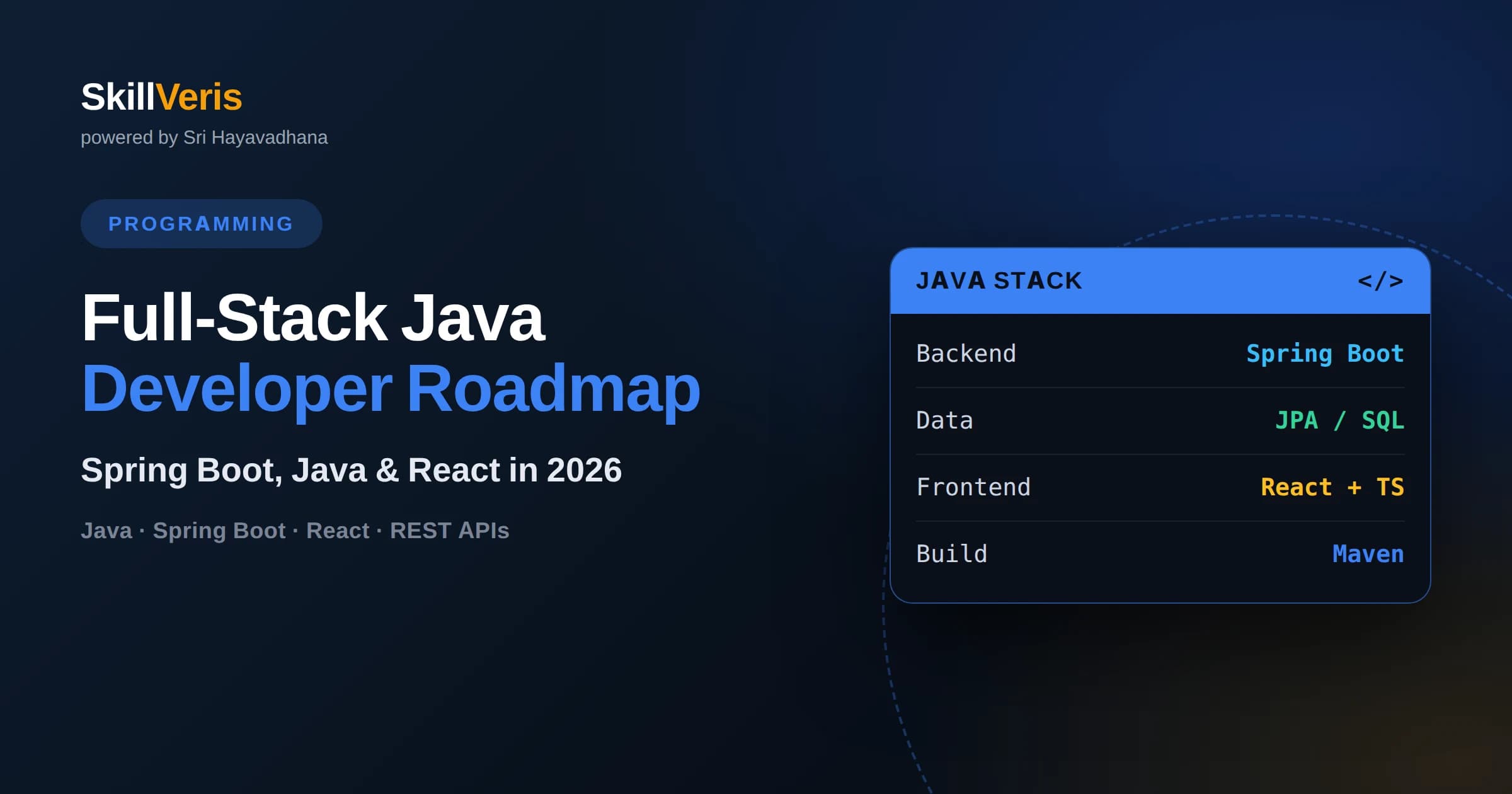
Core Java (OOP, collections, streams, exceptions) must be solid before touching any framework, or every Spring Boot concept feels like magic.
In this guide, you'll learn:
- Spring Boot remains the default enterprise Java backend framework in 2026, handling dependency injection, REST APIs, and data access with minimal boilerplate.
- JPA and Hibernate abstract SQL, but full stack Java developers still need to read execution plans and write raw SQL to debug slow queries.
- React with TypeScript is the most common frontend pairing for Java backends, communicating over versioned, JSON-based REST APIs.
- Maven or Gradle plus Docker are non-negotiable: they turn a laptop project into something a real team can build, test, and deploy consistently.
1What Is the Full-Stack Java Developer Roadmap for 2026?
The full-stack Java developer roadmap for 2026 has five stages in order: core Java fundamentals, the Spring Boot backend stack, relational databases and SQL, a modern frontend (React with TypeScript), and the build/deployment tooling (Maven or Gradle, Docker) that ties it all together for a real team environment.
Java has stayed relevant for full-stack work for one simple reason: it scales. Startups prototype in it, and large enterprises run mission-critical systems on it for decades, which means the demand for developers who can move fluently between a Java backend and a JavaScript-based frontend has not slowed down. What has changed is the shape of the stack itself — Spring Boot has absorbed most of the manual configuration that used to define "enterprise Java," and React (often with TypeScript) has become the default frontend partner instead of server-rendered JSP pages.
This guide lays out the java developer roadmap 2026 employers and teams actually expect, in the sequence it should be learned, with a realistic month-by-month plan at the end. It skips the theoretical detours and focuses on what you need to ship a working, deployable, full stack java developer project.
2Core Java Fundamentals You Need Before Any Framework
You need a solid grip on object-oriented programming, the collections framework, streams, generics, and exception handling before opening a single Spring Boot tutorial, because every framework decision in Spring is built on top of these primitives, and skipping them turns configuration into memorization.
Start with the language mechanics: classes, interfaces, inheritance versus composition, and access modifiers. Then move into the standard library pieces you'll use daily — ArrayList vs. LinkedList vs. HashMap, when to reach for a Set, and how equals()/hashCode() actually affect map and set behavior. From there, the Streams API and lambda expressions deserve real practice time; modern Java code (and modern Spring Boot code especially) leans heavily on functional-style collection processing instead of manual loops.
Exception handling is where a lot of self-taught developers stay shallow. Understand the difference between checked and unchecked exceptions, when to create custom exception types, and how try-with-resources manages resource cleanup — this pays off directly once you're writing database and file-handling code in a Spring service layer.
Finally, get comfortable with generics and basic concurrency (threads, the ExecutorService, and at least a conceptual understanding of the java.util.concurrent package). You won't write multithreaded code constantly as a web developer, but Spring Boot applications are inherently concurrent under the hood, and being able to reason about thread safety will save you from confusing bugs later.
- OOP: classes, interfaces, inheritance vs. composition
- Collections: List, Set, Map implementations and trade-offs
- Streams API and lambda expressions for functional-style processing
- Exception handling: checked vs. unchecked, custom exceptions, try-with-resources
- Generics and basic concurrency fundamentals
3The Java Backend Stack: Spring Boot, REST APIs, and JPA/Hibernate
The modern Java backend stack centers on Spring Boot for application structure, Spring Web (or Spring MVC) for building REST APIs, and Spring Data JPA with Hibernate for talking to a relational database — together they cover roughly 90% of what a backend service needs without hand-writing boilerplate configuration.
Any spring boot tutorial worth following starts with dependency injection and inversion of control, because that's the core idea the rest of the framework is built around: you declare what a class needs, and Spring wires the concrete implementation in at runtime. Once that clicks, the annotation-driven style of Spring Boot (@RestController, @Service, @Repository, @Autowired or constructor injection) stops feeling arbitrary and starts feeling like a consistent pattern.
For REST APIs, focus on getting the fundamentals right before adding complexity: proper use of HTTP verbs and status codes, request/response DTOs (never expose your database entities directly), input validation with Bean Validation annotations, and centralized exception handling via @ControllerAdvice so your API returns consistent error shapes instead of stack traces.
JPA and Hibernate handle the object-relational mapping layer — turning Java objects into database rows and back — through entity classes, repositories, and either derived query methods or JPQL. Learn how relationships (@OneToMany, @ManyToOne, @ManyToMany) map to foreign keys, and understand lazy vs. eager loading early; it's the single most common source of performance surprises in Spring Data JPA applications. Round this stage out with Spring Security basics (authentication, JWT-based stateless auth for APIs) and an introduction to testing with JUnit and Mockito, since untested services are hard to refactor with confidence.
- Dependency injection and inversion of control in Spring
- REST controllers, DTOs, validation, and centralized exception handling
- Spring Data JPA repositories and JPQL
- Entity relationships and lazy vs. eager loading
- JWT-based API authentication with Spring Security
- Unit and integration testing with JUnit and Mockito
4Databases and SQL Every Java Developer Should Master
A full stack Java developer needs working SQL fluency independent of JPA, because ORMs generate queries automatically but don't automatically generate fast ones, and debugging a slow endpoint almost always means reading the actual SQL and its execution plan.
Start with core relational database design: normalization, primary and foreign keys, indexes, and how joins work under the hood. PostgreSQL and MySQL are the two most common choices behind Spring Boot applications, and both are worth installing locally rather than only interacting with a database through an ORM abstraction.
Once you're comfortable writing SELECT, JOIN, GROUP BY, and subquery logic by hand, connect that knowledge back to JPA: learn to read the SQL Hibernate generates (enable SQL logging in development), recognize the N+1 query problem, and know when to reach for a JOIN FETCH or a projection instead of letting the ORM lazily trigger dozens of extra queries. This is also the point to introduce database migration tools like Flyway or Liquibase, since real teams never modify schema by hand against a shared database — every schema change is a versioned, reviewable migration script.
- Relational design: normalization, keys, indexes, joins
- Hands-on SQL: SELECT, JOIN, GROUP BY, subqueries
- Reading Hibernate-generated SQL and spotting the N+1 problem
- Schema versioning with Flyway or Liquibase
5The Frontend Side: React and TypeScript for a Java Backend
React with TypeScript is the standard frontend pairing for a Spring Boot backend, communicating exclusively through the JSON REST APIs the backend exposes — the frontend never talks to the database directly, which is exactly the separation that makes a full stack Java developer's two halves independently testable and deployable.
You don't need to master frontend engineering to the same depth as the backend, but you do need real competence: components and props, hooks (useState, useEffect, and eventually useContext or a state management library for larger apps), and how to structure API calls with fetch or a library like Axios, including handling loading states, errors, and authentication tokens on every request.
TypeScript matters more here than in many other stacks because it lets you mirror your Java DTOs as typed interfaces on the frontend, catching integration bugs (a renamed field, a changed response shape) at compile time instead of at runtime in production. Spend deliberate time on CORS configuration too — it trips up nearly every developer connecting a React dev server to a local Spring Boot API for the first time, and understanding it properly (rather than just disabling security checks) is a mark of someone who understands the client-server boundary.
- Components, props, and core hooks (useState, useEffect)
- Typed API calls with Axios or fetch, mirroring Java DTOs as TypeScript interfaces
- Client-side routing and basic state management
- CORS configuration between a React dev server and Spring Boot API
6Build Tools and Deployment: Maven, Gradle, and Docker
Maven or Gradle manages dependencies and the build lifecycle for your Java project, while Docker packages the finished application into a portable, consistent unit — together they're what separates a project that runs "on your machine" from one a team can actually build, test, and ship.
Maven's XML-based pom.xml is still extremely common in enterprise Java shops and is the default for most Spring Boot starter projects, so learn it first: dependency scopes, the build lifecycle (compile, test, package), and how Spring Boot's Maven plugin produces an executable JAR. Gradle, with its more concise Groovy or Kotlin DSL, is worth learning once Maven feels routine, particularly if you'll work on Android-adjacent or larger multi-module projects.
Docker basics — writing a Dockerfile for a Spring Boot JAR, understanding layers and multi-stage builds to keep images small, and using docker-compose to spin up your app alongside a Postgres or MySQL container — round out the practical skill set. You don't need deep DevOps knowledge, but being able to containerize your own full stack Java project and run it identically on any machine is now a baseline expectation, not a bonus skill.
- Maven fundamentals: pom.xml, dependency scopes, build lifecycle
- When to move from Maven to Gradle
- Dockerfile basics and multi-stage builds for smaller images
- docker-compose for running the app alongside a database container
7A Realistic Month-by-Month Learning Sequence
A realistic timeline to go from zero to a job-ready full stack Java developer is five to seven months of consistent, project-driven practice, front-loaded with core Java and backing off into breadth once the fundamentals hold.
Months one and two: core Java fundamentals — OOP, collections, streams, exceptions, and basic concurrency — reinforced by small standalone programs, not tutorials you just watch. Months three and four: Spring Boot, REST APIs, and JPA/Hibernate, building one non-trivial application (a task manager, a small inventory system, or a booking app) with proper layering, validation, and tests, alongside dedicated SQL practice against a real Postgres or MySQL instance. Month five: React and TypeScript, rebuilding the frontend for that same application so you get real practice wiring authentication, error states, and typed API calls end to end.
Months six and seven (optional but recommended): Docker, CI basics, and a second, slightly more ambitious full stack project built from scratch — this is also the point to revisit and refactor your first project with everything you've since learned. By the end, you should have at least one polished, containerized, end-to-end Java and React application you can walk through in detail, because that project — not a certificate — is what actually demonstrates full stack Java developer capability.
- Months 1-2: Core Java fundamentals through small standalone programs
- Months 3-4: Spring Boot, REST, JPA/Hibernate, and SQL via one real project
- Month 5: React + TypeScript frontend for the same project
- Months 6-7: Docker, CI basics, and a second full stack project
8Frequently Asked Questions
Q: Do I need to learn Java before Spring Boot, or can I learn them together? A: Learn core Java first — OOP, collections, streams, and exceptions — because Spring Boot's annotations and dependency injection only make sense once you understand the plain Java concepts they're abstracting.
Q: Is Spring Boot still the right framework to learn in 2026? A: Yes; Spring Boot remains the dominant framework for enterprise Java backends, with the largest ecosystem, the most job postings referencing it, and the most community resources for troubleshooting.
Q: Do full stack Java developers need to know Angular instead of React? A: Both are used in production, but React (increasingly with TypeScript) has become the more common default pairing with Spring Boot backends in new projects, making it the safer primary choice to learn first.
Q: How much SQL do I really need if I'm using JPA and Hibernate? A: Enough to read and write joins, subqueries, and aggregations by hand and to recognize inefficient generated SQL, since JPA abstracts query writing but not query performance.
Q: Should I learn Maven or Gradle first? A: Learn Maven first, since it's the default build tool for most Spring Boot starter projects and enterprise codebases, then pick up Gradle later if a project or team requires its more flexible DSL.
Q: Is Docker mandatory for a full stack Java developer, or just nice to have? A: It's close to mandatory in practice; most teams containerize Java services and expect developers to write and understand a basic Dockerfile and docker-compose setup, even if dedicated DevOps engineers handle production infrastructure.
Q: What should my portfolio project actually include? A: A Spring Boot REST API backed by a real relational database with proper authentication, a React/TypeScript frontend consuming that API, and a Dockerized setup — that combination demonstrates every layer of the roadmap in one coherent project.
Related Reading
Get The Print Version
Download a PDF of this article for offline reading.
About the Publisher
SkillVeris Team
Engineering Team
Our engineering writers turn abstract code concepts into hands-on, project-driven learning experiences.
View all postsRelated Posts
Never miss an update
Get the latest tutorials and guides delivered to your inbox.
No spam. Unsubscribe anytime.