Dynamic Programming Explained for Beginners
SkillVeris Team
Engineering Team
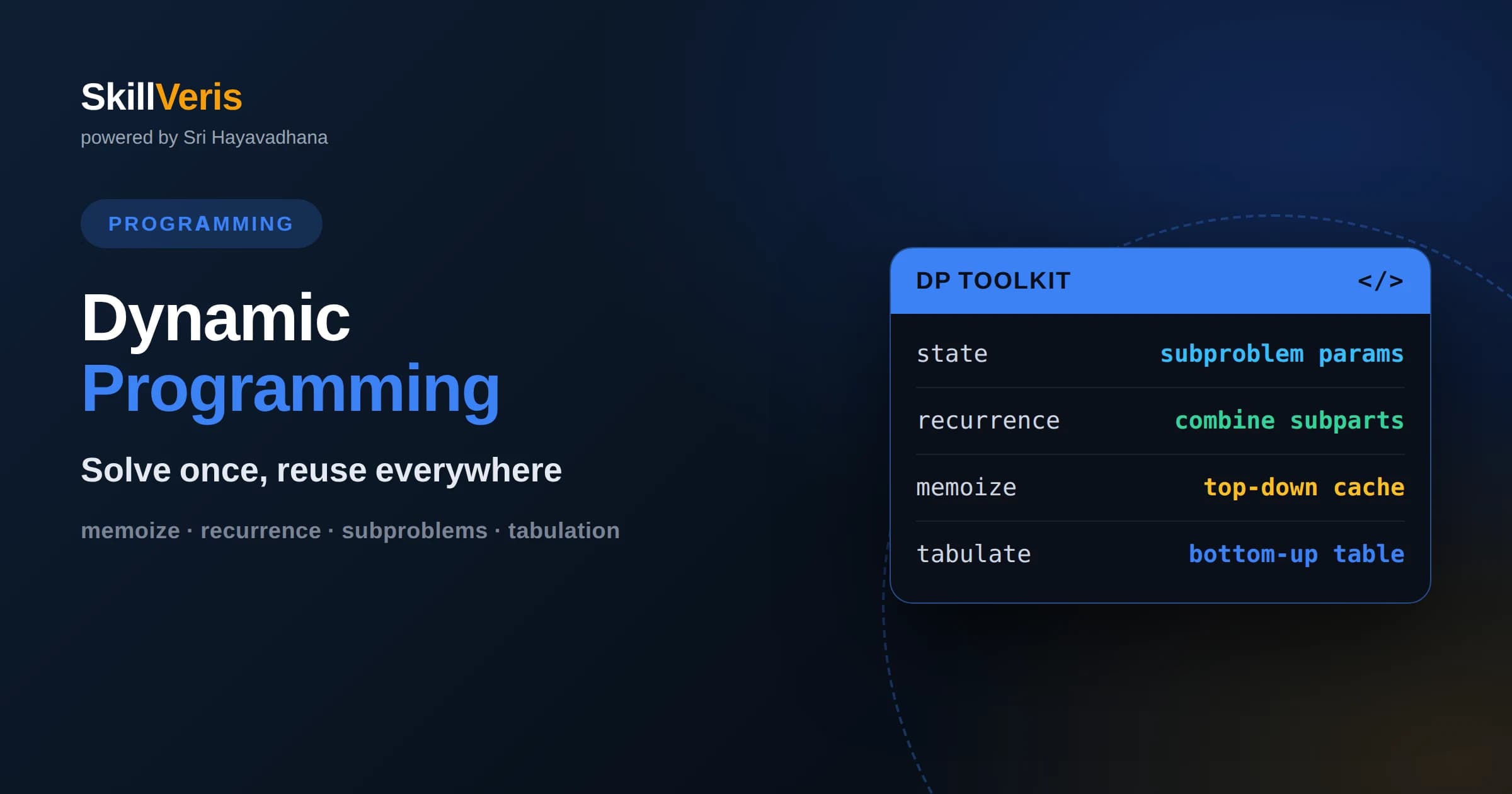
Dynamic programming applies when a problem has overlapping subproblems and optimal substructure, letting you reuse computed answers instead of recomputing them.
In this guide, you'll learn:
- Memoization is top-down caching of recursive results, while tabulation is bottom-up filling of a table; both eliminate redundant work.
- The hardest part is defining the state and the recurrence relation that expresses a solution in terms of smaller solutions.
- Classic examples like Fibonacci, the knapsack problem, and longest common subsequence teach patterns that transfer to countless real problems.
1What Is Dynamic Programming
Dynamic programming is a technique for solving problems by breaking them into smaller subproblems, solving each subproblem once, and storing the result so it never has to be recomputed. It applies specifically when the same subproblems appear again and again, which is exactly the situation where naive recursion wastes enormous amounts of work redoing identical calculations.
The name can be confusing because it has nothing to do with dynamic memory or a programming language. It was coined decades ago, and the word programming here means planning or tabulating, as in a schedule. What matters is the idea: remember what you have already figured out so you never solve the same piece twice.
You can think of dynamic programming as intelligent brute force. Brute force explores every possibility from scratch, redoing enormous amounts of duplicate work. Dynamic programming explores the same space of possibilities but remembers partial results, so the total work collapses to the number of distinct subproblems rather than the number of paths through them. That reframing captures why the technique is so powerful and where its speedups come from.
When you apply dynamic programming correctly, problems that would take exponential time with brute force often drop to polynomial time. That transformation is dramatic and is why the technique is a staple of interviews, competitive programming, and real production systems dealing with optimization.
2The Two Properties You Need
Dynamic programming only works when a problem has two properties. The first is overlapping subproblems, meaning the recursive breakdown revisits the same smaller problems many times. If every subproblem is unique, there is nothing to cache and dynamic programming offers no benefit over ordinary recursion.
The second property is optimal substructure, meaning an optimal solution to the whole problem can be built from optimal solutions to its parts. When both properties hold, you can confidently combine cached sub-answers into a correct final answer. Recognizing these two properties is the first skill to develop, because they tell you whether dynamic programming is even the right tool.
It is worth contrasting this with greedy algorithms, which also exploit optimal substructure but commit to a locally best choice at each step without reconsidering. Greedy works only when local choices never need to be revised, whereas dynamic programming considers combinations of choices and keeps the best overall. When a greedy approach gives wrong answers on some inputs, that failure is often the hint that a dynamic programming formulation is required instead.
3The Fibonacci Example
The Fibonacci sequence is the classic teaching example. Each number is the sum of the two before it. A naive recursive definition calls itself twice for every number, and those calls branch out into an exponential tree of repeated work. Computing the fortieth Fibonacci number this way can involve hundreds of millions of redundant calls.
The subproblems overlap heavily: computing the tenth number requires the ninth and eighth, but computing the ninth also requires the eighth, and so on. If you store each Fibonacci value the first time you compute it, every later request is instant. The exponential explosion collapses into a simple linear pass, and this single insight captures the entire spirit of dynamic programming.
4Memoization: Top Down
Memoization is the top-down flavour of dynamic programming. You write the natural recursive solution, but before doing any work you check a cache to see whether you have already computed the answer for the current inputs. If you have, you return the stored value immediately. If not, you compute it, store it, and then return it.
This approach is intuitive because it preserves the readable recursive structure you would write anyway. You simply bolt on a lookup table, often a dictionary or an array keyed by the subproblem parameters. Memoization only computes the subproblems it actually needs, which can be an advantage when large portions of the state space are never reached.
The cost is recursion depth and function-call overhead. For very deep problems the call stack can grow large, and in some languages that risks a stack overflow. When that becomes a concern, the bottom-up alternative is often a better fit.
5Tabulation: Bottom Up
Tabulation is the bottom-up flavour. Instead of starting from the big problem and recursing down, you start from the smallest base cases and iteratively build up to the answer you want, filling a table as you go. Each entry is computed from entries you have already filled, so by the time you need a value it is guaranteed to be ready.
Tabulation avoids recursion entirely, which sidesteps call-stack limits and function-call overhead. It often runs faster in practice and makes the order of computation explicit. The trade-off is that you must figure out the correct order to fill the table, and you may compute some entries you did not strictly need, unlike memoization which is lazy.
6Defining The State And Recurrence
The genuine difficulty in dynamic programming is not the caching mechanics but the modelling. You must define the state, which is the minimal set of parameters that fully describes a subproblem. For Fibonacci the state is a single number. For a grid path problem it might be a pair of coordinates. Choosing the right state is what makes the whole solution possible.
Once the state is defined, you write the recurrence relation, an equation expressing the answer for a state in terms of the answers to smaller states. You also identify the base cases where the recurrence bottoms out with a known value. Getting the recurrence right is the heart of the craft, and it improves rapidly with practice as you learn to recognize recurring shapes.
7The Knapsack Problem
The knapsack problem is a cornerstone of dynamic programming. You have a set of items, each with a weight and a value, and a bag with a limited capacity. The goal is to choose items that maximize total value without exceeding the capacity. Brute force would try every possible subset, which grows exponentially with the number of items.
Dynamic programming solves it by defining a state over the item index and the remaining capacity. For each item you decide to include it or skip it, taking whichever choice yields more value. By filling a table across items and capacities, you compute the best achievable value efficiently. The knapsack pattern generalizes to budgeting, resource allocation, and many scheduling problems.
8Longest Common Subsequence
Another canonical example is finding the longest common subsequence of two strings, meaning the longest sequence of characters that appears in both in the same relative order but not necessarily contiguously. This underlies diff tools, spell checkers, and bioinformatics sequence alignment.
The state is a pair of positions, one in each string. If the current characters match, the answer extends the best result from the previous positions in both strings. If they do not match, you take the better of skipping a character from either string. Filling this two-dimensional table gives the answer and demonstrates how string problems map naturally onto dynamic programming grids.
9Optimizing Space Usage
Many tabulated solutions only ever look at the previous row or the previous few entries of the table. When that is true, you can throw away older rows and keep just what you need, dramatically reducing memory. Fibonacci, for instance, needs only the last two values rather than the entire sequence.
This space optimization is a valuable second step after you have a correct solution. Write the full table first to get the logic right, then observe which entries the recurrence actually references and compress the storage accordingly. Reducing a two-dimensional table to a couple of one-dimensional arrays is a common and satisfying optimization.
There is a trade-off to be aware of. Once you discard old table entries, you can no longer walk back through them to reconstruct the actual choices that produced the optimal value, only the value itself. If you need the full solution and not just its score, keep enough of the table, or record decision markers separately, so you can trace the path back at the end.
10Reconstructing The Actual Solution
Many problems ask not only for the best value but for the choices that achieve it, such as which items went into the knapsack or which characters form the longest common subsequence. The table you fill holds the optimal values, and you can trace backward through it from the final cell, at each step asking which neighboring entry the value came from, to recover the decisions.
This backtracking step is separate from computing the values and is easy to overlook. A good habit is to first get the optimal value correct, verify it on small inputs, and only then add the reconstruction pass. Keeping the two concerns distinct makes both easier to reason about and to debug.
11Recognizing A Dynamic Programming Problem
With experience you start to sense when dynamic programming applies. Look for problems asking for the maximum, minimum, longest, shortest, or number of ways to do something, especially when choices at each step interact. If you can describe a solution as a sequence of decisions where each decision depends on the results of earlier ones, dynamic programming is likely a fit.
Another strong signal is when a brute-force recursive solution is obvious but far too slow because it recomputes the same states. That is your cue to add memoization or convert to tabulation. Training this recognition is more valuable than memorizing specific solutions, because the shapes repeat across countless problems.
A practical workflow captures this. Start by writing the plain recursion that expresses the problem correctly, ignoring speed entirely. Once it works on small inputs, ask whether it revisits the same arguments, and if it does, add a cache keyed by those arguments. That single change often takes a solution from hopelessly slow to fast, and it teaches you to see the dynamic programming structure hiding inside a naive recursion.
12Avoiding Common Pitfalls
A frequent beginner mistake is applying dynamic programming to problems without overlapping subproblems, adding a cache that never gets a hit and only slows things down. Another is choosing a state that is too large or that fails to capture everything needed, leading to wrong answers because different situations collapse into the same cache key.
Watch your base cases carefully, since an incorrect base case silently corrupts every value built on top of it. And when using tabulation, double-check the fill order so that every entry you read has already been computed. Testing on small inputs where you can trace the table by hand catches most of these errors early.
A subtler trap is premature optimization. Beginners sometimes jump straight to a compressed, space-optimized solution before the basic recurrence is correct, which makes bugs nearly impossible to find. Always get a plain, readable version working and verified first, then optimize. The extra memory of the full table is a small price for the clarity it gives while you are still establishing correctness.
13Practice On SkillVeris
Dynamic programming is a skill built through repetition, not reading. The first few problems feel impossible, then patterns emerge and problems that once looked impenetrable start to feel routine. The turning point comes from working many examples and comparing your recurrence to a known-good one until the modelling instinct clicks.
SkillVeris offers guided dynamic programming exercises that start with Fibonacci and grid paths before advancing to knapsack and sequence problems. Work through them in order, always defining your state and recurrence before writing code, and you will develop the intuition that makes dynamic programming feel less like magic and more like a reliable tool.
Get The Print Version
Download a PDF of this article for offline reading.
About the Publisher
SkillVeris Team
Engineering Team
Our engineering writers turn abstract code concepts into hands-on, project-driven learning experiences.
View all postsRelated Posts
Never miss an update
Get the latest tutorials and guides delivered to your inbox.
No spam. Unsubscribe anytime.