The Core Components of Cloud Computing Explained
SkillVeris Team
Cloud & Security Team
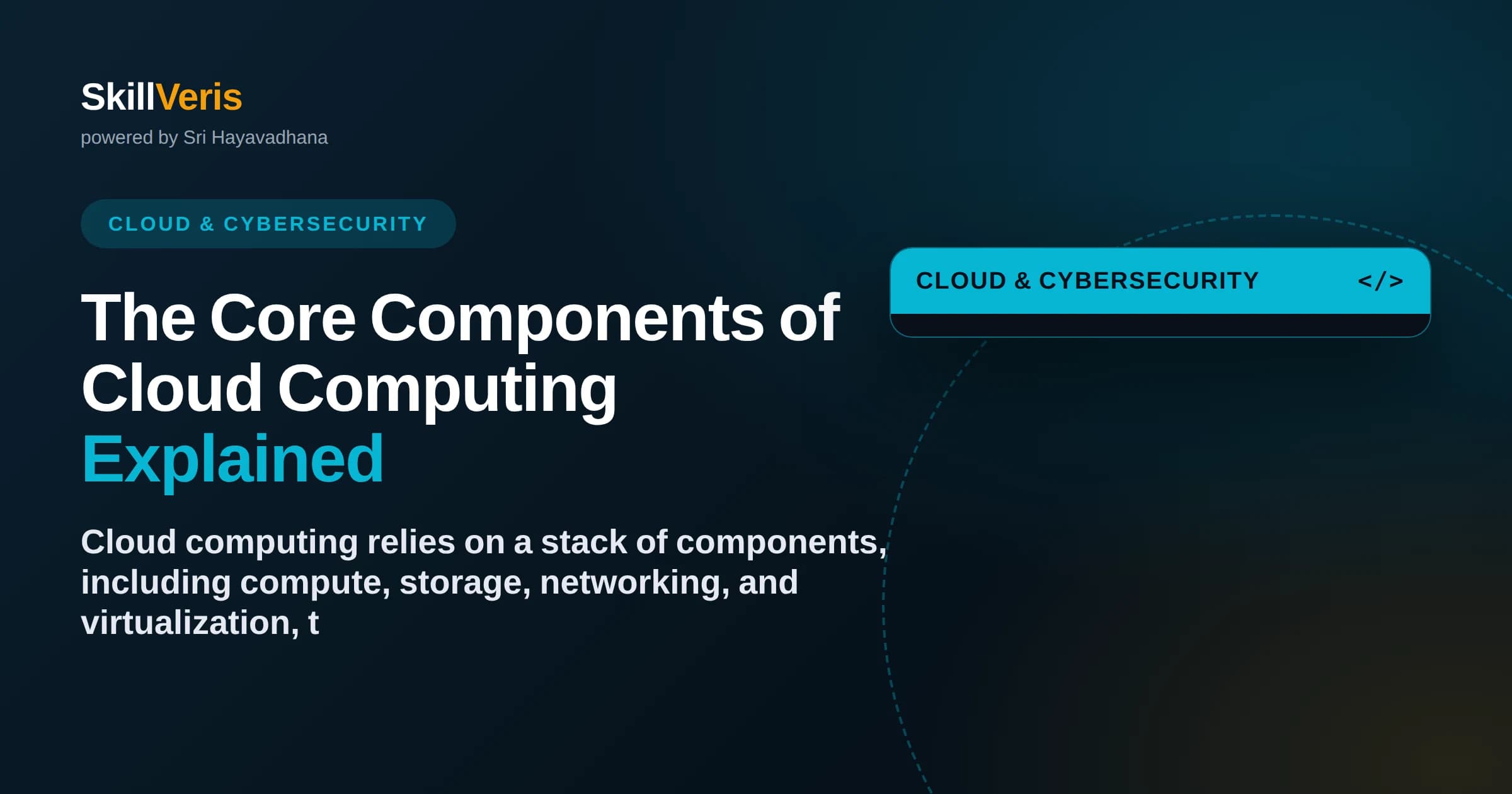
Cloud computing is built from a stack of components: compute, storage, networking, virtualization, and management tools.
In this guide, you'll learn:
- Compute resources, like virtual machines and containers, run the actual applications and workloads.
- Storage components range from block storage for databases to object storage for unstructured files.
- Virtualization is the foundational technology that lets one physical server host many isolated virtual environments.
- Networking components connect cloud resources securely to each other and to the internet.
1What Are the Components of Cloud Computing?
Cloud computing is built from a set of interconnected components, including compute, storage, networking, virtualization, and management tools, that together deliver on-demand IT resources over the internet.
Every cloud service, from hosting a website to running a machine learning pipeline, is assembled from combinations of these underlying building blocks.
2Compute
Compute components provide the processing power that runs applications and workloads, and are typically the first resource provisioned in a cloud environment.
Cloud compute comes in a few common forms, each suited to different workload patterns.
- Virtual machines: full simulated computers with their own operating system, offering flexibility for a wide range of workloads.
- Containers: lightweight, portable units that package an application with its dependencies, sharing the host operating system for efficiency.
- Serverless functions: code that runs in response to events without the developer managing any underlying server.
3Storage
Storage components hold data persistently, and cloud providers offer several types suited to different access patterns.
Block storage behaves like a traditional hard drive attached to a virtual machine, well suited to databases. Object storage holds unstructured files like images and backups at large scale with simple retrieval. File storage provides shared file systems accessible by multiple systems at once.
4Networking
Networking components connect cloud resources to each other and to the outside internet, while controlling who can reach what.
A virtual private cloud isolates a customer's resources into a private network space. Load balancers distribute incoming traffic across multiple compute instances. Content delivery networks cache content closer to end users to reduce latency.
💡
5Virtualization
Virtualization is the foundational technology that makes cloud computing possible, letting a single physical server be divided into multiple isolated virtual environments.
A hypervisor manages this division, allocating a share of the physical machine's CPU, memory, and storage to each virtual machine while keeping them isolated from one another. This is what allows cloud providers to serve many customers efficiently from shared physical hardware.
6Management and Orchestration
Management and orchestration tools let teams provision, monitor, and automate cloud resources rather than configuring everything by hand.
This includes dashboards for monitoring resource usage and cost, infrastructure-as-code tools for defining resources in version-controlled configuration files, and orchestration platforms that automatically scale compute resources up or down based on demand.
7Security Components
Security is embedded across every layer of the cloud stack rather than existing as a single separate component.
Identity and access management controls who can access which resources. Encryption protects data both at rest and in transit. Monitoring and logging tools track activity across the environment to detect unusual behavior.
8How the Components Fit Together
A typical cloud application combines several of these components into a working system.
A web application might run on virtual machines or containers for compute, store user data in a managed database backed by block storage, keep uploaded files in object storage, sit behind a load balancer for traffic distribution, and use a content delivery network to serve static assets quickly worldwide.
9Next Steps
Understanding these core components gives you a mental model for reasoning about cloud architecture, cost, and performance trade-offs on any project.
SkillVeris's MLOps and DevOps learning path builds directly on these cloud computing fundamentals for readers moving toward deployment and infrastructure-focused roles.
Related Reading
Get The Print Version
Download a PDF of this article for offline reading.
About the Publisher
SkillVeris Team
Cloud & Security Team
Our cloud and security experts break down complex infrastructure topics into practical, beginner-friendly guides.
View all postsRelated Posts
Never miss an update
Get the latest tutorials and guides delivered to your inbox.
No spam. Unsubscribe anytime.