Common Web Security Vulnerabilities (OWASP Top 10)
SkillVeris Team
Cloud & Security Team
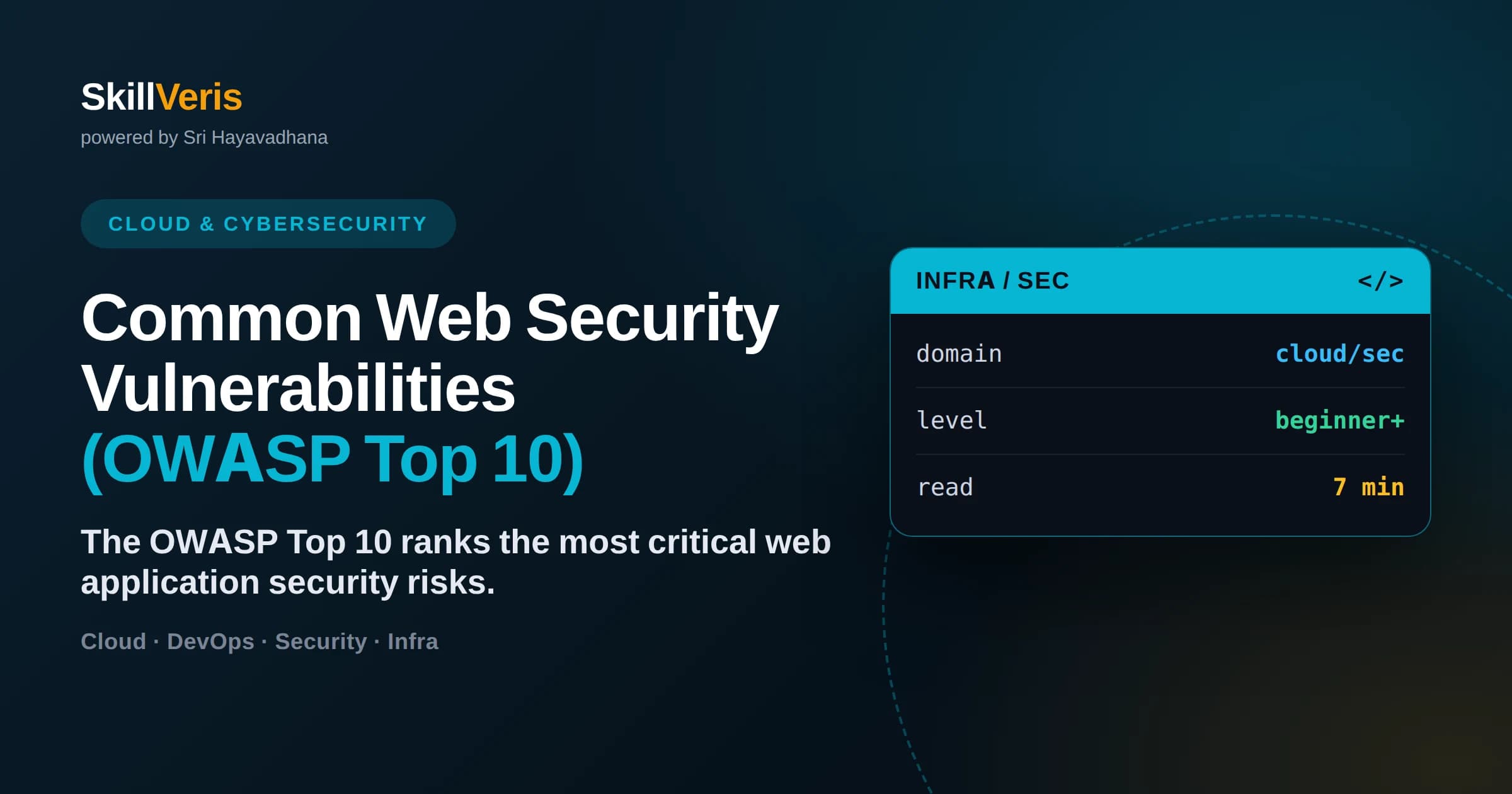
The OWASP Top 10 is a community-driven list of the most critical web application security risks, used worldwide as a baseline security checklist.
In this guide, you'll learn:
- Broken access control tops the list — it happens when users can reach data or actions they should not be authorized for.
- Injection flaws like SQL injection let attackers run their own commands by smuggling code into input fields.
- Most vulnerabilities share one root cause: trusting user input or misconfiguring defaults instead of validating and hardening.
- Defenses are well understood — parameterized queries, least privilege, strong authentication, and keeping dependencies patched.
1What Is the OWASP Top 10?
The OWASP Top 10 is a regularly updated list of the ten most critical security risks facing web applications, published by the Open Worldwide Application Security Project. It is compiled from real-world data and expert consensus, and it serves as the industry's shared baseline for what every developer should defend against.
It is not a checklist that guarantees security if you tick every box, nor is it a certification. Instead, it is a prioritized map of where applications most often go wrong, so teams can focus their limited time on the risks that actually cause breaches.
2Why the List Matters
The OWASP Top 10 matters because it turns a vast, intimidating field into a focused set of well-understood problems. Most breaches you read about map directly to one of its categories.
- It gives developers a common vocabulary for discussing risk.
- It prioritizes: you fix the most damaging, most common issues first.
- It is free, vendor-neutral, and updated as the threat landscape shifts.
- Many compliance frameworks and security tools reference it directly.
🔑Key Idea
Nearly every category on the list shares one theme: never trust input, and never rely on insecure defaults. Master that mindset and you address most of the Top 10 at once.
3Access Control and Cryptographic Failures
The two highest-ranked categories deal with who can do what, and whether sensitive data is properly protected.
Broken Access Control
This is when users can act outside their intended permissions — viewing another user's account by changing an ID in the URL, or reaching an admin page without being an admin. The fix is to enforce authorization checks on the server for every request, deny by default, and never rely on hiding a link to protect a resource.
Cryptographic Failures
This covers sensitive data that is exposed because it was not encrypted, was encrypted weakly, or was sent over plain HTTP. Defenses include enforcing HTTPS everywhere, hashing passwords with a strong algorithm like bcrypt or Argon2, and not storing data you don't actually need.
4Injection Attacks
Injection happens when untrusted input is interpreted as a command. SQL injection is the classic example: an attacker types a crafted string into a form field, and the database executes it as part of a query, letting them read, alter, or delete data.
The reliable defense is to never build queries by concatenating strings. Use parameterized queries or an ORM that separates code from data, so user input is always treated as a value, never as executable code.
- Unsafe: query = "SELECT * FROM users WHERE name = '" + name + "'"
- Safe: cursor.execute("SELECT * FROM users WHERE name = %s", (name,))
- Validate and sanitize all input on the server, not just the browser
- Apply least privilege to the database account the app uses
⚠️Watch Out
Client-side validation improves user experience but provides zero security — attackers bypass the browser entirely. Every check that matters must run on the server.
5Misconfiguration and Vulnerable Components
Two of the most common categories require no clever exploit at all — they exploit sloppy setup and outdated code.
- Security misconfiguration: default passwords, verbose error messages that leak internals, or open cloud storage buckets.
- Vulnerable and outdated components: using libraries with known published flaws that attackers scan for automatically.
- Identification and authentication failures: weak passwords, no rate limiting on login, or session tokens that never expire.
- Software and data integrity failures: trusting updates or plugins from unverified sources in your build pipeline.
Keep Dependencies Patched
Run automated dependency scanning in your pipeline — tools like npm audit, pip-audit, or Dependabot flag known-vulnerable packages. Patching promptly closes doors that attackers actively look for.
6Practical Defenses That Cover Most Risks
You don't need a different tool for every vulnerability. A handful of solid habits address the majority of the list.
- Validate and sanitize every input on the server side.
- Use parameterized queries and modern frameworks that escape output by default.
- Enforce authentication and authorization on the server for every action.
- Encrypt data in transit and at rest, and hash passwords with a slow, salted algorithm.
- Keep dependencies updated and scan them automatically in CI.
- Log security events and monitor for anomalies so you can detect attacks early.
7Common Mistakes to Avoid
Even teams aware of OWASP fall into predictable traps. These are the ones worth guarding against.
- Treating the Top 10 as a complete security program rather than a starting floor.
- Relying on client-side checks that attackers simply skip.
- Storing passwords in plain text or with fast, unsalted hashes like MD5.
- Leaving detailed stack traces and debug modes enabled in production.
- Fixing a vulnerability in one place but missing the same pattern elsewhere in the codebase.
8Key Takeaways
The essentials of the OWASP Top 10 come down to a few guiding principles.
- The OWASP Top 10 is the industry baseline for the most critical web app risks.
- Broken access control and injection are among the most damaging and common.
- The unifying lesson is: never trust input and never ship insecure defaults.
- Parameterized queries, least privilege, HTTPS, and patched dependencies cover most risks.
- Use the list as a floor to build on, not a finish line to reach.
9Frequently Asked Questions
Q: What does OWASP stand for? A: OWASP is the Open Worldwide Application Security Project, a nonprofit community that produces free security resources, tools, and standards. Its Top 10 list is its best-known publication and is used globally as a security baseline.
Q: Is the OWASP Top 10 enough to secure my application? A: No. It is a prioritized starting point covering the most common risks, but real security also requires threat modeling, testing, secure design, and ongoing monitoring. Treat it as a floor, not a ceiling.
Q: What is the most common vulnerability? A: Broken access control consistently ranks at or near the top, because it is easy to introduce and hard to catch without deliberate server-side authorization checks on every request and resource.
Q: How do I test my app against the Top 10? A: Combine automated tools — static analysis, dependency scanners, and dynamic scanners like OWASP ZAP — with manual code review and penetration testing. Automation catches the obvious cases; humans catch the logic flaws tools miss.
Related Reading
Get The Print Version
Download a PDF of this article for offline reading.
About the Publisher
SkillVeris Team
Cloud & Security Team
Our cloud and security experts break down complex infrastructure topics into practical, beginner-friendly guides.
View all postsRelated Posts
Never miss an update
Get the latest tutorials and guides delivered to your inbox.
No spam. Unsubscribe anytime.