100% Free Forever
AI-Powered Learning
Industry Expert Content
Certificates & Badges
Learn At Your Own Pace
HomeBlogBuilding REST APIs With Node.js and Express
Programming

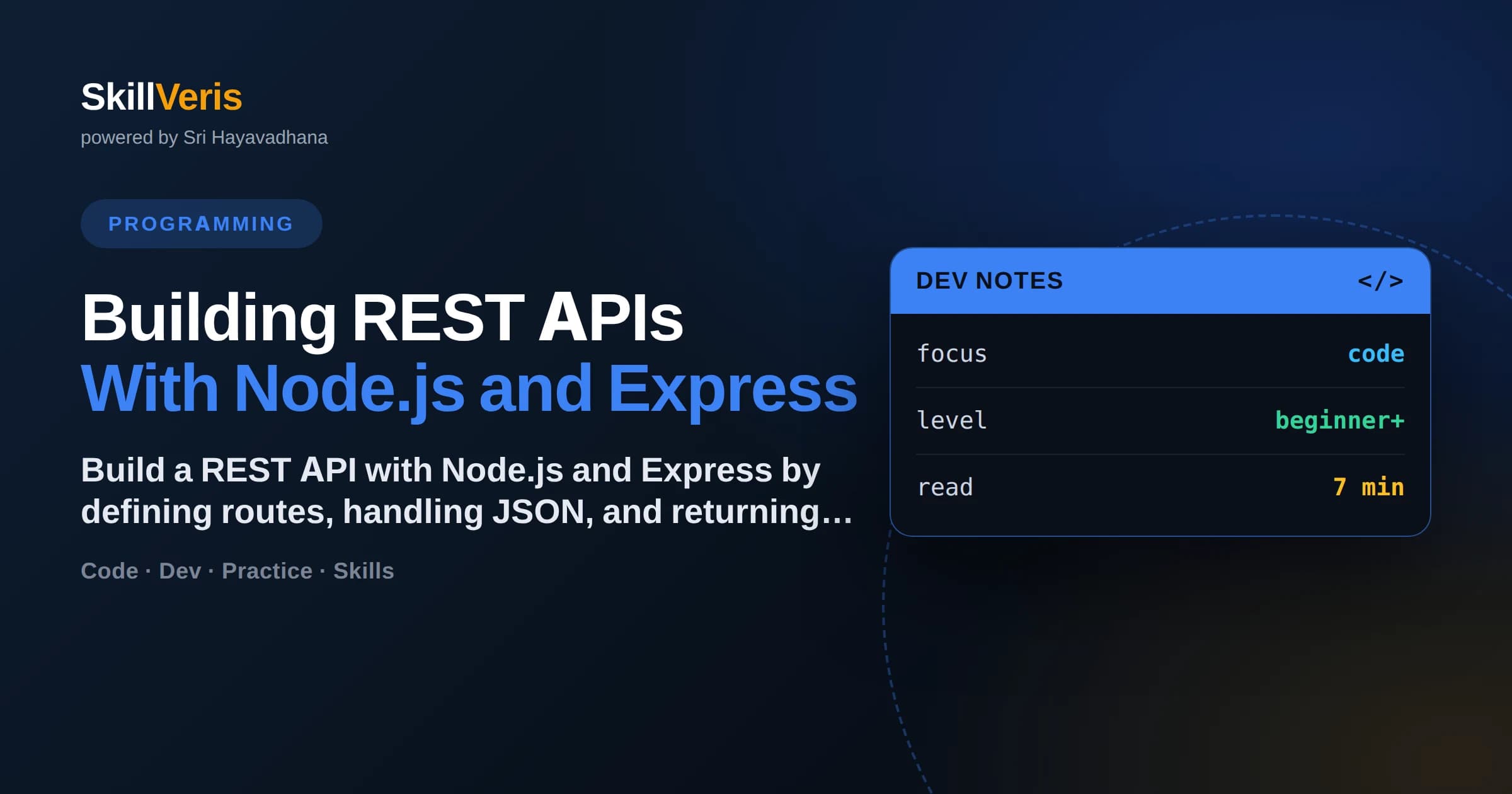
Building REST APIs With Node.js and Express

SV

SkillVeris Team

Engineering Team

Dec 13, 2025 7 min read
Share:
Building REST APIs With Node.js and Express
Key Takeaway

A REST API in Express is a set of route handlers that map HTTP methods and URL paths to functions returning JSON, built on Node.js.

In this guide, you'll learn:

  • Express keeps things minimal: install it, create an app, define routes, and call app.listen to start a server in under 20 lines.
  • Use the correct HTTP verb per operation — GET to read, POST to create, PUT/PATCH to update, DELETE to remove.
  • Middleware like express.json() and error handlers run in order, letting you parse bodies, log, and authenticate cleanly.
  • Return meaningful status codes: 200 and 201 for success, 400 and 404 for client errors, 500 for server faults.

1Building a REST API With Node and Express

A REST API built with Node.js and Express is a server that responds to HTTP requests by mapping methods and URL paths to functions that return JSON. Express is a thin web framework for Node that handles routing, request parsing, and middleware so you can focus on your endpoints instead of low-level networking.

REST (Representational State Transfer) is a convention, not a library. It says: model your app as resources, address them with URLs, and act on them with standard HTTP verbs. Express is simply the fastest way to put that convention into practice in JavaScript, which is why it remains one of the most widely used backend frameworks in 2026.

2Why Express for REST APIs

Express earns its popularity by staying out of your way. It ships with almost no opinions, so you assemble exactly the pieces you need and nothing more.

  • Minimal core: routing and middleware are all it provides, keeping the mental model small.
  • Huge ecosystem: thousands of middleware packages exist for auth, validation, logging, and CORS.
  • JSON-native: pairs naturally with JavaScript objects, so serializing responses is trivial.
  • Battle-tested: it powers countless production services and has years of stability behind it.
  • Easy to learn: a working API fits in a single file, which is ideal for learning the fundamentals.

💡Modern Alternatives

Fastify and NestJS build on the same ideas with more structure and speed. Learn Express first — the concepts transfer directly, and most tutorials and jobs still assume it.

3Your First Express Server

Getting a server running takes three steps: initialize a project, install Express, and write a handful of lines. The example below creates an app, defines one route, and starts listening on a port.

Run node server.js and visit http://localhost:3000 in a browser to see the response. That is a complete, working HTTP server.

  • npm init -y # create package.json
  • npm install express # add the framework
  • const express = require('express')
  • const app = express()
  • app.get('/', (req, res) => res.json({ message: 'Hello API' }))
  • app.listen(3000, () => console.log('Running on port 3000'))

4Routes and HTTP Verbs

A route ties an HTTP method and a URL path to a handler function. The handler receives a request object and a response object, and its job is to read the request and send a response. Matching verbs to intent is the heart of REST design.

  • app.get('/users', ...) # read a collection
  • app.get('/users/:id', ...) # read one item by id
  • app.post('/users', ...) # create a new user
  • app.put('/users/:id', ...) # replace an existing user
  • app.patch('/users/:id', ...) # partially update a user
  • app.delete('/users/:id', ...) # remove a user

Route Parameters and Queries

Dynamic segments like :id arrive in req.params, while query strings such as ?page=2 arrive in req.query. Both are strings, so convert them before use — Number(req.params.id) — and validate them before touching a database.

5Middleware: The Request Pipeline

Middleware are functions that run in order on every request before it reaches your route handler. Each one can inspect or modify the request, end the response early, or call next() to pass control along. This pipeline is how Express handles cross-cutting concerns cleanly.

  • app.use(express.json()) # parse JSON request bodies into req.body
  • app.use(cors()) # allow browser requests from other origins
  • app.use(morgan('dev')) # log each request for debugging
  • Custom auth middleware: check a token, then call next() or return 401.

⚠️Order Matters

Middleware runs top to bottom. Register express.json() before any route that reads req.body, or the body will be undefined.

6Returning Proper Status Codes

The status code is how clients understand the outcome of a request without parsing the body. Setting the right one is not optional polish — it is part of the API contract. Chain res.status(code).json(data) to send both together.

  • 200 OK — a successful GET, PUT, or PATCH.
  • 201 Created — a successful POST that made a new resource.
  • 204 No Content — a successful DELETE with nothing to return.
  • 400 Bad Request — the client sent invalid or missing data.
  • 404 Not Found — the requested resource does not exist.
  • 500 Internal Server Error — something failed on the server.

7Handling Errors Gracefully

Express recognizes error-handling middleware by its four arguments: (err, req, res, next). Placing one after all your routes gives you a single place to catch failures and return a consistent error shape instead of leaking stack traces to clients.

A Central Error Handler

Wrap async handlers in try/catch and pass errors to next(err). The handler below logs the problem and returns a clean JSON message with a 500 status.

code
app.use((err, req, res, next) => {
  console.error(err.stack)
  res.status(err.status || 500).json({ error: err.message })
})

8Structuring a Growing Project

A single file is fine for learning, but real APIs split responsibilities across folders. Separating routing from business logic from data access keeps each file small and testable.

  • routes/ — define endpoints and delegate to controllers.
  • controllers/ — read the request, call a service, shape the response.
  • services/ — hold business logic and talk to the database.
  • models/ — describe your data (with an ORM like Prisma or Mongoose).
  • middleware/ — reusable auth, validation, and logging functions.

9Best Practices

A few habits separate a toy endpoint from an API you would trust in production.

  • Validate every input with a library like Zod or Joi before using it.
  • Never trust the client — check auth on protected routes with middleware.
  • Use environment variables for secrets and ports, never hardcode them.
  • Version your API with a /v1 prefix so you can evolve it without breaking clients.
  • Return consistent error shapes so front-end code can handle them uniformly.
  • Handle async errors — an unhandled promise rejection can crash the process.

🔑Security Baseline

Add the helmet middleware for safe default headers and express-rate-limit to blunt brute-force attacks. Both are one line each and cover common vulnerabilities.

10Key Takeaways

The core of Express REST development fits into a handful of durable ideas.

  • An Express API maps HTTP verbs and paths to handlers that return JSON.
  • Middleware runs in order — register express.json() before body-reading routes.
  • Match verbs to intent and return accurate status codes on every response.
  • Centralize error handling with four-argument middleware after your routes.
  • Split routes, controllers, and services as the project grows.

11Frequently Asked Questions

Q: Do I need a database to build an Express API? A: No. You can start with an in-memory array to learn routing and status codes, then swap in a database like PostgreSQL or MongoDB once the endpoints work. The route code barely changes.

Q: What is the difference between PUT and PATCH? A: PUT replaces an entire resource with the payload you send, while PATCH updates only the fields you include. Use PATCH when clients should be able to change one attribute without resending the whole object.

Q: How do I handle CORS errors in Express? A: Install the cors package and add app.use(cors()) before your routes. For production, configure it to allow only your front-end's origin rather than every site.

Q: Is Express still relevant in 2026? A: Yes. While Fastify and NestJS have grown, Express remains the default choice for learning and for many production services thanks to its simplicity and enormous ecosystem.

📄

Get The Print Version

Download a PDF of this article for offline reading.

About the Publisher

SV

SkillVeris Team

Engineering Team

Our engineering writers turn abstract code concepts into hands-on, project-driven learning experiences.

View all posts

Never miss an update

Get the latest tutorials and guides delivered to your inbox.

No spam. Unsubscribe anytime.

Frequently Asked Questions

21 categories · pick one to explore

Does SkillVeris have a tech blog, and what does it cover?
Yes, the SkillVeris blog has over 500 articles covering AI and machine learning, programming, web development, DevOps, cloud, security, databases and career guidance. Articles are practical and answer-first, and many use the Learn Through Hobbies approach, teaching technical concepts through cricket, music, gaming or cooking analogies. Everything is free to read.
What is the SkillVeris tech glossary and how big is it?
The SkillVeris glossary is a free reference of roughly 2,000-plus technology terms, each with a clear plain-language definition. It spans AI, programming, web, DevOps, cloud, security and database vocabulary, so whenever a lesson, article or job description uses jargon you do not recognise, the glossary gives you a fast, reliable answer.
Are the developer cheat sheets on SkillVeris free to download?
The cheat sheets are completely free to use, like everything else on SkillVeris. Each sheet condenses a language or tool into its essential syntax, commands and patterns for quick reference while coding. They are designed for rapid lookup during real work, complementing the deeper explanations found in study notes and courses.
Which programming references and cheat sheets are available?
Cheat sheets cover the platform's main domains, including programming languages, AI and ML tooling, web development, DevOps, cloud, security and databases, matching the topics of the 37 live courses. Each sheet lists related reading links and hashtags, so you can jump from a quick reference into fuller study notes or blog articles.
How do I find the meaning of a technical term quickly?
Search the SkillVeris glossary, which holds around 2,000-plus terms with concise, plain-language definitions. Each entry gets to the point in its first sentence, then links to related reading like blog posts or study notes for deeper context. It is faster and more consistent than sifting through scattered search results.
Is the SkillVeris blog good for beginners learning to code?
Yes, many blog articles are written specifically for beginners, and the Learn Through Hobbies style makes them unusually approachable: you might learn Python concepts through cricket or understand APIs through cooking. With 500-plus articles across skill levels, beginners can start with fundamentals and keep reading as they advance, entirely free.
Can cheat sheets replace full courses for learning a language?
No, cheat sheets are references, not teaching tools; they assume you already understand the concepts and just need syntax or commands fast. To actually learn a language, take a structured SkillVeris course with its 24–40 lessons and assessments, then keep the cheat sheet beside you while practising in Code Lab.
How often are new blog articles published on SkillVeris?
The blog grows regularly and already exceeds 500 articles, with new posts added as courses launch and technologies evolve. Topics track the platform's catalogue across AI, programming, web development, DevOps, cloud and security, so checking the Blog section periodically surfaces fresh tutorials, explainers and career-focused pieces, all free to read.
Does the glossary cover AI and machine learning terms?
Yes, AI and machine learning vocabulary is a major part of the roughly 2,000-plus term glossary, covering everything from foundational terms to modern concepts around LLMs, RAG and MLOps. Definitions are plain-language and answer-first, which helps when dense AI papers or course lessons throw unfamiliar jargon at you.
Are there cheat sheets for interview preparation?
Cheat sheets work well as interview-day refreshers because they compress syntax, commands and key concepts into scannable references. For dedicated preparation, combine them with the SkillVeris interview questions feature, which includes readiness scoring, plus study notes for depth. Reviewing a relevant cheat sheet just before an interview steadies recall under pressure.
Can I read the tech blog without signing up?
Yes, the blog is freely readable, and SkillVeris never charges for content. All 500-plus articles are open, covering tutorials, concept explainers and career advice. Creating a free account adds value elsewhere on the platform, like course progress tracking and certificates, but reading the blog requires no commitment at all.
How is the SkillVeris glossary different from Wikipedia?
The glossary is purpose-built for learners: definitions are short, plain-language and answer-first, sized for a quick lookup mid-lesson rather than a deep encyclopedic read. Entries also cross-link to related SkillVeris study notes, blog posts and courses, so a definition becomes a doorway into structured learning instead of a dead end.
Do blog articles use the Learn Through Hobbies method?
Many blog articles teach technical topics through hobby analogies, a hallmark of the SkillVeris blog, so you will find articles explaining programming through cricket, machine learning through music, or system design through cooking. The analogy is the teaching device; the article still delivers the real technical concept underneath.
Where can I find quick programming references while coding?
Open the SkillVeris cheat sheets, which are built exactly for that moment: compact, scannable references for syntax, commands and common patterns across languages and tools. Keep the relevant sheet in a browser tab while you work in Code Lab or your own editor, and dip into the glossary for terminology.
Is there a glossary entry for terms I meet in job descriptions?
Very likely yes, with roughly 2,000-plus terms across AI, programming, web, DevOps, cloud, security and databases, the glossary covers most jargon that appears in tech job descriptions. Decoding a listing this way helps you judge role fit honestly and prepares you to discuss those terms in interviews.
Are the blog articles written for the Indian tech audience?
The blog serves Indian learners plus a worldwide audience. Content stays globally relevant while acknowledging realities that matter in India, such as free access being essential for students and freshers, and career guidance that connects naturally to the SkillVeris jobs portal, which aggregates roles across India, UK, USA, Germany and Remote.
Can I suggest a topic for the blog or glossary?
SkillVeris content grows in response to what learners need, so feedback is welcome through the platform's support channels. If a term is missing from the glossary or a topic deserves an article, telling the team helps prioritise it. Meanwhile, the AI Mentor can answer the question immediately, 24/7, at any depth.
Do cheat sheets and glossary entries link to deeper learning?
Yes, every cheat sheet and glossary entry carries related reading links into study notes, blog articles and courses, plus concept hashtags for discovering similar content. This cross-linking means a thirty-second lookup can smoothly become a structured learning session whenever you decide you want more than a quick answer.
What makes SkillVeris programming references trustworthy?
The references are written to strict internal quality standards, kept consistent with the platform's 37 live courses, and never padded with invented statistics or hype. Definitions and cheat sheets are reviewed against the same content contracts that govern courses, and the answer-first style makes any inaccuracy easy to spot and correct.
How do the blog, glossary and cheat sheets fit into my learning routine?
Use them as satellites around your main course: read blog articles for context and motivation, hit the glossary the instant jargon appears, and keep cheat sheets open while coding. Together with study notes, Code Lab and the 24/7 AI Mentor, they turn passive reading into a complete, free learning system.

What Learners Say

Real journeys from the SkillVeris community — swipe for more.

SkillVeris taught me Python through Cricket. Now I’m building real projects and feeling confident!
Arjun S. · B.Tech Student
The best platform for hobby-based learning. Concepts finally stick.
Priya R. · Data Analyst
I went from zero coding to a portfolio of projects — all by learning through my love for gaming. Landed my first internship!
Kabir M. · CS Undergraduate
Trending Topics50 popular tags — tap to explore
Trending CoursesAll 37 free courses — tap to browse