AI in Healthcare: Opportunities and Risks in 2026
SkillVeris Team
AI Research Team
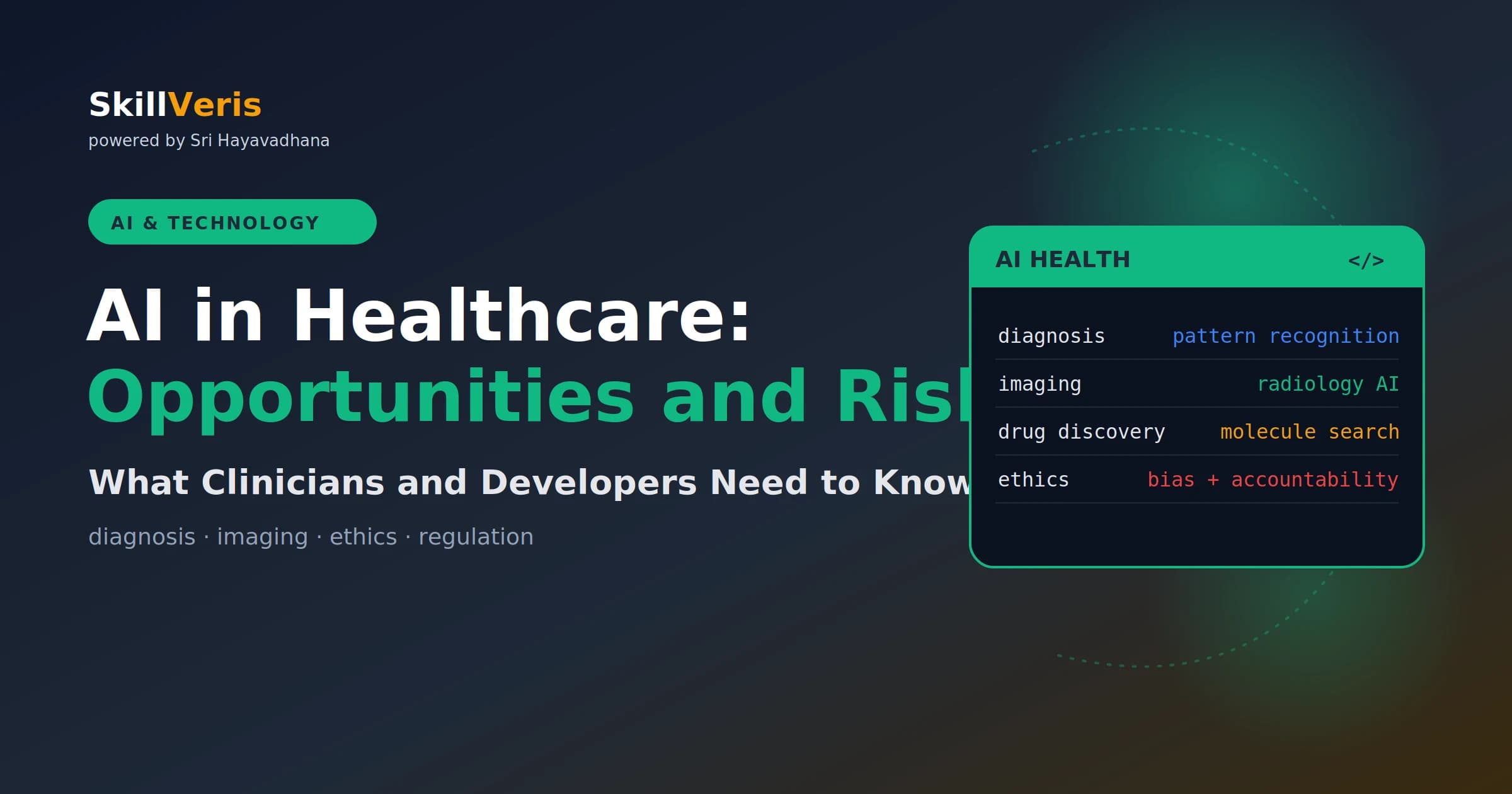
AI in healthcare shows genuine promise in radiology, drug discovery, and clinical documentation, but the risks of bias, hallucination, and unclear accountability are equally real.
In this guide, you'll learn:
- FDA-cleared radiology AI now assists and prioritises across retinopathy, chest X-rays, mammography, and pathology — but clinicians still make the final call.
- AlphaFold solved a 50-year protein folding problem and now underpins rational drug design and generative molecule discovery.
- LLMs cut clinical documentation time by 30-70%, yet they can hallucinate medical details that a rushed clinician might sign off.
- Documented bias cases show medical AI can perform worse for underrepresented groups unless training data and evaluation are demographically representative.
1AI in Healthcare: The Current State
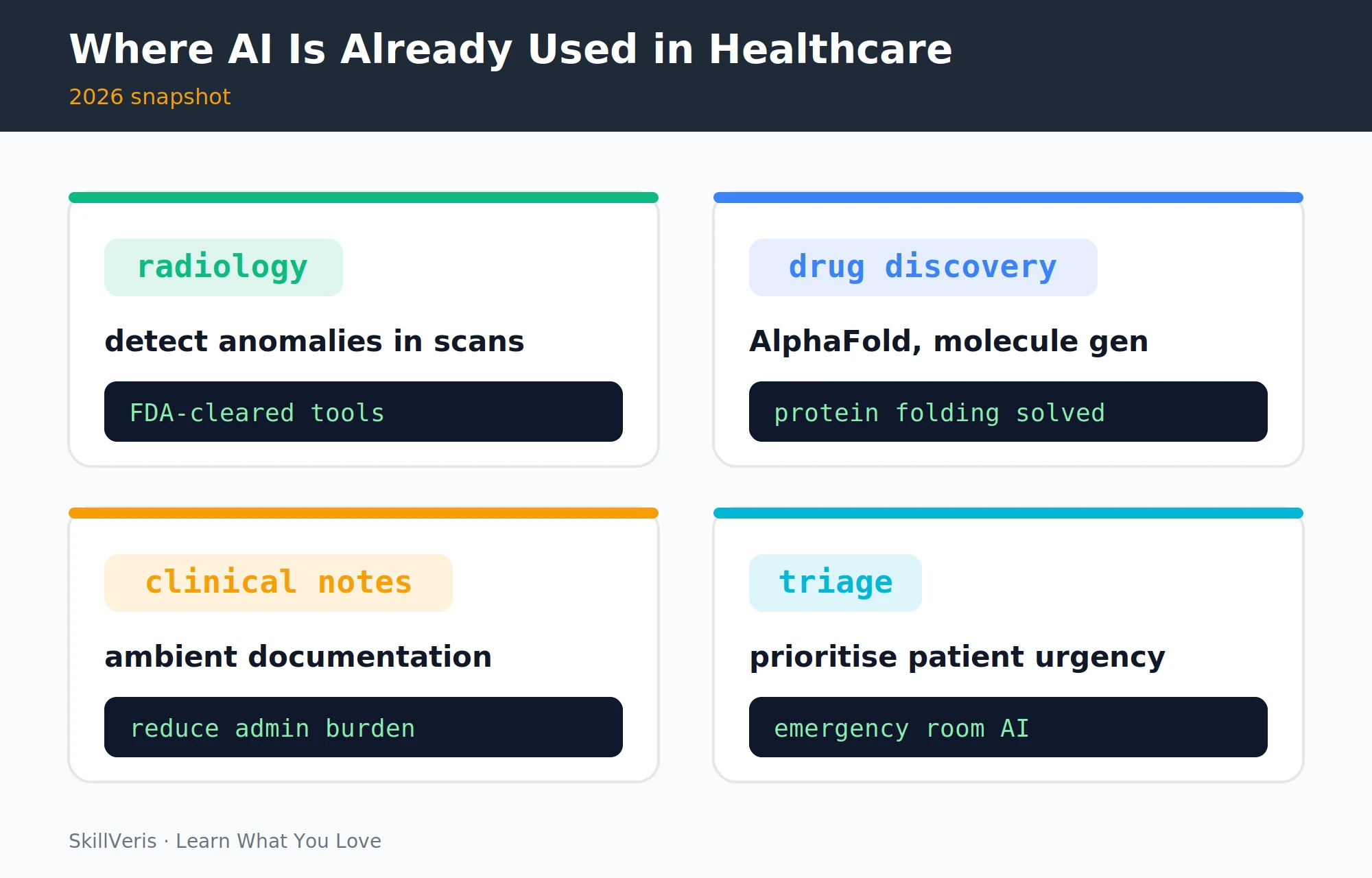
Healthcare is one of the most data-rich and consequential domains for AI. The potential is enormous: earlier disease detection, faster drug development, more consistent diagnostic accuracy, and reduced administrative burden on clinicians. In 2026, AI tools are in active clinical use — FDA-cleared radiology AI, LLM-powered clinical note systems, and protein structure prediction that has transformed drug discovery.
The risks are equally significant: biased training data producing worse outcomes for underrepresented populations, LLMs hallucinating clinical information, and unclear accountability when AI contributes to medical errors. Understanding both is essential for anyone building in or around healthcare.
2Diagnostic Imaging: Where AI Performs Best
AI performs strongest in pattern recognition on large, structured imaging datasets. Four areas are already deployed in clinical settings, and FDA-cleared applications in 2026 span screening, triage, and diagnosis.
Common to all these applications: they assist and prioritise, they don't replace. The clinician makes the final decision; AI improves throughput and consistency.
- Diabetic retinopathy screening: AI identifies signs of diabetic retinopathy in fundus images with sensitivity matching or exceeding specialist ophthalmologists, enabling screening at scale in primary care settings.
- Chest X-ray triage: algorithms flag likely pneumothorax, pulmonary oedema, and other critical findings for urgent radiologist review, reducing time from image to escalation.
- Mammography: AI second-reads reduce both false positives and false negatives in breast cancer screening programs across several countries.
- Pathology: digital pathology AI identifies cancer cells in biopsy samples, assisting pathologists in quantification tasks.
3Drug Discovery and AlphaFold
DeepMind's AlphaFold 2 (2020) and subsequent models solved the protein folding problem that had stumped biology for 50 years: predicting a protein's 3D structure from its amino acid sequence. The AlphaFold database now contains predicted structures for over 200 million proteins — essentially the entire known proteome.
The impact on drug discovery has been significant: understanding protein structure is the foundation of rational drug design. AI is also being applied across several adjacent areas of the development pipeline.
Drug development timelines have historically averaged 10-15 years. AI tools are compressing early discovery phases, though clinical trials and regulatory approval remain rate-limiting.
- Generative molecule design: models propose novel molecular structures with desired properties rather than screening existing compound libraries.
- Clinical trial optimisation: identifying patient cohorts, predicting trial outcomes, and accelerating recruitment.
- Drug repurposing: finding new uses for approved drugs by matching their mechanisms to different diseases.
4Clinical Documentation and LLMs
Administrative burden is a leading cause of clinician burnout: studies consistently show physicians spend as much time on documentation as on direct patient care. LLMs address this through ambient clinical intelligence — tools that listen to patient-clinician conversations and automatically generate structured clinical notes.
Systems like Microsoft Nuance DAX and several competitors are in active clinical deployment, reducing documentation time by 30-70% in reported implementations. The notes are reviewed and signed by the clinician before entering the medical record; the AI drafts, the human certifies.
⚠️Watch Out
LLMs drafting clinical notes can hallucinate: generate plausible-sounding but incorrect medical information. A busy clinician skimming rather than reading carefully may sign a note containing an error. Review standards and workflow design matter as much as model accuracy in clinical deployment.
5Patient Triage and Risk Prediction
Predictive models are increasingly embedded in clinical settings, surfacing risk earlier than human recognition alone. They analyse vital signs, lab results, and EHR data to flag patients who need attention.
These tools face significant challenges in translating from research to practice: models trained on one hospital's data often perform poorly at another due to differences in patient populations, clinical practices, and data recording habits.
- Sepsis early warning: models predict sepsis onset 6-12 hours earlier than clinical recognition by analysing vital signs and lab results continuously.
- Readmission prediction: identifying patients at high risk of 30-day readmission after discharge, enabling targeted follow-up interventions.
- Mental health crisis prediction: analysing EHR data to flag patients at elevated risk of self-harm or psychiatric crisis, enabling proactive outreach.
6Personalised Medicine
Personalised medicine uses a patient's genetic, molecular, and clinical data to tailor treatment, and AI enables this at scale. By matching individual profiles to the right drug, dose, and tumour subtype, it moves care beyond one-size-fits-all protocols.
This is genuinely transformative medicine in oncology and rare disease treatment, but the data infrastructure requirements (genomic sequencing, integrated EHRs, standardised data formats) are significant barriers to widespread deployment.
- Pharmacogenomics: predicting which patients will respond to specific drugs based on genetic variants.
- Cancer subtyping: classifying tumours by molecular profile rather than just tissue of origin, enabling more targeted treatment selection.
- Precision dosing: adapting medication dosages in real time based on patient-specific parameters.
7The Risk Landscape
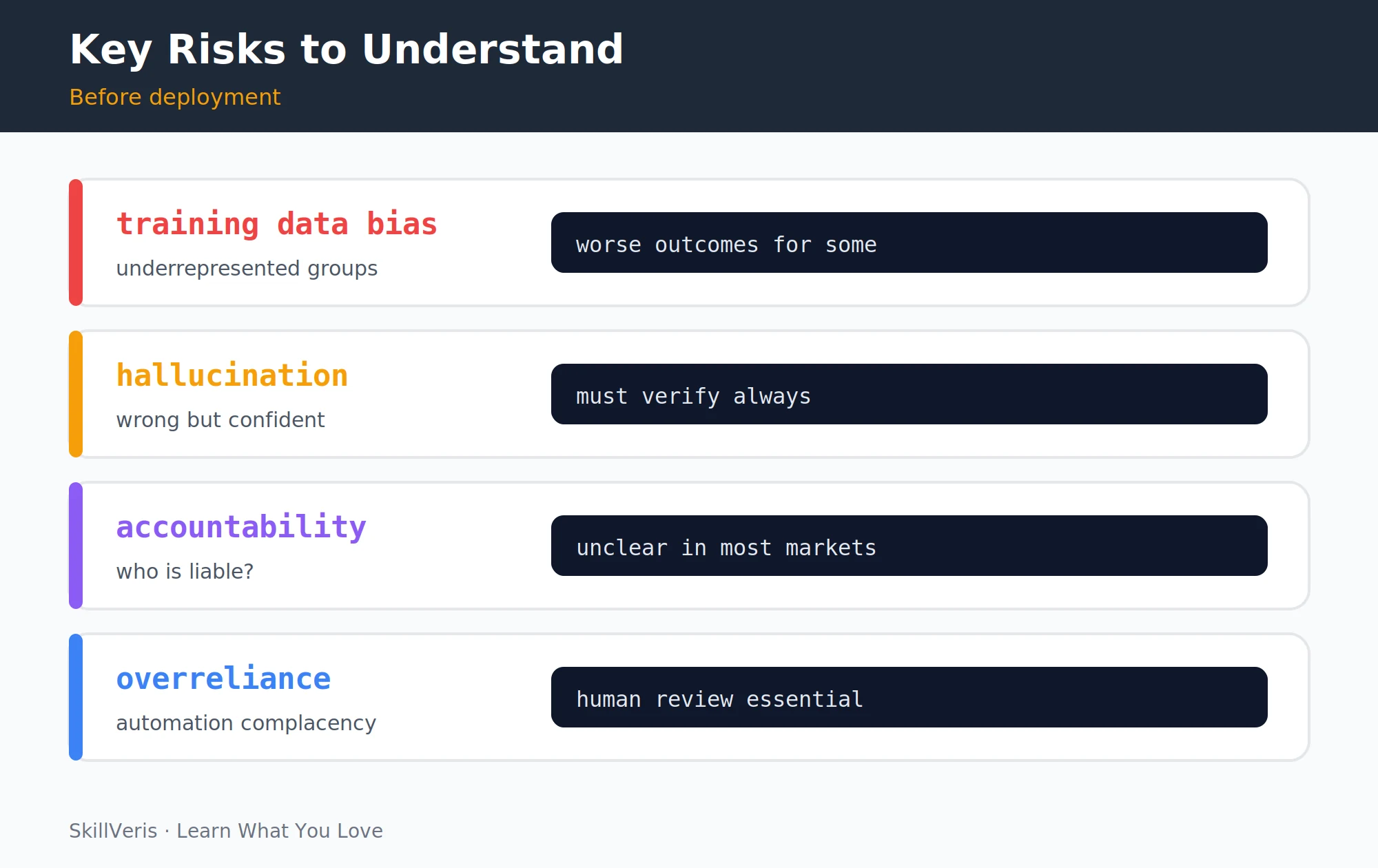
Four risks require active mitigation in any healthcare AI deployment, spanning technical, ethical, and governance dimensions. Each compounds the others when left unaddressed.
- Bias: models trained on data from one demographic perform worse on underrepresented groups (see Section 8).
- Hallucination: LLMs generating confident but incorrect clinical information (see Section 9).
- Accountability gaps: when AI contributes to a misdiagnosis, existing medical liability frameworks don't clearly assign responsibility between the AI developer, the hospital, and the clinician.
- Automation complacency: over time, clinicians may defer to AI recommendations without adequate critical evaluation — particularly dangerous when AI is usually correct.
- Data privacy: training and operating AI systems on patient data creates legal and ethical obligations under HIPAA, GDPR, and equivalent regulations.
8Bias in Medical AI
Medical AI bias has been documented in multiple high-profile cases, where systems inherited inequities from the data they were trained on. The consequences fall hardest on the populations least represented in that data.
Mitigation requires diverse and representative training data, mandatory performance evaluation across demographic subgroups before deployment, ongoing monitoring for performance drift in production, and diverse teams building and evaluating the tools.
- Pulse oximeters were found to perform less accurately on darker skin tones, with AI-assisted monitoring inheriting this bias.
- A widely deployed US hospital risk algorithm was found to systematically underestimate the health needs of Black patients because it used healthcare spending as a proxy for health needs — spending that was lower due to systemic inequities, not lower need.
- Dermatology AI trained predominantly on lighter skin tones performs worse on conditions presenting differently on darker skin.
9Hallucination and Clinical Safety
LLMs generate fluent, confident text that may contain clinical errors. High-risk scenarios include a note tool inventing a medication history or test result, a patient-facing chatbot giving incorrect dosage information, or a decision-support LLM citing a study that doesn't exist.
Current mitigations include grounding responses in retrieved patient records (RAG), mandatory clinician review before any AI-drafted text enters the official record, explicit disclosure to patients when AI is involved in their care, and conservative scope limitation: only summarise what was said; don't add information.
The important caveat: human clinicians also make errors, including documentation errors. The relevant question is whether AI-assisted care produces better or worse outcomes than the counterfactual — not whether AI is perfect.
- A clinical note tool inventing a medication history, allergy, or test result not mentioned in the consultation.
- A patient-facing health chatbot providing incorrect dosage information.
- A clinical decision support LLM citing a study that doesn't exist to support its recommendation.
10Regulation in 2026
Regulatory frameworks for AI as a medical device vary by region, but all are converging on conformity assessment and post-market oversight. The table below summarises the major regimes in force in 2026.
The FDA's Pre-Determined Change Control Plan (PCCP) framework allows AI systems to update and improve post-deployment within pre-approved parameters, addressing the challenge of regulating systems that learn and change over time.
- FDA 510(k) / De Novo · United States · Medical device clearance including AI/ML software as a medical device (SaMD)
- EU AI Act · European Union · High-risk classification for AI in healthcare; requires conformity assessment
- MHRA AI guidance · United Kingdom · Post-Brexit framework for AI medical devices
- CDSCO guidelines · India · Software as medical device regulations still maturing
11What Responsible Deployment Looks Like
For teams building or deploying healthcare AI, responsible practice goes beyond benchmark accuracy. It demands clinical validation, transparency, and continuous oversight across the lifecycle of the system.
- Clinical validation before deployment: prospective clinical trials, not just retrospective benchmark performance, to measure patient outcome impact.
- Demographic subgroup performance reporting: require performance metrics disaggregated by age, sex, ethnicity, and socioeconomic status before clearance.
- Human in the loop for high-stakes decisions: AI that assists; humans that decide. Clear workflows preventing automation complacency.
- Explainability: clinicians and patients have a right to understand why AI reached a conclusion, particularly for consequential decisions.
- Ongoing monitoring: post-deployment surveillance for performance drift, bias emergence, and adverse events.
12Key Takeaways
Healthcare AI in 2026 is a story of real value paired with real risk. The same systems that improve throughput and consistency can also entrench bias or introduce subtle errors if deployed without discipline.
- AI shows genuine clinical value in radiology, drug discovery, and documentation reduction — with FDA-cleared tools in active use in 2026.
- Bias in training data produces worse outcomes for underrepresented groups; demographic performance reporting is a non-negotiable requirement.
- LLMs hallucinate; mandatory clinician review before clinical documentation enters official records is a safety baseline.
- Human oversight is essential for high-stakes clinical decisions — AI should assist and prioritise, not replace clinical judgment.
13What to Learn Next
Deepen your AI ethics and application knowledge with these related topics, each building on the themes covered here.
- AI Safety and Ethics — the broader responsible AI framework.
- RAG Explained — how to ground LLM outputs in verified clinical data.
- Multimodal AI — vision models are the technology behind radiology AI.
14Frequently Asked Questions
Q: Can AI replace doctors?
A: Not in any meaningful near-term sense. Medicine involves physical examination, patient communication, ethical judgment, and navigating uncertainty with incomplete information in ways current AI systems handle poorly. AI can perform specific, well-defined perceptual tasks (reading a scan) better than humans in narrow conditions, but the full scope of clinical practice involves far more than pattern recognition on structured data.
Q: Is it safe to use an AI chatbot for medical advice?
A: General-purpose LLMs (ChatGPT, Claude) can provide helpful health information and help patients formulate questions for their doctors. They should not be used as substitutes for clinical diagnosis or treatment decisions. They lack access to your personal medical history, cannot examine you, and may hallucinate specific clinical details. Use them as a starting point; consult a clinician for anything requiring diagnosis or treatment.
Q: What programming skills do I need to work in healthcare AI?
A: Python (pandas, NumPy, scikit-learn, PyTorch), experience with healthcare data formats (FHIR, HL7, DICOM), knowledge of the specific regulatory framework for AI as a medical device in your target market, and a solid understanding of clinical AI ethics and bias. Clinical domain knowledge (or access to clinical collaborators) is also essential for building tools that work in practice.
Q: What is FHIR and why does it matter for healthcare AI?
A: FHIR (Fast Healthcare Interoperability Resources) is the international standard for exchanging healthcare information electronically. It defines how patient records, medication lists, lab results, and clinical notes are structured and shared between systems. For AI applications, FHIR-compliant data pipelines are becoming the standard for accessing structured EHR data in a consistent, interoperable format.
Related Reading
Get The Print Version
Download a PDF of this article for offline reading.
About the Publisher
SkillVeris Team
AI Research Team
Our AI team covers the latest in machine learning, generative AI, and emerging tech — clearly and accurately.
View all postsRelated Posts
Never miss an update
Get the latest tutorials and guides delivered to your inbox.
No spam. Unsubscribe anytime.