AI Ethics: Bias, Fairness and Responsibility
SkillVeris Team
AI Research Team
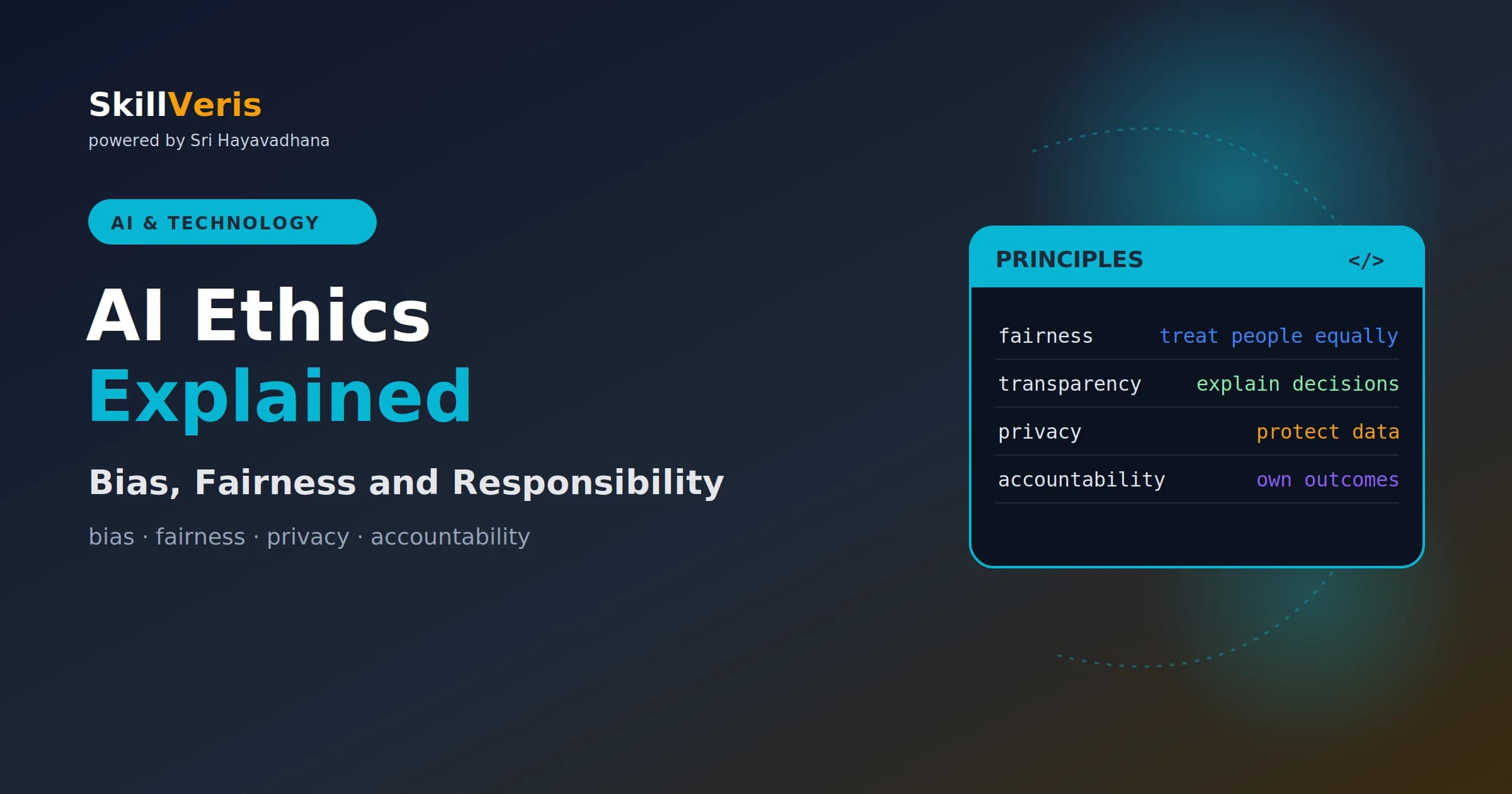
AI ethics is about building and using AI responsibly
In this guide, you'll learn:
- The core principles are fairness (avoid unfair bias), transparency (explain decisions), privacy (protect data), and accountability (humans own the outcomes)
- Bias mostly comes from data and design — and can be reduced with diverse data, testing, and oversight.
- All concepts are explained with real-world examples and hands-on practice.
- All concepts are explained with real-world examples and hands-on practice.
1About This Guide
ethics essential, not academic. This guide explains the key issues in plain language and what
2Why AI Ethics Matters
When AI makes or shapes decisions about people, mistakes and biases have real consequences — at
scale and often invisibly. Ethics is how we make sure these systems help rather than harm, and treat
3What Is Algorithmic Bias?
Bias is when an AI system produces systematically unfair results for certain groups — for example,
performing worse for some demographics. Because AI operates at scale, a single biased system can
4Where Bias Comes From
Bias is rarely intentional — which is exactly why it must be actively looked for.
- Data: if the training data reflects past bias, the model learns it.
- Design: choices about what to optimise can embed unfairness.
- Use: applying a model in a context it wasn't built for causes harm.
5Fairness
Fairness means an AI system treats people equitably and doesn't disadvantage groups unjustly. It's
genuinely hard, because there are different, sometimes conflicting definitions of "fair" — so it requires
6Transparency and Explainability
People affected by AI decisions deserve to understand them. Transparency is being open about where
and how AI is used; explainability is being able to say why a system reached a decision — difficult with
7Privacy
collects only what's needed, protects it, and respects people's rights over their own information.
When an AI system causes harm, "the algorithm did it" isn't good enough. Accountability means
- Biased hiring, lending, or risk-scoring tools.
- Facial recognition errors and surveillance concerns.
- Misinformation and deepfakes.
- Opaque decisions people can't question.
- Diverse, representative training data — and testing for bias.
Related Reading
Get The Print Version
Download a PDF of this article for offline reading.
About the Publisher
SkillVeris Team
AI Research Team
Our AI team covers the latest in machine learning, generative AI, and emerging tech — clearly and accurately.
View all postsRelated Posts
Never miss an update
Get the latest tutorials and guides delivered to your inbox.
No spam. Unsubscribe anytime.